The time period of a simple pendulum when it is made to oscillate on the surface of moon
Easy
Download our app for free and get started
(a) At the surface of moon, $g$ decreases hence time period increases $\left( {{\rm{as}}\,T \propto \frac{1}{{\sqrt g }}} \right)$

Download our appand get started for free
Experience the future of education. Simply download our apps or reach out to us for more information. Let's shape the future of learning together!No signup needed.*
Similar Questions
- 1A function is represented by equationView Solution
$y = A\,\cos \,\omega t\,\cos \,2\omega t + A\,\sin \,\omega t\,\sin \,2\omega t$.
Than the nature of the function is
- 2The maximum speed of a particle executing $S.H.M.$ is $1\,m/s$ and its maximum acceleration is $1.57\,m/se{c^2}$. The time period of the particle will be .... $\sec$View Solution
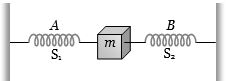
- 3In the figure, ${S_1}$ and ${S_2}$ are identical springs. The oscillation frequency of the mass $m$ is $f$. If one spring is removed, the frequency will becomeView Solution
- 4$Assertion :$ The amplitude of an oscillating pendulum decreases gradually with timeView Solution
$Reason :$ The frequency of the pendulum decreases with time. - 5The position, velocity and acceleration of a particle executing simple harmonic motion are found to have magnitudes of $4 \mathrm{~m}, 2 \mathrm{~ms}^{-1}$ and $16 \mathrm{~ms}^{-2}$ at a certain instant. The amplitude of the motion is $\sqrt{\mathrm{x}} \mathrm{m}$ where $\mathrm{x}$ is. . . . . . .View Solution
- 6The potential energy of a simple harmonic oscillator when the particle is half way to its end point is (where $E$ is the total energy)View Solution
- 7The force-deformation equation for a nonlinear spring fixed at one end is $F =4x^{1/ 2}$ , where $F$ is the force (expressed in newtons) applied at the other end and $x$ is the deformation expressed in metersView Solution
- 8Consider the following statements. The total energy of a particle executing simple harmonic motion depends on itsView Solution
$(1)$ Amplitude $(2) $ Period $(3)$ Displacement
Of these statements
- 9A block of rectangular size of mass $m$ and area of cross-section $A$, floats in a liquid of density $\rho$. If we give a small vertical displacement from equilibrium, it undergoes $S H M$ with time period $T$, thenView Solution
- 10A simple pendulum of mass $m$ executes $S.H.M.$ with total energy $E$. If at an instant it is at one of extreme positions, then its linear momentum after a phase shift of $\frac{\pi}{3} \,rad$ will beView Solution