The time period of a simple pendulum when it is made to oscillate on the surface of moon
Easy


Download our appand get started for free
Experience the future of education. Simply download our apps or reach out to us for more information. Let's shape the future of learning together!No signup needed.*
Similar Questions
- 1The total energy of particle performing $S.H.M.$ depend onView Solution
- 2The total energy of the body executing $S.H.M.$ is $E$. Then the kinetic energy when the displacement is half of the amplitude, isView Solution
- 3A lift is descending with acceleration $g/3$ . What will be the time period of a simple pendulum suspended from its ceiling if its time period in staionary life is $'T'$ ?View Solution
- 4A particle executes linear simple harmonic motion with an ampilitude of $3\,cm$ . When the particle is at $2\,cm$ from the mean position , the magnitude of its velocity is equal to that of its acceleration. Then its time period in seconds isView Solution
- 5A force of $6.4\ N$ stretches a vertical spring by $0.1\ m$. The mass that must be suspended from the spring so that it oscillates with a time period of $\pi/4\ second$ is .... $kg$View Solution
- 6Two $SHM$ are represented by equations, $y_1 = 6\cos \left( {6\pi t + \frac{\pi }{6}} \right)\,,{y_2} = 3\left( {\sqrt 3 \sin 3\pi t + \cos 3\pi t} \right)$View Solution
- 7View SolutionA tunnel has been dug through the centre of the earth and a ball is released in it. It will reach the other end of the tunnel after
- 8View SolutionThe diagram shows two oscillations. What is the phase difference between the oscillations?
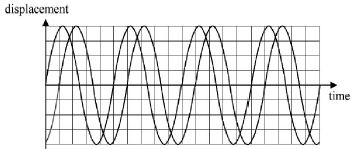
- 9View SolutionTo make the frequency double of a spring oscillator, we have to
- 10A damped harmonic oscillator has a frequency of $5$ oscillations per second. The amplitude drops to half its value for every $10$ oscillations. The time it will take to drop to $\frac{1}{1000}$ of the original amplitude is close to .... $s$View Solution