MCQ
The tones that are separated by three octaves have a frequency ratio of
  • A
    $3$
  • B
    $6$
  • $8$
  • D
    $16$

Answer

Correct option: C.
$8$
c
(c)

Each octaves is double the frequency of the previous octave.

If initial frequency is $f$.

Final frequency $=2 \times 2 \times 2 f$ or $2^3 f$ or $8 f$

$\therefore$ Frequency ratio $=8: 1$.

Need a full question paper?

Generate a complete, print-ready paper with questions like this in minutes — across 16+ boards, with answer keys.

Start Generating Free

Similar questions

A transverse wave of amplitude $0.5\, m$ and wavelength $1\, m$ and frequency $2\, Hz$ is propagating in a string in the negative $x-$direction. The expression for this wave is
If there were no gravity. which of the following will not be there for a fluid?
This question has Statement $1$ and Statement $2.$ Of the four choices given after the Statements, choose the one that best describes the two Statements.

Statement $1:$ In the resonance tube experiment, if the tuning fork is replaced by another identical turning fork but with its arm having been filled, the length of the air column should be increased to obtain resonance again.

Statement $2:$ On filling the arms, the frequency of a tuning fork increases.
A perfect gas goes from state $A$ to another state $B$ by absorbing $8 \times {10^5}J$ of heat and doing $6.5 \times {10^5}J$ of external work. It is now transferred between the same two states in another process in which it absorbs ${10^5}J$ of heat. Then in the second process
A liquid is kept in a closed vessel. If a glass plate (negligible mass) with a small hole is kept on top of the liquid surface, then the vapour pressure of the liquid is the vessel is
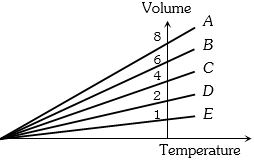
The expansion of an ideal gas of mass $m$ at a constant pressure $P$ is given by the straight line $D$. Then the expansion of the same ideal gas of mass $2m$ at a pressure $P/ 2 $ is given by the straight line
A particle of mass $m$ moves on a straight line with its velocity increasing with distance according to the equation $\mathrm{v}=\alpha \sqrt{\mathrm{x}}$, where $\alpha$ is a constant. The total work done by all the forces applied on the particle during its displacement from $\mathrm{x}=0$ to $\mathrm{x}=\mathrm{d}$, will be:
The angular speed of a fly-wheel making $120\, revolution/minute$ is
A thermally insulated vessel contains an ideal gas of molecular mass $M$ and ratio of specific heats $1.4$. Vessel is moving with speed $v$ and is suddenly brought to rest. Assuming no heat is lost to the surrounding and vessel temperature of the gas increases by ... ( $R =$ universal gas constant )
If magnitude of average speed and average velocity over a time interval are same, then