Question
The total area of a solid metallic sphere is $1256 \ cm^2.$ It is melted and recast into solid right circular cones of radius $2.5 \ cm$ and height $8 \ cm.$ Calculate: the radius of the solid sphere.

Answer

Total area of solid metallic sphere $=1256 \ cm ^2$
Let radius of the sphere is $r$ then
$ 4 \pi r^2=1256$
$ \Rightarrow 4 \times \frac{22}{7} r^2=1256$
$ \Rightarrow r^2=\frac{1256 \times 7}{4 \times 22}$
$ \Rightarrow r^2=\frac{157 \times 7}{11}$
$ \Rightarrow r^2=\frac{1099}{11}$
$ \Rightarrow r=\frac{1099}{11}$
$ \Rightarrow r=\sqrt{99.909}$
$ \Rightarrow r=9.995 \ cm \approx 10 \ cm$

Need a full question paper?

Generate a complete, print-ready paper with questions like this in minutes — across 16+ boards, with answer keys.
Start Generating Free

Similar questions

Use a graph paper to answer the following questions. (Take 1 cm = 1 unit on both axis):
(i) Plot A (4, 4), B (4, – 6) and C (8, 0), the vertices of a triangle ABC.
(ii) Reflect ABC on the y-axis and name it as A’B’C’.
(iii) Write the coordinates of the images A’, B’ and C’.
(iv) Give a geometrical name for the figure AA’ C’B’ BC.
(v) Identify the line of symmetry of AA’ C’ B’ BC.
Find the diameter of the sphere for the following:
Surface Area $=576 \pi cm ^2$
Calculate the amount and the compouncl interest of the following:
$Rs.9,125$ for $2$ years if tl1e rates of interest are $12\%$ and $14\%$ for the successive years.
If $A=\left[\begin{array}{cc}1 & 2 \\ -3 & 4\end{array}\right], B=\left[\begin{array}{cc}0 & 1 \\ -2 & 5\end{array}\right]$ and $C=\left[\begin{array}{cc}-2 & 0 \\ -1 & 1\end{array}\right]$ find $A(4 B-$ (3C)
If $A$ and $B$ are complementary angles, prove that: $cosec^2A + cosec^2B = cosec^2A \ cosec^2B$
Solve $(x-10)\left(\frac{1200}{x}+2\right)=1260$ and $x<0$.
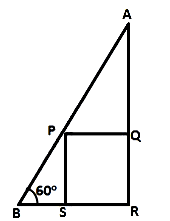
In the following diagram , $AB$ is a floor $-$ board : $\text{PQRS}$ is a cubical box with each edge $= 1m$ and $\angle B = 60^\circ $. Calculate the lenght of the board $AB.$
Find the reciprocal ratio of e following :
$a^3b^2 : a^2b^3$
A sum of $Rs. 65000$ is invested for $3$ years at $8\%$ p.a. compound interest.
Find the sum due at the end of the first year.
Prove the following identitie:$\frac{\left(1-2 \sin ^2 A\right)^2}{\cos ^4 A-\sin ^4 A}=2 \cos ^2 A-1$