MCQ
The total charge induced in a conducting loop when it is moved in magnetic field depend on
  • A
    the rate of change of magnetic flux
  • B
    initial magnetic flux only
  • the total change in magnetic flux and resistance
  • D
    final magnetic flux only

Answer

Correct option: C.
the total change in magnetic flux and resistance
c
${\rm{q}} = \int {{\rm{ldt}}}  = \frac{1}{{\rm{R}}}\int {\varepsilon {\rm{dt}}}  = \frac{1}{{\rm{R}}}\int {\frac{{{\rm{d}}\phi }}{{{\rm{dt}}}}} {\rm{dt}} = \frac{1}{{\rm{R}}}\int {\rm{d}} \phi $

Hence total charge induced in the conducting loop depend upon the total change in magnetic flux and resistance.

Need a full question paper?

Generate a complete, print-ready paper with questions like this in minutes — across 16+ boards, with answer keys.
Start Generating Free

Similar questions

The potential energy of a body of mass $m$ is given by $U = ax + by$, where $x$ and $y$ are the position coordinates of the particle. The acceleration of the particle is
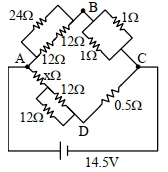
The value of unknown resistance $(x)$ for which the potential difference between $B$ and $D$ will be zero in the arrangement shown, is:
When a magnetic substance is heated, then it
There are three sources of sound of equal intensities with frequencies $101, 103$ and $106\, Hz$. What is the beat frequency heard if all are sounded simultaneously ... $Hz$?
An alternating $emf$ $E =440 \sin 100 \pi t$ is applited to a circuit containing an inductance of $\frac{\sqrt{2}}{\pi} H$. If an a.c. ammeter is connected in the circuit, its reading will be $.......A$
A bar magnet when placed at an angle of $30^o$ to the direction of magnetic field induction of $5 \times  10^{-2} \,T$, experiences a moment of couple $25 \times 10^{-6} \,N-m$. If the length of the magnet is $ 5\, cm $ its pole strength is
Consider two nuclei of the same radioactive nuclide. One of the nuclei was created in a supernova explosion $5$ billion years ago. The other was created in a nuclear reactor $5$ minutes ago. The probability of decay during the next time is
'Mirage' is a phenomenon due to
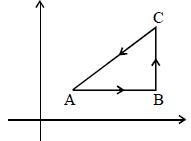
As shown in figure, on bringing a charge $Q$ from point $A$ to $B$ and from $B$ to $C$, the work done are $2\, joule$ and $-3\, joule$ respectively. The work done to bring the charge from $C$ to $A$ is
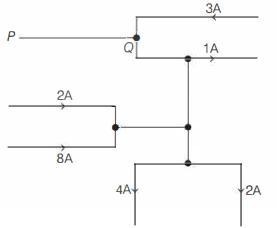
Figure below shows a portion of an electric circuit with the currents in amperes and their directions. The magnitude and direction of the current in the portion $P Q$ is