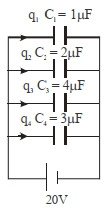
The total charge on the system of capacitance $C _{1}=1\,\mu F , C _{2}=2\,\mu F , C _{3}=4\,\mu F$ and $C _{4}=3\,\mu F$ connected in parallel is $......\mu C$ (Assume a battery of $20\,V$ is connected to the combination)
JEE MAIN 2022, Medium


Download our appand get started for free
Experience the future of education. Simply download our apps or reach out to us for more information. Let's shape the future of learning together!No signup needed.*
Similar Questions
- 1In a uniform electric field, a cube of side $1\ cm$ is placed. The total energy stored in the cube is $8.85\ μJ$ . The electric field is parallel to four of the faces of the cube. The electric flux through any one of the remaining two faces isView Solution
- 2The plates of parallel plate capacitor are charged upto $100\;V$. A $2\,mm$ thick plate is inserted between the plates. Then to maintain the same potential difference, the distance between the plates is increased by $1.6\;mm$. The dielectric constant of the plate isView Solution
- 3View SolutionAssertion : Two concentric charged shells are given. The potential difference between the shells depends on charge of inner shell.
Reason : Potential due to charge of outer shell remains same at every point inside the sphere.

- 4A particle of mass $m$ and charge $q$ is kept at the top of a fixed frictionless sphere. $A$ uniform horizontal electric field $E$ is switched on. The particle looses contact with the sphere, when the line joining the center of the sphere and the particle makes an angle $45^o$ with the vertical. The ratio $\frac{qE}{mg}$ is :-View Solution
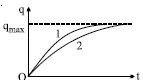
- 5The charge across the capacitor in two different $RC$ circuits $1$ and $2$ are plotted as shown in figure. Identify the correct statement$(s)$ related to the $R_1, R_2, C_1 $ and $C_2$ of the two $RC$ circuits.View Solution
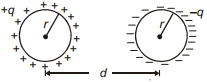
- 6Two similar conducting balls having charges $+q$ and $-q$ are placed at a separation $d$ from each other in air. The radius of each ball is $r$ and the separation between their centres is $d(d > > r)$. Calculate the capacitance of the two ball systemView Solution
- 7View SolutionThe energy stored in the condenser is
- 8The displacement of a charge $Q$ in the electric field $E = {e_1}\hat i + {e_2}\hat j + {e_3}\hat k$ is $\hat r = a\hat i + b\hat j$. The work done isView Solution
- 9A charge of ${10^{ - 9}}\,C$ is placed on each of the $64$ identical drops of radius $2\,cm$. They are then combined to form a bigger drop. Find its potentialView Solution
- 10Two thin concentric hollow conducting spheres of radii $R_1$ and $R_2$ bear charges $Q_1$ and $Q_2$ respectively. If $R_1 < R_2$, then the potential of a point at a distance $r$ from the centre $(R_1 < r < R_2)$ isView Solution