MCQ
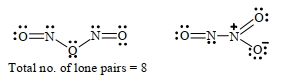
The total number of lone pairs of electrons in $N _2 O _3$ is
  • A
    $5$
  • B
    $6$
  • C
    $7$
  • $8$

Answer

Correct option: D.
$8$
d

Need a full question paper?

Generate a complete, print-ready paper with questions like this in minutes — across 16+ boards, with answer keys.

Start Generating Free

Similar questions

Nucleus of an element contains $9$ protons. It's valency would be
${H_3}B{O_3}\,\xrightarrow{{{T_1}}}X\,\xrightarrow{{{T_2}}}Y\,\xrightarrow{{\operatorname{Re} d\,\,\,hot}}{B_2}{O_3}$

if $T_1 < T_2$ then $X$ and $Y$ respectively are

If the work function of a metal is $6.63 \times 10^{-19}\, J$, the maximum wavelength of the photon required to remove a photoelectron from the metal is $....\,nm.$ (Nearest integer)

[Given : $h =6.63 \times 10^{-34}\, J \,s$, and $c =3 \times 10^{8} \,m\, s ^{-1}$ ]

One among the following is the correct $IUPAC$ name of the compound 

$\begin{array}{*{20}{c}}
  {\,\,\,\,\,H} \\ 
  {\,\,\,\,\,\,|} \\ 
  {C{H_3}C{H_2} - N - CHO} 
\end{array}$
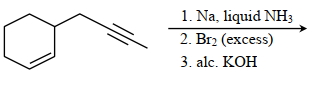
The number of isomeric tetraenes (NOT containing $s p$-hybridized carbon atoms) that can be formed from the following reaction sequence is. . . . . . 
The compound $YB{a_2}C{u_3}{O_7}$ which shows superconductivity has copper in oxidation state ........ Assume that the rare earth element Yttrium is in its usual $ + \,3$ oxidation state
If a gas expands at constant temperature, it indicates that :
In the reaction product $D$ is $\begin{array}{*{20}{c}}
  {C{H_2}} \\ 
  {||\,\,\,\,\,\,\,\,} \\ 
  {C{H_2}} 
\end{array}$ $\xrightarrow{{B{r_2}/CC{l_4}}}A\xrightarrow{{KCN}}B\xrightarrow{{{H_3}{O^ + }}}C\xrightarrow{\Delta }D$
Two compounds $I$ and $II$ are eluted by column chromato-graphy(adsorption of $I> II$). Which one of the following is a correct statement?
Order of solubility of solid $AgCl(s)$ in given cases.

$(i)$ In pure water

$(ii)$ In presence of $0.1\  M AgNO_3$

$(iii)$ In presence of $2\  M aq.$ solution of $KCN$

$(iv)$  In presence of $ 1\ M aq$. solution of $Ca(CN)_2$

$(v)$ In presence of $2\ M aq.$ solution of $NH_3$ 

(Assuming $100\%$ dissociation of $AgNO_3, KCN$ and $Ca(CN)_2)$ and complex formation with $NH_3$ and $CN^-$ will take place.