Question
The transverse displacement of a string (clamped at its both ends) is given by
$\text{y}(\text{x, t})=0.06\sin\Big(\frac{2\pi}{3}\text{x}\Big)\cos(120\pi\text{ t})$
where x and y are in m and t in s. The length of the string is 1.5m and its mass is $3.0 \times 10^{–2}kg$.
Answer the following:
Interpret the wave as a superposition of two waves travelling in opposite directions. What is the wavelength, frequency, and speed of each wave?
Answer

A wave travelling along the positive x-direction is given as: $\text{y}_1=\text{a}\sin(\omega\text{t}-\text{kx})$The wave travelling along the negative x-direction is given as:
$\text{y}_2=\text{a}\sin(\omega\text{t}-\text{kx})$ The superposition of these two waves yields: $\text{y}=\text{y}_1+\text{y}_2=\text{a}\sin(\omega\text{t}-\text{kx})-\text{a}\sin(\omega\text{t}-\text{kx})$
$=\text{a}\sin(\omega\text{t})\cos(\text{kx})-\text{a}\sin(\text{kx})\cos(\omega\text{t})-\text{a}\sin(\omega\text{t})\cos(\text{kx})-\text{a}\sin(\text{kx})\cos(\omega\text{t})$
$=-2\text{a}\sin(\text{kx})\cos(\omega\text{t})$
$=-2\text{a}\sin\Big(\frac{2\pi}{\lambda}\text{x}\Big)\cos(2\pi\text{ vt})\ \dots(\text{i})$ The transverse displacement of the string is given as: $\text{y}(\text{x, t})=0.06\sin\Big(\frac{2\pi}{3}\text{x}\Big)\cos(120\pi\text{ t})\ \dots(\text{ii})$ Comparing equations (i) and (ii), we have: $\frac{2\pi}{\lambda}=\frac{2\pi}{3}$
$\therefore$ Wavelength, $\lambda=3\text{m}$ It is given that: $120\pi=2\pi\text{v}$ Frequency, $\text{v} = 60\text{Hz}$ Wave speed, $\text{v}=\text{v}\lambda$
$=60\times3=180\text{m/s}$

Need a full question paper?

Generate a complete, print-ready paper with questions like this in minutes — across 16+ boards, with answer keys.

Start Generating Free

Similar questions

Establish an expression for the mean kinetic energy of molecules. Under what circumstances can this be known?
A particle executes simple harmonic motion of amplitude A.
i. At what distance from the mean position is its kinetic energy equal to its potential energy?
ii. At what points is its speed half the maximum speed?
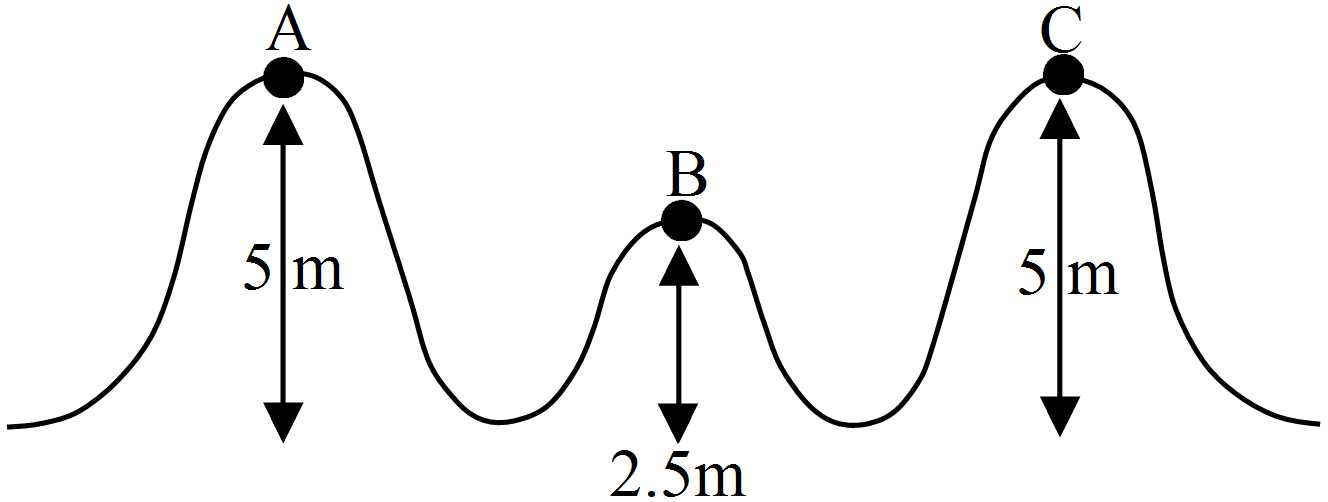
A mass 5kg starts sliding from A on a smooth surface shown in the figure. Find the velocity of the mass at B and C?
Two identical heavy spheres are separated by a distance $10$ times their radius. Will an object placed at the mid point of the line joining their centres be in stable equilibrium or unstable equilibrium? Give reason for your answer.
A stone of mass m is tied to an elastic string of negligble mass and spring constant k. The unstretched length of the string is L and has negligible mass. The other end of the string is fixed to a nail at a point P. Initially the stone is at the same level as the point P. The stone is dropped vertically from point P.
  1. Find the distance y from the top when the mass comes to rest for an instant, for the first time.
  2. What is the maximum velocity attained by the stone in this drop?
  3. What shall be the nature of the motion after the stone has reached its lowest point?
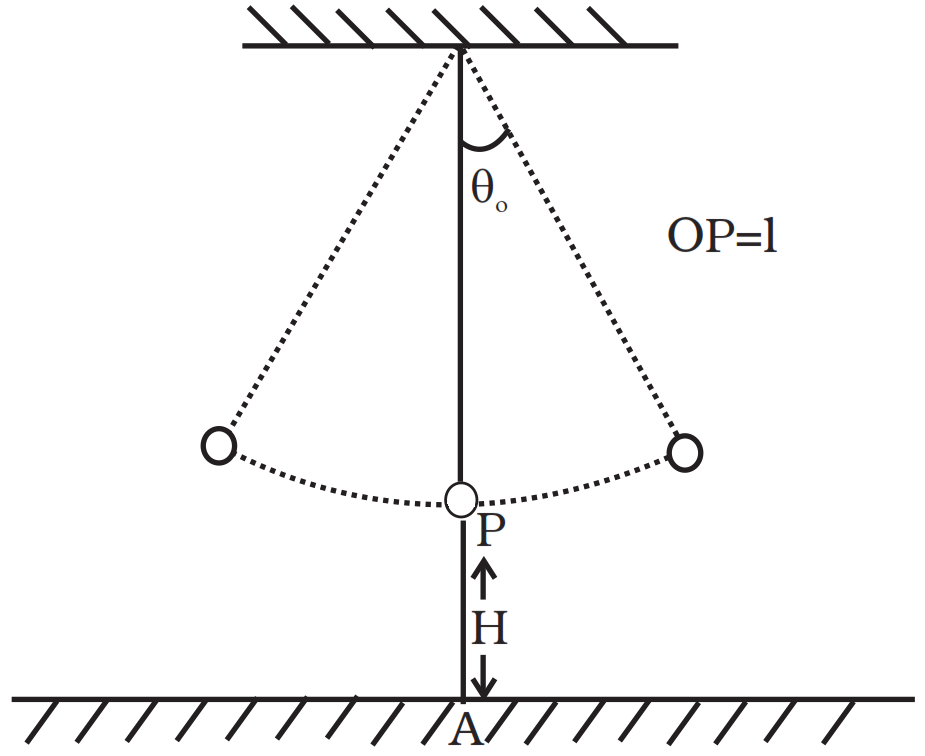
A simple pendulum of time period $1s$ and length l is hung from a fixed support at O, such that the bob is at adistance H vertically above A on the ground The amplitude is $\theta$ The string snaps at $\theta=\frac{\theta_0}{2}$ Find the time taken by the bob to hit the ground. Also find distance from A where bob hits the ground. Assume θ to be small so that $\sin\theta_0\ \text{and}\ \cos\theta_0=1.$
A car moving at $108km/h$ finds another car in front of it going in the same direction at $72km/h$. The first car sounds a horn that has a dominant frequency of $800Hz$. What will be the apparent frequency heard by the driver in the front car? Speed of sound in air = $330m/s$.
Three coplanar parallel wires, each carrying a current of 10A along the same direction, are placed with a separation 5.0cm between the consecutive ones. Find the matnitude ol the magnetic force per unit lenght acting on the wires.
What do you understand by beat? Explain beats analytically.
Give example of a motion where x > 0, v < 0, a > 0 at a particular instant.