Question
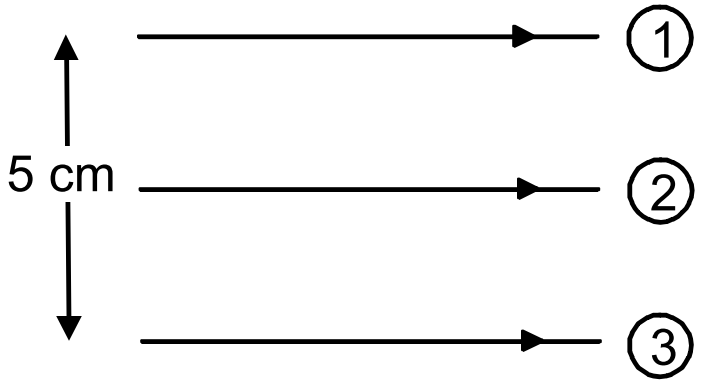
Three coplanar parallel wires, each carrying a current of 10A along the same direction, are placed with a separation 5.0cm between the consecutive ones. Find the matnitude ol the magnetic force per unit lenght acting on the wires.
Answer

i = 10A Magnetic force due to two parallel Current Carrying wires.$\text{F}=\frac{\mu_0\text{I}_1\text{I}_2}{2\pi\text{r}}$
So, $\overrightarrow{\text{F}}\ \text{or}\ 1=\overrightarrow{\text{F}}\ \text{or}\ 2+\overrightarrow{\text{F}}\ \text{by}\ 3$$=\frac{\mu_0\times10\times10}{2\pi\times5\times10^{-2}}+\frac{\mu_0\times10\times10}{2\pi\times10\times10^{-2}}$
$=\frac{4\pi\times10^{-7}\times10\times10}{2\pi\times5\times10^{-2}}+=\frac{4\pi\times10^{-7}\times10\times10}{2\pi\times10\times10^{-2}}$
$=\frac{2\times10^{-3}}{5}+\frac{10^{-3}}{5}=\frac{3\times10^{-3}}{5}=6\times10^{-4}\text{N}$ towards middle wire

Need a full question paper?

Generate a complete, print-ready paper with questions like this in minutes — across 16+ boards, with answer keys.
Start Generating Free

Similar questions

Two discs of moments of inertia $I_1$ and $I_2$ about their respective axes (normal to the disc and passing through the centre), and rotating with angular speed $\omega_1$ and $\omega_2$ are brought into contact face to face with their axes of rotation coincident.
  1. Does the law of conservation of angular momentum apply to the situation? why?
  2. Find the angular speed of the two-disc system.
  3. Calculate the loss in kinetic energy of the system in the process.
  4. Account for this loss.
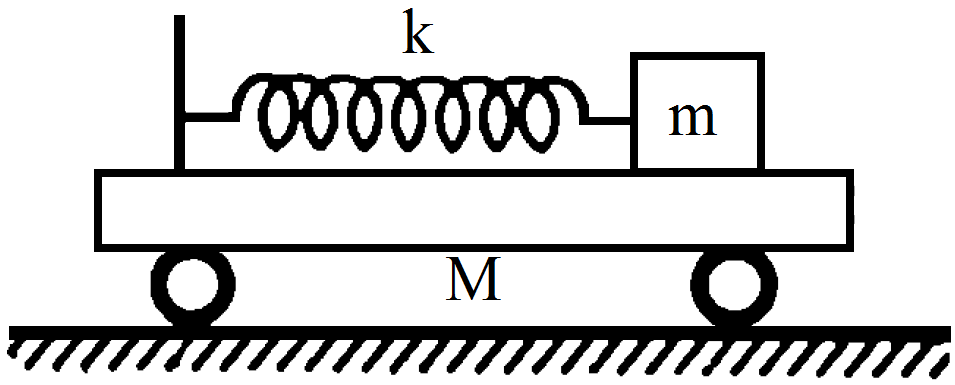
All the surfaces shown in are frictionless. The mass of the car is $M$, that of the block is m and the spring has spring constant k. Initially, the car and the block are at rest and the spring is stretched through a length $x$, when the system is released.
  1. Find the amplitudes of the simple harmonic motion of the block and of the car as seen from the road.
  2. Find the time period(s) of the two simple harmonic motions.
Refer to the graphs in Fig. Match the following.
Graph
 
Characteristic
a.
i.
has v > 0 and a < 0 throughout.
b.
ii.
has x > 0 throughout and has a point with v = 0 and a point with a = 0.
c.
iii.
has a point with zero displacement for t > 0.
d.
iv.
has v < 0 and a > 0.
A capacitor of capacitance $5.00\mu\text{F}$ is charged to $24.0V$ and another capacitor of capacitance $6.0\mu\text{F}$ is charged to $12.0V$:
  1. Find the energy stored in each capacitor.
  2. The positive plate of the first capacitor is now connected to the negative plate of the second and vice versa. Find the new charges on the capacitors.
  3. Find the loss of electrostatic energy during the process.
  4. Where does this energy go?
A nucleus is at rest in the laboratory frame of reference. Show that if it disintegrates into two smaller nuclei the products must move in opposite directions.
A stream of water flowing horizontally with a speed of $15ms^{-1}$ gushes out of a tube of cross-sectional area $10^{-2}m^2$, and hits a vertical wall nearby. What is the force exerted on the wall by the impact of water, assuming it does not rebound?
Two trains each having a speed of $30\ km/ hr$ are headed at each other on the same track. A bird that can fly at $60\ km/ hr$ flies off from one train, when they are $60\ km$ apart, and heads directly for the other train. On reaching the other train, it flies directly back to the first, and so forth.
  1. How many trips can the bird make from one train to the other before they crash?
  2. What is the total distance the bird travels?
A charge Q is uniformly distributed on a thin spherical shell. What is the field at the centre of the shell? If a point charge is brought close to the shell, will the field at the centre change? Does your answer depend on whether the shell is conducting or nonconducting?
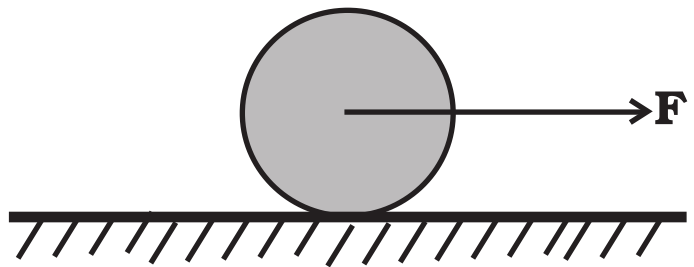
A uniform disc of radius R, is resting on a table on its rim.The coefficient of friction between disc and table is $\mu.$Now the disc is pulled with a force F as shown in the figure. What is the maximum value of F for which the disc rolls without slipping?