Question
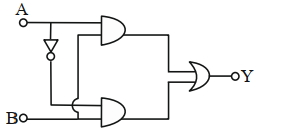
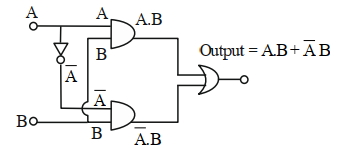
The truth table for this gvien circuit is:
Answer

$\mathrm{Y}  =\mathrm{A} \cdot \mathrm{B}+\overline{\mathrm{A}} \cdot \mathrm{B} $

$ =(\mathrm{A}+\overline{\mathrm{A}}) \cdot \mathrm{B} $

$\mathrm{Y}  =1 \cdot \mathrm{B} $

$\mathrm{Y}  =\mathrm{B}$
Need a full question paper?

Generate a complete, print-ready paper with questions like this in minutes — across 16+ boards, with answer keys.

Start Generating Free

Similar questions

A cubical block is floating in a liquid with one fourth of its volume immersed in the liquid. If whole of the system accelerates upward with acceleration $g / 4$, the fraction of volume immersed in the liquid will be ..........
A parallel plate capacitor has a capacitance $\mathrm{C}=200 \mathrm{pF}$. It is connected to $230 \mathrm{~V}$ ac supply with an angular frequency $300 \mathrm{rad} / \mathrm{s}$. The $\mathrm{rms}$ value of conduction current in the circuit and displacement current in the capacitor respectively are :
When the current in a coil changes from $8$ $ampere$ to $2$ $ampere$ in $3 \times {10^{ - 2}}$ $second,$ the $e.m.f$ induced in the coil is $2\;volt$. The self inductance of the coil (in $millihenry$) is  
Acceleration of a particle, executing $SHM$, at it’s mean position is
An ammeter gives full deflection when a current of $2\, amp$. flows through it. The resistance of ammeter is $12 \,\Omega$. If the same ammeter is to be used for measuring a maximum current of $5\, amp$., then the ammeter must be connected with a resistance of
An electron enters a region where magnetic $(B)$ and electric $(E)$ fields are mutually perpendicular to one another, then
For the reaction, the product expected is
A sphere of radius $R$ and charge $Q$ is placed inside a concentric imaginary sphere of radius $2R$. The flux associated with the imaginary sphere is
A liquid is coming out from a vertical tube. The relation between the weight of the drop $W$, surface tension of the liquid $T$ and radius of the tube $r$ is given by, if the angle of contact is zero
Electrons of mass $m$ with de-Broglie wavelength $\lambda$ fall on the target in an $X-$ray tube. The cutoff wavelength $(\lambda_0)$ of the emitted $X-$ ray is