Question
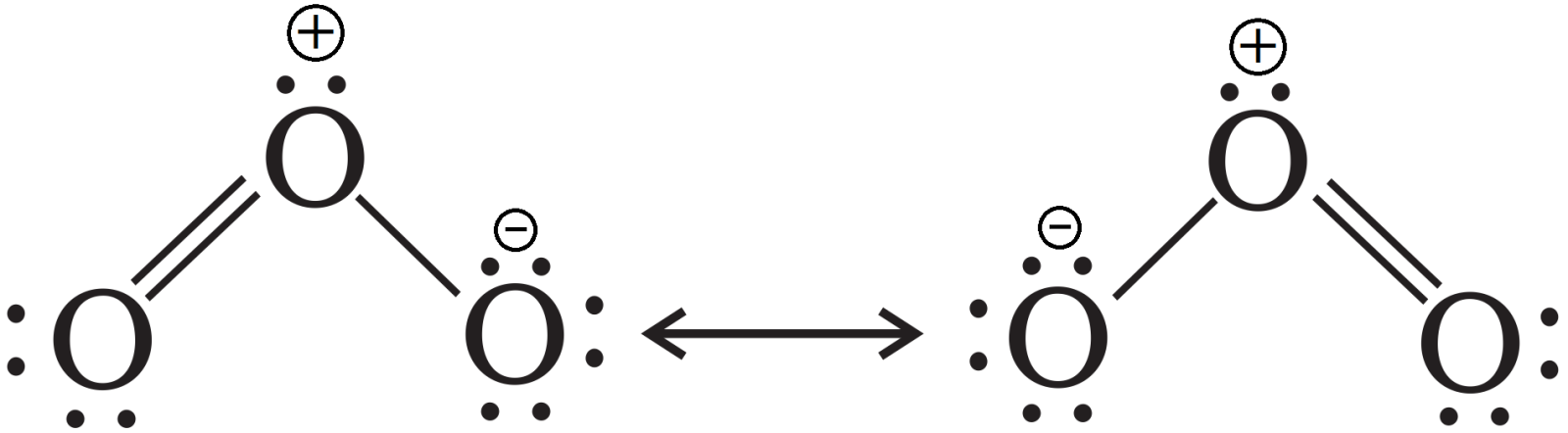
The two $\text{O}-\text{O}$ bond distances in ozone molecule are equal. Justify.
Answer

It is due to resonance.

Need a full question paper?

Generate a complete, print-ready paper with questions like this in minutes — across 16+ boards, with answer keys.

Start Generating Free

Similar questions

What are the oxidation number of the underlined elements in the following and how do you rationalise your results?
KI3
  1. Deduce the structures of:
  1. BrF5
  2. PF5 on the basis of VSEPR theory.
  1. Which out of NH3 and NF3 has higher dipole moment and why?
Which of the following sets of orbitals are degenerate and why?
  1. 1s, 2s and 3s in Mg-atom.
  2. 2px, 2py and 2pz in C-atom.
  3. 3s, 3px and 3d-orbitals in H-atom.
What are electrophiles and nucleophiles? Explain with examples.
Balance the following redox reactions by ion-electron method:

H2O2(aq) + Fe2+(aq) → Fe3+(aq) + H2O(l) (in acidic solution).

In a reaction
$A + B _2 \rightarrow AB _2$
Identify the limiting reagent, if any, in the following reaction mixtures.
(i) 300 atoms of A + 200 molecules of B
(ii) 2 mol A + 3 mol B
(iii) 100 atoms of A + 100 molecules of B
(iv) 5 mol A + 2.5 mol B
(v) 2.5 mol A + 5 mol B
  1. List two main differences between orbit and orbital.
  2. If an electron is moving with a velocity 600m/ s which is accurate upto 0.005%, then calculate the uncertainty in its position.

(h = 6.626 × 10-34Js and mass of election = 9.11 × 10-31kg)

Explain the term 'standard molar free energy of formation’ of a compound. Calculate the equilibrium constant for the reaction:

$2\text{SO}_2(\text{g})+\text{O}_2(\text{g})\rightleftharpoons2\text{SO}_3(\text{g})$ at 25°C.

Given: $\Delta_\text{f}\text{G}^\circ\text{SO}_3(\text{g})=-371.1\text{kJ mol}^{-1},$ $\Delta_\text{f}\text{G}^\circ\text{SO}_2(\text{g})=-300.2\text{kJ mol}^{-1},$ R = 8.31JK-1 mol-1.
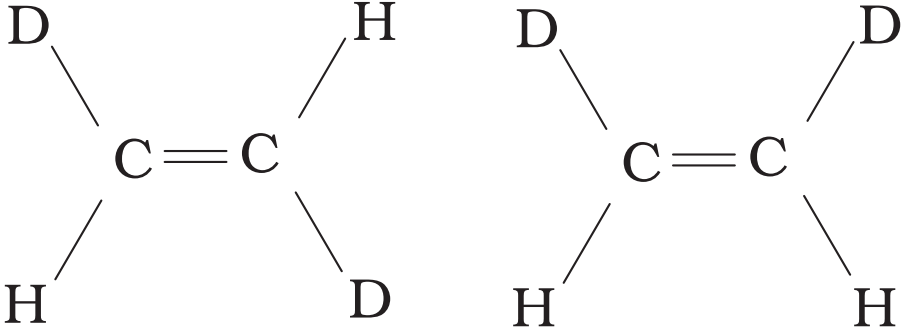
What is the relationship between the members of following pairs of structures? Are they structural or geometrical isomers or resonance contributors?

Identify the type of redox reaction taking place in the following.
  1. $3\stackrel{0\ \ \ \ \ \ \ \ \ \ \ \ }{\text{Mg(s)}}+\stackrel{0\ \ \ \ \ \ \ \ \ \ \ }{\text{N}_2\text{(g)}}\ \xrightarrow{\ \ \ \ \ \ \ \ \ \ }\ \stackrel{+2\ \ \ \ -3\ \ \ \ \ \ \ \ }{\text{Mg}_3\text{N}_2\text{(s)}}$
  2. $\stackrel{+5\ \ \ \ \ \ -2\ \ \ \ \ \ \ }{\text{V}_2\text{O}_5\text{(s)}}5\stackrel{0\ \ \ \ \ \ \ \ \ \ }{\text{Ca(s)}}\xrightarrow{\ \ \ \ \ \ \ }2\stackrel{0\ \ \ \ \ \ \ \ }{\text{V(s)}}+\text{5}\stackrel{+2\ \ -2\ \ \ \ \ \ \ \ \ \ }{\text{CaO(s)}}$
  3. $2\stackrel{+1\ +5\ -2\ \ \ \ \ \ \ \ \ \ \ \ }{\text{KClO}_3(\text{s})}\xrightarrow{\ \ \ \ \ \ \ }2\stackrel{+1\ \ -1\ \ \ \ \ \ \ \ \ \ }{\text{KCl(s)}}+3\stackrel{0\ \ \ \ \ \ \ \ \ \ }{\text{O}_2\text{(g)}}$
  4. $\stackrel{0}{\text{Ca}\text{(s)}}+2\stackrel{+1-2}{\text{H}_2\text{O}\text{l}}\ \xrightarrow{\ \ \ \ \ \ \ \ \ \ \ }\stackrel{+2\ \ -2+1\ \ \ \ \ \ \ \ \ \ \ \ \ \ \ \ \ \ }{\text{Ca(OH)}_2(\text{aq})}+\stackrel{0}{\text{H}}_2\text{(g)}$
  5. $\stackrel{0\ \ \ \ \ \ \ \ \ \ \ }{\text{Br}_2(\text{l})}+\stackrel{-1\ \ \ \ \ \ \ \ \ \ \ \ }{2\text{I}^-(\text{aq})}\xrightarrow{\ \ \ \ \ \ \ \ \ \ }\stackrel{1-}{\text{2Br}^-}(\text{aq})+\stackrel{0\ \ \ \ \ \ \ \ \ \ }{\text{I}_2\text{(s)}}$