Question
The two vectors $\hat{\text{j}}+\hat{\text{k}}$ and $3\hat{\text{i}}-\hat{\text{j}}+4\hat{\text{k}}$ represents the sides $\overrightarrow{\text{AB}}$ and $\overrightarrow{\text{AC}}$ respectively of a triangle ABC. Find the length of the median through A.
Answer

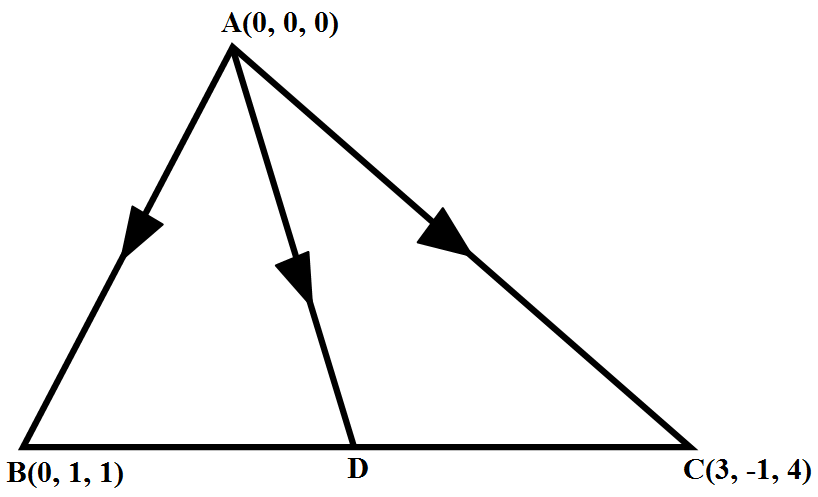
Disclaimer: The question has been solved by taking the vector $\overrightarrow{\text{AB}}$ as $\hat{\text{j}}+\hat{\text{k}}$.In $\triangle\text{ABC},\ \overrightarrow{\text{AB}}=\hat{\text{j}}+\hat{\text{k}}$ and $\overrightarrow{\text{AC}}=3\hat{\text{i}}-\hat{\text{j}}+4\hat{\text{k}}$
Let the position vector of A be (0, 0, 0). Then, the position vectors of B and C are (0, 1, 1) and (3, -1, 4), respectively.

Suppose D be the mid-point of the line segment joining the points B(0, 1, 1) and C(3, -1, 4).
$\therefore$ position vector of D $=\frac{\big(\hat{\text{j}}+\hat{\text{k}}\big)+\big(3\hat{\text{i}}-\hat{\text{j}}+4\hat{\text{k}}\big)}{2}=\frac{3\hat{\text{i}}+5\hat{\text{k}}}{2}=\frac{3}2\hat{\text{i}}+\frac{5}2\hat{\text{k}}$
Now,
Length of the median, AD =
$\Big|\overrightarrow{\text{AD}}\Big|=\Big|\Big(\frac{3}2\hat{\text{i}}+\frac{5}2\hat{\text{k}}\Big)-\big(0\hat{\text{i}}+0\hat{\text{j}}+0\hat{\text{k}}\big)\Big|$
$=\Big|\frac{3}2\hat{\text{i}}+\frac{5}2\hat{\text{k}}\Big|$
$=\sqrt{\Big(\frac{3}{2}\Big)^2+0^2+\Big(\frac{5}2\Big)^2}$
$=\sqrt{\frac{34}{4}}$
$=\sqrt{\frac{17}2}\text{units}$

Need a full question paper?

Generate a complete, print-ready paper with questions like this in minutes — across 16+ boards, with answer keys.

Start Generating Free

Similar questions

Verify Rolle's theorem of the following function on the indicated interval
$\text{f}(\text{x})=\text{e}^{1-\text{x}^2}\text{ on }[-1,1]$
A card is drawn and replaced in an ordinary pack of 52 cards. How many times must a card be drawn so that.
  1. there is at least an even chance of drawing a heart.
  2. the probability of drawing a heart is greater than $\frac{3}{4}$?
Solve the following systems of linear equations by cramer's rule:
$x + y = 5,$
$y + z = 3,$
$x + z = 4$
Evaluate the following integrals:$\int\frac{\text{x}^3\sin^{-1}\text{x}^2}{\sqrt{1-\text{x}^4}}\text{dx}$
Write the minors and cofactors of element of the first column of the following matrices and hence evaluate the determinant in case:
$\text{A}=\begin{vmatrix}1&\text{a}&\text{bc}\\1&\text{b}&\text{ca}\\1&\text{c}&\text{ab} \end{vmatrix}$
If $\text{e}^{\text{x}}+\text{e}^{\text{y}}=\text{e}^{\text{x}+\text{y}},$ prove that $\frac{\text{dy}}{\text{dx}}=-\frac{\text{e}^{\text{x}}(\text{e}^\text{y}-1)}{\text{e}^{\text{y}}(\text{e}^{\text{x}}-1)}$ or $\frac{\text{dy}}{\text{dx}}+\text{e}^{\text{y}-\text{x}}=0$
Show that the following system of linear equations is consistent and also find solution:
$2x + 3y = 5$
$6x + 9y = 15$
Evaluate the following integrals:
$\int\text{cosec x}\log({\text{cosec x}-\cot\text{x})}\text{dx}$
Evaluate:
$\int\frac{\sin \text{x} - \text{x}\cos \text{x}}{\text{x} ( \text{x}+ \sin \text{x})} \text{dx}$
Solve the matrix equations:
$\begin{bmatrix}\text{x}&1\end{bmatrix}\begin{bmatrix}1&0\\-2&-3\end{bmatrix}\begin{bmatrix}\text{x}\\5\end{bmatrix}=0$