MCQ
The two vectors $\vec A$ and $\vec B$ that are parallel to each other are
  • $\vec A = 3\hat i + 6\hat j + 9\hat k$     $\vec B = \hat i + 2\hat j + 3\hat k$
  • B
    $\vec A = 3\hat i - 6\hat j + 9\hat k$     $\vec B = \hat i + 2\hat j + 3\hat k$
  • C
    $\vec A = 2\hat i + 6\hat j - 9\hat k$     $\vec B = \hat i + 2\hat j - 3\hat k$
  • D
    $\vec A = 2\hat i + 3\hat j + 3\hat k$     $\vec B = \hat i - 2\hat j - 3\hat k$
Answer

Correct option: A.
$\vec A = 3\hat i + 6\hat j + 9\hat k$     $\vec B = \hat i + 2\hat j + 3\hat k$
a

Need a full question paper?

Generate a complete, print-ready paper with questions like this in minutes — across 16+ boards, with answer keys.

Start Generating Free

Similar questions

The frequency of a whistle of an engine is $600\, cycles/sec$ is moving with the speed of $30 \,m/sec$ towards an observer. The apparent frequency will be .... $cps$ (velocity of sound $= 330 \,m/s$)
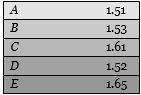
Immiscible transparent liquids $A, B, C, D$ and $E$ are placed in a rectangular container of glass with the liquids making layers according to their densities. The refractive index of the liquids are shown in the adjoining diagram. The container is illuminated from the side and a small piece of glass having refractive index $1.61$ is gently dropped into the liquid layer. The glass piece as it descends downwards will not be visible in
Two charges each of magnitude $Q$ are fixed at $2a$ distance apart. A third charge ($-q$ of mass $'m'$) is placed at the mid point of the two charges; now $-q$ charge is slightly displaced perpendicular to the line joining the charges then find its time period
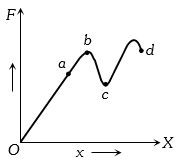
The graph is drawn between the applied force $F$ and the strain $(x)$ for a thin uniform wire. The wire behaves as a liquid in the part
A quantity Q is formulated as $\mathrm{X}^{-2} \mathrm{Y}^{+\frac{3}{2}} \mathrm{Z}^{-\frac{2}{5}} \cdot \mathrm{X}, \mathrm{Y}$ and Z are independent parameters which have fractional errors of 0.1, 0.2 and 0.5 , respectively in measurement. The maximum fractional error of $Q$ is
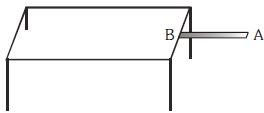
A thin uniform stick of length $l$ and mass $m$ is held horizontally with its end $B$ hinged on the edge of a table. Point $A$ is suddenly released. The acceleration of the centre of mass of the stick at the time of release, is
If the energy of a photon corresponding to a wavelength of $6000 Å$ is $3.32 \times {10^{ - 19}}J$, the photon energy for a wavelength of $4000 Å$ will be ............ $eV$ 
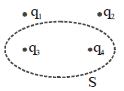
Figure shows four charges $q_1, q_2, q_3$ and $q_4$ fixed in space. Then the total flux of electric field through a closed surface $S$, due to all charges $q_1, q_2, q_3$ and $q_4$ is
A solid cylinder of radius $R$ and mass $M$, rolls down on inclined plane without slipping and reaches the bottom with a speed $v$. The speed would be less than $v$ if we use
If $\sigma$ be the surface tension, the work done in breaking a big drop of radius R in n drops of equal radius is