The type of waves that can be propagated through solid is
Easy
Download our app for free and get started
(c) Since solid has both the properties (rigidity and elasticity)

Download our appand get started for free
Experience the future of education. Simply download our apps or reach out to us for more information. Let's shape the future of learning together!No signup needed.*
Similar Questions
- 1A wave is represented by the equation : $y = a\sin (0.01x - 2t)$ where $a$ and $x$ are in $cm$. velocity of propagation of wave is .... $cm/s$View Solution
- 2$Assertion :$ When a beetle moves along the sand within a few tens of centimeters of a sand scorpion, the scorpion immediately turns towards the beetle and dashes towards itView Solution
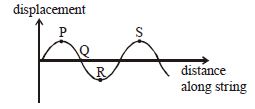
$Reason :$ When a beetle disturbs the sand, it sends pulses along the sand's surface. One set of pulses is longitudinal while the other set is transverse. - 3The given graph illustrates a transverse wave travelling on a string at a particular instant, and the points $P, Q, R$ and $S$ represent elements of the string. Which of the following statements about the motion of the elements is correct?View Solution
- 4The equation of a progressive wave is $y = 8\sin \left[ {\pi \left( {\frac{t}{{10}} - \frac{x}{4}} \right) + \frac{\pi }{3}} \right]$. The wavelength of the wave is .... $m$View Solution
- 5The temperature at which the speed of sound in air becomes double of its value at ${27^o}C$ is ... $^oC$View Solution
- 6The superposition takes place between two waves of frequency $f$ and amplitude $a.$ The total intensity is directly proportional toView Solution
- 7If at same temperature and pressure, the densities for two diatomic gases are respectively ${d_1}$ and ${d_2}$, then the ratio of velocities of sound in these gases will beView Solution
- 8Tone $A$ has frequency of $240 Hz.$ Of the following tones, the one which will sound least harmonious with $A$ isView Solution
- 9A tuning fork of frequency $480 Hz$ produces $10$ beats per second when sounded with a vibrating sonometer string. What must have been the frequency of the string if a slight increase in tension produces lesser beats per second than before ..... $Hz$View Solution
- 10The engine of a train moving with speed $10\,ms ^{-1}$ towards a platform sounds a whistle at frequency $400\,Hz$. The frequency heard by a passenger inside the train is $........\,Hz$ (neglect air speed. Speed of sound in air $330\,ms ^{-1}$ )View Solution