The temperature at which the speed of sound in air becomes double of its value at ${27^o}C$ is ... $^oC$
AIPMT 1993, Medium


Download our appand get started for free
Experience the future of education. Simply download our apps or reach out to us for more information. Let's shape the future of learning together!No signup needed.*
Similar Questions
- 1A sound source $S$ is moving along a straight track with speed $v,$ and is emitting sound of frequency $v_{o}$ (see figure). An observer is standing at a finite clistance, at the point $O$, from the track. The time variation of frequency heard by the observer is best represented byView Solution
$\left(t_{0}\right.$ represents the instant when the distance between the source and observer is minimum)
- 2The wavelengths of two waves are $50$ and $51 cm$ respectively. If the temperature of the room is ${20^o}C$, then what will be the number of beats produced per second by these waves, when the speed of sound at ${0^o}C$ is $\,332 m/sec$View Solution
- 3In a Resonance -Coulmn lab experiment to measure the velocity of sound, the first resonance is obtained at a length $l_1$ and the second resonance at a length $l_2$. Then-View Solution
- 4$50$ tuning forks are arranged in increasing order of their frequencies such that each gives $4 \,beats/sec$ with its previous tuning fork. If the frequency of the last fork is octave of the first, then the frequency of the first tuning fork is ... $Hz$View Solution
- 5It is found that an increase in pressure of $100\, kPa$ causes a certain volume of water to decrease by $5 × 10^{-3}$ percent of its original volume. Then the speed of sound in the water is about .... $m/s$ (density of water $10^3 \,kg/m^3$)View Solution
- 6In one metre long open pipe what is the harmonic of resonance obtained with a tuning fork of frequency $480 Hz$View Solution
- 7A closed organ pipe of length $L$ and an open organ pipe contain gases of densities $\rho_{1}$ and $\rho_{2}$ respectively. The compressibility of gases are equal in both the pipes. Both the pipes are vibrating in their first overtone with same frequency. The length of the open pipe is $\frac{ x }{3} L \sqrt{\frac{\rho_{1}}{\rho_{2}}}$ where $x$ is ......... . (Round off to the Nearest Integer)View Solution
- 8The correct graph between the frequency $n$ and square root of density ($\rho$) of a wire, keeping its length, radius and tension constant, isView Solution
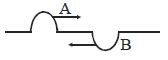
- 9View SolutionTwo identical harmonic pulses travelling in opposite directions in a taut string approach each other. At the instant when they completely overlap, the total energy of the string will be
- 10View SolutionWhen a wave travelling in medium is reflected from the boundary of a denser medium, which of the following will not change?