Question
The uncertainty in the experimental or the calculated values is indicated by mentioning the number of significant figures. Significant figures are meaningful digits which are known with certainty plus one which is estimated or uncertain. The uncertainty is indicated by writing the certain digits and the last uncertain digit. there are certain rules for determining the Number of significant figures. These are Stated below:

  • All non-zero digits are significant. For Example in 285cm, there are three Significant figures and in 0.25 mL, there are two significant figures.
  • Zeros preceding to first non-zero digit are not significant. such zero indicates the position of decimal point. thus, 0.03 has one significant figure and 0.0052 has two significant figures.
  • Zeros between two non-zero digits are significant. thus, 2.005 has four Significant figures.
  • Zeros at the end or right of a number are significant, provided they are on the right side of the decimal point. For example, 0.200 g has three significant figures. But, if otherwise, the terminal zeros are not significant if there is no decimal point.
Precision refers to the closeness of various measurements for the same quantity. However, accuracy is the agreement of a particular valueto the true value of the result.

LAWS OF CHEMICALCOMBINATIONS- The combination of elements to form compounds is governed by the following five basic laws.

  1. Law of Conservation of Mass-This law was put forth by Antoine Lavoisierin 1789. He performed careful experimental studies for combustion reactions and reached to the conclusion that in all physical andchemical changes, there is no net change inmassduring the process. Hence, he reachedto the conclusion that matter can neither becreated nor destroyed. This is called ‘Law ofConservation of Mass’.
  2. Law of Definite Proportions-This law was given by, a French chemist, Joseph Proust. He stated that a given compound always contains exactly the same proportion of elements by weight.
  3. Law of Multiple Proportions-This law was proposed by John Dalton. According to this law, if two elements can combine to form more than one compound, the masses of one element that combine with a fixed mass of the other element, are in the ratio of small whole numbers. For example, hydrogen combines with oxygen to form two compounds, namely, water and hydrogen peroxide.

Hydrogen + Oxygen→ Water

2g                 16g       18g

Hydrogen + Oxygen → Hydrogen Peroxide

    2g                  32g        34g

Here, the masses of oxygen (i.e., 16 g and 32 g), which combine with a fixed mass of hydrogen (2g) bear a simple ratio, i.e., 16:32 or 1:2.

  1. Gay Lussac’s Law of Gaseous Volumes-This law was given by Gay Lussac in 1808. Heobserved that when gases combine or are produced in a chemicalreaction they do so in asimple ratio by volume,provided all gases are at the same temperature and pressure.
  2. Avogadro’s Law – In 1811, Avogadro proposed that equal volumes of all gases at the same temperature and pressure should contain equal number of molecules.
In 1808, Dalton published ‘A New System of Chemical Philosophy’, in which he proposed the following :

  1. Matter consists of indivisible atoms.
  2. All atoms of a given element have identical properties, including identical mass. Atoms of different elements differ in mass.
  3. Compounds are formed when atoms of different elements combine in a fixed ratio.
  4. Chemical reactions involve reorganisati on of atoms. These are neither created nor destroyed in a chemical reaction.
  1. … refers to the closeness of variousmeasurements for the same quantity.
  1. Accuracy
  2. Reliability
  3. Precision
  4. Uncertainty
  1. Law of Conservation of mass was put forth by ….in 1789.
  1. Joseph Proust
  2. Antoine Lavoisier
  3. Joseph Louis
  4. Gay Lussac
  1. Which of the following number has twosignificant figures.
  1. 0.0052
  2. 052
  3. 52
  4. 0052
  1. … is the agreement of a particular valueto the true value of the result.
  1. Accuracy
  2. Reliability
  3. Precision
  4. Uncertainty
  1. Law of Multiple Proportions proposed by....
  1. Joseph Proust
  2. Antoine Lavoisier
  3. Joseph Louis
  4. John Dalton

Answer

  1. (c) Precision
  1. (b) Antoine Lavoisier
  1. (a) 0.0052
  1. (a) Accuracy
  1. (d) John Dalton

Need a full question paper?

Generate a complete, print-ready paper with questions like this in minutes — across 16+ boards, with answer keys.

Start Generating Free

Similar questions

Read the passage given below and answer the following questions from 1 to 5.

Alkanes are generally inert towards acids, bases, oxidising and reducing agents. However, they undergo the following reactions under certain conditions.

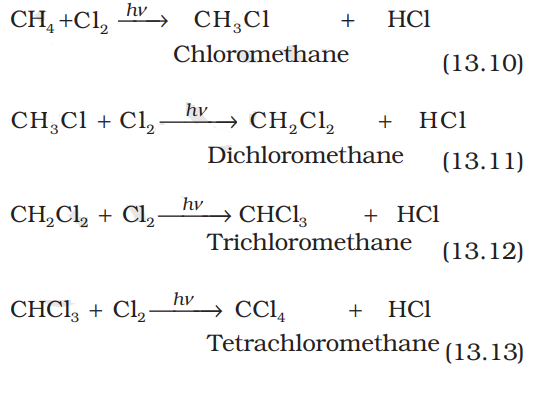
1) Substitution reactions One or more hydrogen atoms of alkanes can be replaced by halogens, nitro group and sulphonic acid group. Halogenation takes place either at higher temperature (573-773K) or in the presence of diffused sunlight or ultraviolet light. Lower alkanes do not undergo nitration and sulphonation reactions. These reactions in which hydrogen atoms of alkanes are substituted are known as substitution reactions. As an example, chlorination of methane is given below: Halogenation

$\text{CH}_3-\text{CH}_3+\text{CL}_2\xrightarrow{\text{hv}}\text{CH}_3-\text{CH}_2\text{Cl}+\text{HCl}$

It is found that the rate of reaction of alkanes with halogens is F2 > Cl2 > Br2 > I2. Rate of replacement of hydrogens of alkanes is: 3° > 2° > 1°. Fluorination is too violent to be controlled. Iodination is very slow and a reversible reaction. It can be carried out in the presence of oxidizing agents like HIO3 or HNO3.

$\text{CH}_4+\text{I}_2\rightleftharpoons\text{CH}_3\text{I}+\text{HI}$

$\text{HIO}_3+5\text{HI}\rightarrow3\text{I}_2+3\text{H}_2\text{O}$

Halogenation is supposed to proceed via free radical chain mechanism involving three steps namely initiation, propagation and termination.

The General combustion equation for any alkane is:

$\text{C}_\text{n}\text{H}_{2\text{n}+2}+\Bigg(\frac{3\text{n}+1}{2}\Bigg)\text{O}_2\rightarrow\text{nCO}_2+(\text{n}+1)\text{H}_2\text{O}$

Combustion
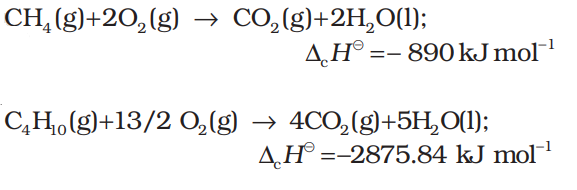
Alkanes on heating in the presence of air or dioxygen are completely oxidized to carbon dioxide and water with the evolution of large amount of heat.

Due to the evolution of large amount of heat during combustion, alkanes are used as fuels. During incomplete combustion of alkanes with insufficient amount of air or dioxygen, carbon black is formed which is used in the manufacture of ink, printer ink, black pigments and as filters.

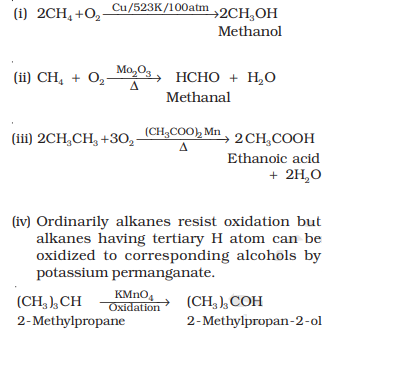
Controlled oxidation Alkanes on heating with a regulated supply of dioxygen or air at high pressure and in the presence of suitable catalysts give a variety of oxidation products.

Ordinarily alkanes resist oxidation but alkanes having tertiary H atom can be oxidized to corresponding alcohols by potassium permanganate .

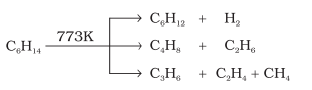
Pyrolysis Higher alkanes on heating to higher temperature decompose into lower alkanes, alkenes etc. Such a decomposition reaction into smaller fragments by the application of heat is called pyrolysis or cracking.

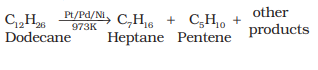
Pyrolysis of alkanes is believed to be a free radical reaction. Preparation of oil gas or petrol gas from kerosene oil or petrol involves the principle of pyrolysis. For example, dodecane, a constituent of kerosene oil on heating to 973K in the presence of platinum, palladium or nickel gives a mixture of heptane and pentene.

Conformations- Alkanes contain carbon-carbon sigma $(\sigma)$bonds. Electron distribution of the sigma molecular orbital is symmetrical around the internuclear axis of the C–C bond which is not disturbed due to rotation about its axis. This permits free rotation about C–C single bond. This rotation results into different spatial arrangements of atoms in space which can change into one another. Such spatial arrangements of atoms which can be converted into one another by rotation around a C-C single bond are called conformations or conformers or rotamers. Alkanes can thus have infinite number of conformations by rotation around C-C single bonds. However, it may be remembered that rotation around a C-C single bond is not completely free. It is hindered by a small energy barrier of 1-20 kJ mol–1 due to weak repulsive interaction between the adjacent bonds. Such a type of repulsive interaction is called torsional strain. Conformations of ethane : Ethane molecule (C2H6) contains a carbon – carbon single bond with each carbon atom attached to three hydrogen atoms. Considering the ball and stick model of ethane, keep one carbon atom stationary and rotate the other carbon atom around the C-C axis. This rotation results into infinite number of spatial arrangements of hydrogen atoms attached to one carbon atom with respect to the hydrogen atoms attached to the other carbon atom. These are called conformational isomers (conformers). Thus there are infinite number of conformations of ethane. However, there are two extreme cases. One such conformation in which hydrogen atoms attached to two carbons are as closed together as possible is called eclipsed conformation and the other in which hydrogens are as far apart as possible is known as the staggered conformation. Any other intermediate conformation is called a skew conformation. It may be remembered that in all the conformations, the bond angles and the bond lengths remain the same. Eclipsed and the staggered conformations can be represented by Sawhorse and Newman projections.

  1. Alkanes contain carbon-carbon … bonds.
  1. sigma $\sigma$
  2. pi bond$\pi$
  3. delta$\delta$
  4. eta $\eta$
  1. C-C single bond is hindered by a small energy barrier of…. kJ mol–1
  1. 10 - 200
  2. 1 - 20
  3. 100 - 427
  4. 342 - 786
  1. A decomposition reaction into smaller fragments by the application of heat is called as ….
  1. pyrolysis
  2. cracking
  3. both (a) & (b)
  4. combustion
  1. Which of the following steps are involving in free radical chain mechanism
  1. initiation
  2. propagation
  3. termination
  4. All the above
  1. The … reaction in which alkanes on heating in the presence of air or dioxygen are completely oxidized to carbon dioxide and water with the evolution of large amount of heat.
  1. pyrolysis
  2. cracking
  3. both (a) & (b)
  4. combustion
Read the passage given below and answer the following questions from (i) to (v).
The presence of positive charge on thenucleus is due to the protons in the nucleus.As established earlier, the charge on the proton is equal but opposite to that of electron.Atomic number (Z) = number of protons inthe nucleus of an atom = number of electrons in a nuetral atom. protons and neutrons present in thenucleus are collectively known as nucleons.The total number of nucleons is termed asmass number (A) of the atom.
mass number (A) = number of protons (Z) + number of neutrons (n).
Isobars are the atoms with same massnumber but different atomic number forexample, 64C and 714N. On the other hand, atomswith identical atomic number but differentatomic mass number are known as Isotopes.For example,considering of hydrogen atom again, 99.985% of hydrogen atoms contain only one proton.This isotope is called protium (11H). Rest of thepercentage of hydrogen atom contains two otherisotopes, the one containing 1 proton and 1neutron is called deuterium (21D, 0.015%)and the other one possessing 1 proton and 2neutrons is called tritium (13T )..the studiesof interactions of radiations with matter haveprovided immense information regarding thestructure of atoms and molecules. Neils Bohrutilised these results to improve upon themodel proposed by Rutherford. Twodevelopments played a major role in theformulation of Bohr’s model of atom. Thesewere:
  1. Dual character of the electromagneticradiation which means that radiations possess both wave like and particle likeproperties, and
  2. Experimental results regarding atomicspectra.
James Maxwell (1870) was the first to givea comprehensive explanation about theinteraction between the charged bodies andthe behaviour of electrical and magnetic fieldson macroscopic level. He suggested that whenelectrically charged particle moves underaccelaration, alternating electrical and magnetic fields are produced and transmitted.These fields are transmitted in the forms ofwaves called electromagnetic waves orelectromagnetic radiation.radiations are characterised by theproperties, namely, frequency (ν) and wavelength $(\lambda).$The SI unit for frequency (ν) is hertz(Hz, s–1), after Heinrich Hertz. It is defined asthe number of waves that pass a given pointin one second.Wavelength should have the units of lengthand as you know that the SI units of length ismeter (m). Since electromagnetic radiationconsists of different kinds of waves of muchsmaller wavelengths, smaller units are used.In vaccum all types of electromagneticradiations, regardless of wavelength, travel atthe same speed, i.e., 3.0 × 10⁸m s–1 (2.997925× 10⁸ ms–1, to be precise). This is called speedof light and is given the symbol ‘c‘. Thefrequency (ν), wavelength $(\lambda)$ and velocity of light(c) are related by the following equation .
$\text{c}=\text{v}\lambda$
The other commonly used quantityspecially in spectroscopy, is the wavenumber.It is defined as the number of wavelengthsper unit length. Its units are reciprocal ofwavelength unit, i.e., m–1. However commonlyused unit is cm–1
  1. The presence of positive charge on the nucleus is due to the …. in the nucleus.
  1. Protons
  2. Neutrons
  3. Electron
  4. Nucleons
  1. Atomic Number is denoted by:
  1. A
  2. Z
  3. N
  4. M
  1. Atomic Mass number is denoted by:
  1. M
  2. Z
  3. N
  4. A
  1. … are the atoms with same mass number but different atomic number.
  1. Isotopes
  2. Allotropes
  3. Isobars
  4. None of above
  1. Atoms with identical atomic number but different atomic mass number are known as ..
  1. Isotopes
  2. Allotropes
  3. Isobars
  4. None of above
Read the passage given below and answer the following questions from (i) to (iii).

Le Chatelier’s principle is also known as the equilibrium law, used to predict the effect of change on a system at chemical equilibrium. This principle states that equilibrium adjusts the forward and backward reactions in such a way as to accept the change affecting the equilibrium condition. When factor-like concentration, pressure, temperature, inert gas that affect equilibrium are changed, the equilibrium will shift in that direction where the effects caused by these changes are nullified. This principle is also used to manipulate reversible reactions in order to obtain suitable outcomes.

  1. Which one of the following conditions will favour the maximum formation of the product in the reaction?

$\text{A}_{2(\text{g})}+\text{B}_{2(\text{g})}\rightleftharpoons\text{X}_{2(\text{g})},\triangle_\text{r}\text{H}=-\text{XkJ}?$

  1. Low temperature and high pressure.
  2. Low temperature and low pressure.
  3. High temperature and high pressure.
  4. High temperature and low pressure.
  1. For the reversible reaction, 

$\text{N}_{2(\text{g})}+3\text{H}_{2(\text{g})}\rightleftharpoons2\text{NH}_{3(\text{g})}+\text{heat}$

The equilibrium shifts in forwarding direction

  1. By increasing the concentration of NH3(g)
  2. By decreasing the pressure.
  3. By decreasing the concentrations of N2(g) and H2(g)
  4. By increasing pressure and decreasing temperature.
  1. In which one of the following equilibria will the point of equilibrium shift to left when the pressure of the system is increased?
  1. $\text{H}_{2(\text{g})}+\text{l}_{2(\text{g})}\rightleftharpoons2\text{HI}_{(\text{g})}$

  2. $2\text{NH}_{3(\text{g})}\rightleftharpoons\text{N}_{2(\text{g})}+3\text{H}_{2(\text{g})}$

  3. $\text{C}_{(\text{s})}+\text{O}_{2(\text{g})}\rightleftharpoons\text{CO}_{2{\text{g}}}$

  4. $2\text{H}_{2(\text{g})}+\text{O}_{2(\text{g})}\rightleftharpoons2\text{H}_2\text{O}_{(\text{g})}$

Read the passage given below and answer the following questions from 1 to 5.

A reagent that brings an electron pair to the reactive site is called a nucleophile (Nu:) i.e., nucleus seeking and the reaction is then called nucleophilic. A reagent that takes away an electron pair from reactive site is called electrophile (E+) i.e., electron seeking and the reaction is called electrophilic.

Electron Displacement Effects in Covalent Bonds The electron displacement in an organic molecule may take place either in the ground state under the influence of an atom or a substituent group or in the presence of an appropriate attacking reagent. The electron displacements due to the influence of an atom or a substituent group present in the molecule cause permanent polarlisation of the bond. Inductive effect and resonance effects are examples of this type of electron displacements. Temporary electron displacement effects are seen in a molecule when a reagent approaches to attack it. This type of electron displacement is called electrometric effect or polarisability effect.

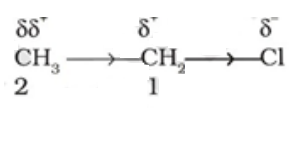
Inductive Effect When a covalent bond is formed between atoms of different electronegativity, the electron density is more towards the more electronegative atom of the bond. Such a shift of electron density results in a polar covalent bond. Bond polarity leads to various electronic effects in organic compounds. Let us consider cholorethane (CHCH2Cl) in which the C–Cl bond is a polar covalent bond. It is polarised in such a way that the carbon-1 gains some positive charge $(\delta+)$ and the chlorine some negative charge $(\delta-)$ The fractional electronic charges on the two atoms in a polar covalent bond are denoted by symbol (delta) and the shift of electron density is shown by an arrow that points from$(\delta+)$ to $(\delta-)$ end of the polar bond.

In turn carbon-1, which has developed partial positive charge $(\delta+)$draws some electron density towards it from the adjacent C-C bond. Consequently, some positive charge$(\delta\delta+)$develops on carbon-2 also, where $(\delta\delta+)$ symbolises relatively smaller positive charge as compared to that on carbon – 1. In other words, the polar C – Cl bond induces polarity in the adjacent bonds. Such polarisation of σ- bond caused by the polarisation of adjacent $σ-$bond is referred to as the inductive effect.

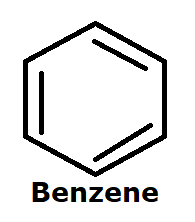
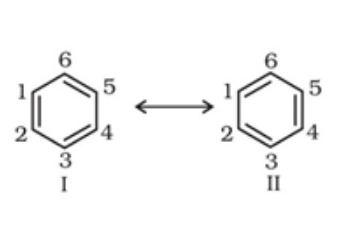
Resonance Structure There are many organic molecules whose behaviour cannot be explained by a single Lewis structure. An example is that of benzene. Its cyclic structure containing alternating C–C single and C=C double bonds shown is inadequate for explaining its characteristic properties.

As per the above representation, benzene should exhibit two different bond lengths, due to C–C single and C=C double bonds. However, as determined experimentally benzene has a uniform C–C bond distances of 139 pm, a value intermediate between the C–C single(154 pm) and C=C double (134 pm) bonds. Thus, the structure of benzene cannot be represented adequately by the above structure. Further, benzene can be represented equally well by the energetically identical structures I and II.

Therefore, according to the resonance theory the actual structure of benzene cannot be adequately represented by any of these structures, rather it is a hybrid of the two structures (I and II) called resonance structures. The resonance structures (canonical structures or contributing structures) are hypothetical and individually do not represent any real molecule. They contribute to the actual structure in proportion to their stability.

Resonance Effect The resonance effect is defined as ‘the polarity produced in the molecule by the interaction of two π-bonds or between a π-bond and lone pair of electrons present on an adjacent atom’. The effect is transmitted through the chain. There are two types of resonance or mesomeric effect designated as R or M effect. (i) Positive Resonance Effect (+R effect) In this effect, the transfer of electrons is away from an atom or substituent group attached to the conjugated system. This electron displacement makes certain positions in the molecule of high electron densities. This effect in aniline is shown as : (ii) Negative Resonance Effect (- R effect)  This effect is observed when the transfer of  Electrons is towards the atom or substituent  Group attached to the conjugated system. For  Example in nitrobenzene this electron  Displacement can be depicted as : The atoms or substituent groups, which represent +R or –R electron displacement effects are as follows: +R effect: – halogen, –OH, –OR, –OCOR, –NH2, –NHR, –NR2, –NHCOR, – R effect: – COOH, –CHO, > C = O, – CN, – NO2 The presence of alternate single and double bonds in an open chain or cyclic system is termed as a conjugated system. These systems often show abnormal behaviour. The examples are 1,3- butadiene, aniline and nitrobenzene etc. In such systems, the π-electrons are delocalised and the system develops polarity.

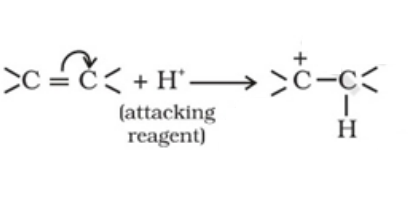
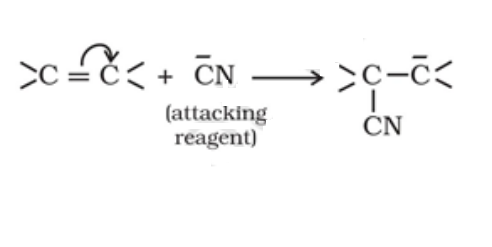
Electromeric Effect (E effect) It is a temporary effect. The organic compounds having a multiple bond (a double or triple bond) show this effect in the presence of an attacking reagent only. It is defined as the complete transfer of a shared pair of π-electrons to one of the atoms joined by a multiple bond on the demand of an attacking reagent. The effect is annulled as soon as the attacking reagent is removed from the domain of the reaction. It is represented by E and the shifting of the electrons is shown by a curved arrow ( ). There are two distinct types of electromeric effect.

a) Positive Electrometric Effect (+E effect)- In this effect the π−electrons of the multiple bond are transferred to that atom to which the reagent gets attached. For example

b) Negative Electromeric Effect (–E effect) -In this effect the $\pi-$ electrons of the multiple bond are transferred to that atom to which the attacking reagent does not get attached. For example: When inductive and electromeric effects operate in opposite directions, the electomeric  effect predominates.

  1. A reagent that brings an electron pair to the reactive site is called a …
  1. nucleophile
  2. electrophile
  3. amphoteric
  4. amphophillic
  1. A reagent that takes away an electron pair from reactive site is called ..
  1. nucleophile
  2. electrophile
  3. amphoteric
  4. amphophillic
  1. The … effect is defined as the polarity produced in the molecule by the interaction of two π-bonds or between a π-bond and lone pair of electrons present on an adjacent atom.
  1. hindrance
  2. inductive
  3. resonance
  4. hyperconjunction
  1. –OH group, represent … electron displacement effect.
  1. M+
  2. M-
  3. R-
  4. R+
  1. – COOH group, represent … electron displacement effect.
  1. M+
  2. M-
  3. R-
  4. R+

Read the passage given below and answer the following questions from 1 to 5.

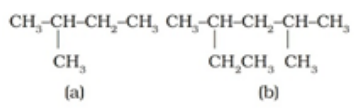
Branched chain hydrocarbons: In a branched chain compound small chains of carbon atoms are attached at one or more carbon atoms of the parent chain. The small carbon chains (branches) are called alkyl groups. For example:

In order to name such compounds, the names of alkyl groups are prefixed to the name of parent alkane. An alkyl group is derived from a saturated hydrocarbon by removing a hydrogen atom from carbon. Thus, CH4 becomes – CH3 and is called methyl group. An alkyl group is named by substituting ‘yl’ for ‘ane’ in the corresponding alkane. Some alkyl groups are listed in Table

AlkaneAlkyl Group
Molecular formulaName of alkaneStructural formulaName of alkyl group
CH4Methane-CH3Methyl
C2H6Ethane-CH2CH3Ethyl
C3H8Propane-CH2CH2CH3Propyl
C4H10Butane-CH2CH2CH2CH3Butyl
C10H22Decane-CH2(CH2)8CH3Decyl

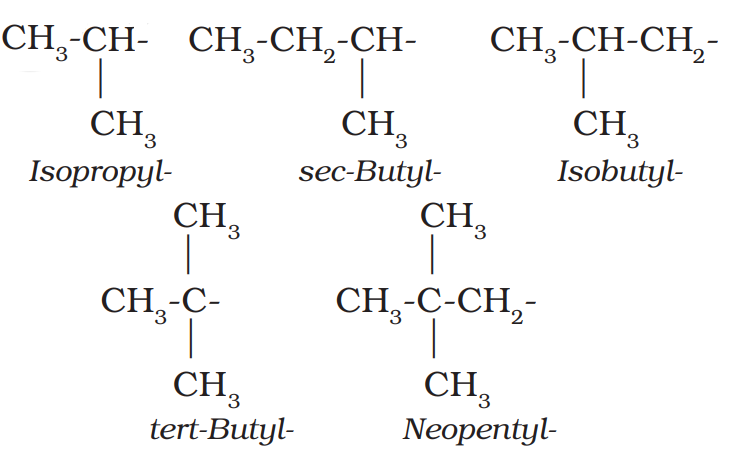
Abbreviations are used for some alkyl groups. For example, methyl is abbreviated as Me, ethyl as Et, propyl as Pr and butyl as Bu. The alkyl groups can be branched also. Thus, propyl and butyl groups can have branched structures as shown below .

Common branched groups have specific trivial names. For example, the propyl groups can either be n-propyl group or isopropyl group. The branched butyl groups are called sec- butyl, isobutyl and tert-butyl group. We also encounter the structural unit, – CH2C(CH3)3, which is called neopentyl group.

For Nomenclature of branched chain alkanes ,longest carbon chain in the molecule is identified. The numbering is done in such a way that the branched carbon atoms get the lowest possible numbers. lower number is given to the one coming first in the alphabetical listing. Carbon atom of  the branch that attaches to the root  alkane. in alphabetical order, the prefixes iso- and neo- are considered to be the part of the fundamental name of alkyl group. The prefixes sec- and tert- are not considered to be the part of the fundamental name.

Cyclic Compounds: A saturated monocyclic compound is named by prefixing ‘cyclo’ to the corresponding straight chain alkane. If side chains are present, then the rules given above are applied. Names of some cyclic compounds are given below.

The phenomenon of existence of two or more compounds possessing the same molecular formula but different properties is known as isomerism. Such compounds are called as isomers. The following flow chart shows different types of isomerism.

Structural Isomerism Compounds having the same molecular formula but different structures (manners in which atoms are linked) are classified as structural isomers. Some typical examples of different types of structural isomerism are given below:

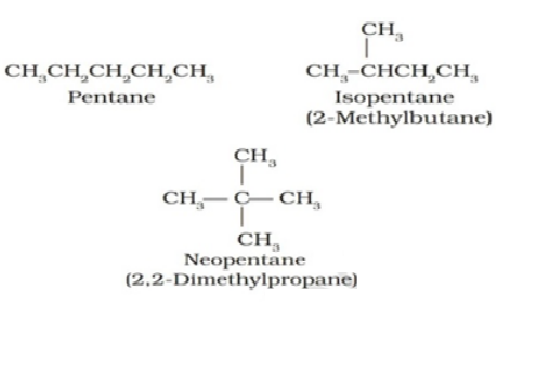
(i) Chain isomerism: When two or more compounds have similar molecular formula but different carbon skeletons, these are referred to as chain isomers and the phenomenon is termed as chain isomerism. For example, C5H12 represents three compounds:

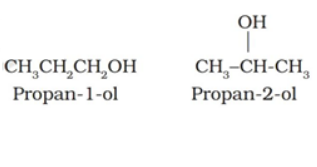
(ii) Position isomerism: When two or more compounds differ in the position of substituent atom or functional group on the carbon skeleton, they are called position isomers and this phenomenon is termed as position isomerism. For example, the molecular formula C3H8O represents two alcohols:

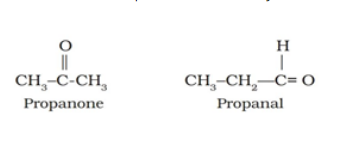
(iii) Functional group isomerism: Two or more compounds having the same molecular formula but different functional groups are called functional isomers and this phenomenon is termed as functional group isomerism. For example, the molecular formula C3H6O represents an aldehyde and a ketone:

(iv) Metamerism: It arises due to different alkyl chains on either side of the functional group in the molecule. For example, C4H10O represents methoxy propane (CH3OC3H7) and ethoxyethane (C2H5OC2H5).

Stereoisomerism The compounds that have the same constitution and sequence of covalent bonds but differ in relative positions of their atoms or groups in space are called stereoisomers. This special type of isomerism is called as stereoisomerism and can be classified as geometrical and optical isomerism.

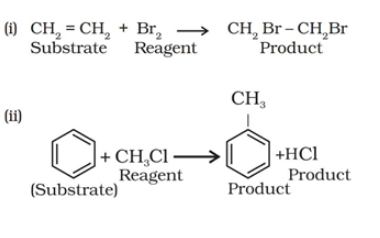
Substrate and Reagent Ions are generally not formed in the reactions of organic compounds. Molecules as such participate in the reaction. It is convenient to name one reagent as substrate and other as reagent. In general, a molecule whose carbon is involved in new bond formation is called substrate and the other one is called reagent. When carbon-carbon bond is formed, the choice of naming the reactants as substrate and reagent is arbitrary and depends on molecule under observation. Example:

  1. CH4 becomes – CH3,  is called … group.
  1. methyl
  2. ethyl
  3. propyl
  4. butyl
  1. For the Nomenclature of branched chain alkanes  …. carbon chain in the molecule is identified.
  1. shortest
  2. longest
  3. smallest
  4. none of above
  1. when two or more compounds possessing the same molecular formula but different properties is known as ….
  1. Allotrops
  2. Isotops
  3. Isomers
  4. Isobars
  1. For the Nomenclature of branched chain alkanes, the numbering is done in such a way that the branched carbon atoms get the … possible numbers.
  1. biggest
  2. Lower
  3. Highest
  4. lowest
  1. Which of the following is not an example of isomerisim?
  1. Functional
  2. Positional
  3. Chain
  4. Preconditional
Read the passage given below and answer the following questions from (i) to (vi).
The atomic theory of matter was first proposed on afirm scientific basis by JohnDalton, a British schoolteacher in 1808. His theory, called Dalton’s atomictheory, regarded the atom as the ultimate particle ofmatter Dalton’s atomic theory was able to explainthe law of conservation of mass, law of constantcomposition and law of multiple proportion verysuccessfully. However, it failed to explain the results ofmany experiments.In mid 1850s many scientists mainlyFaraday began to study electrical dischargein partially evacuated tubes, known ascathode ray discharge tubes.Electrical discharge carried out in the modifiedcathode ray tube led to the discovery of canalrays carrying positively charged particles. Thecharacteristics of these positively chargedparticles are listed below.
  1. Unlike cathode rays, mass of positivelycharged particles depends upon thenature of gas present in the cathode raytube. These are simply the positivelycharged gaseous ions.
  2. The charge to mass ratio of the particlesdepends on the gas from which theseoriginate.
  3. Some of the positively charged particlescarry a multiple of the fundamental unitof electrical charge.
  4. The behaviour of these particles in themagnetic or electrical field is opposite tothat observed for electron or cathoderays.
The smallest and lightest positive ion wasobtained from hydrogen and was called
proton. This positively charged particle wascharacterised in 1919. Later, a need was feltfor the presence of electrically neutral particleas one of the constituent of atom. Theseparticles were discovered by Chadwick (1932)by bombarding a thin sheet of beryllium byα-particles. When electrically neutral particleshaving a mass slightly greater than that ofprotons were emitted. He named theseparticles as neutrons.J. J. Thomson, in 1898, proposed that an atom possesses a spherical shape (radiusapproximately 10–10 m) in which the positivecharge is uniformly distributed. The electronsare embedded into it in such a manner as togive the most stable electrostatic arrangementMany different names are given tothis model, for example, plum pudding, raisinpudding or watermelon. This model can be visualised as a pudding or watermelon ofpositive charge with plums or seeds (electrons)embedded into it. An important feature of thismodel is that the mass of the atom is assumed to be uniformly distributed over theatom.Rutherford and his students (Hans Geiger andErnest Marsden) bombarded very thin gold foilwith α–particles. Rutherford’s famous α–particle scattering experiment.The observations of Scattering experiment are as follows-:
  1. most of the α–particles passed throughthe gold foil undeflected.
  2. a small fraction of the α–particles wasdeflected by small angles.
  3.  a very few α–particles (∼1 in 20,000)bounced back, that is, were deflected bynearly 180°.
On the basis of observations andconclusions from this experiment, Rutherford proposed the nuclearmodel of atom. According to this model:
  1. The positive charge and most of the massof the atom was densely concentrated inextremely small region. This very smallportion of the atom was called nucleusby Rutherford.
  2. The nucleus is surrounded by electronsthat move around the nucleus with a veryhigh speed in circular paths called orbits.Thus, Rutherford’s model of atomresembles the solar system in which thenucleus plays the role of sun and theelectrons that of revolving planets.
  3. Electrons and the nucleus are held together by electrostatic forces of attraction.
  1. The atomic theory of matter was first proposed on afirm scientific basis by:
  1. John Dalton
  2. Ernest Rutherford
  3. J.Thomson
  4. Henry Moseley
  1. The cathode rays start from … and move towards the….
  1. Anode, Cathode
  2. Centre, Anode
  3. Cathod, Anode
  4. Cathod, Centre
  1. Negativelycharged particles in atoms, called…
  1. Protons
  2. Electrons
  3. Neutron
  4. Positron
  1. The smallest and lightest positive ion wasobtained from …. and was called proton.
  1. Oxygen
  2. Nitrogen
  3. Carbon
  4. Hydrogen
  1. Electrically neutral particles having a mass slightly greater than that of protons, these particles termed as:
  1. Protons
  2. Electrons
  3. Neutron
  4. Positron
  1. J.J. Thomson’s atomic model is also named as:
  1. Plum pudding
  2. Raisin pudding
  3. Watermelon
  4. All the above

The orbital wave function or $\psi$ for an electronin an atom has no physical meaning. It issimply a mathematical function of thecoordinates of the electron. However, fordifferent orbitals the plots of correspondingwave functions as a function of r (the distancefrom the nucleus) are different. According to the German physicist, MaxBorn, the square of the wave function(i.e.,$\psi^2$) at a point gives the probability densityof the electron at that point. Boundary surface diagrams of constantprobability density for different orbitals give afairly good representation of the shapes of theorbitals. In this representation, a boundarysurface or contour surface is drawn in spacefor an orbital on which the value of probabilitydensity $\mid\psi\mid2$ is constant. In principle manysuch boundary surfaces may be possible.However, for a given orbital, only thatboundary surface diagram of constantprobability density* is taken to be goodrepresentation of the shape of the orbital whichencloses a region or volume in which theprobability of finding the electron is very high,say, 90%.

In hydrogen atom, electron has the same energy when it is in the2s orbital as when it is present in 2p orbital.The orbitals having the same energy are calleddegenerate. The 1s orbital in a hydrogenatom, as said earlier, corresponds to the moststable condition and is called the ground stateand an electron residing in this orbital is moststrongly held by the nucleus.

An electron inthe 2s, 2p or higher orbitals in a hydrogen atomis in excited state.The filling of electrons into the orbitals ofdifferent atoms takes place according to theaufbau principle which is based on the Pauli’sexclusion principle, the Hund’s rule ofmaximum multiplicity and the relativeenergies of the orbitals. Theaufbausprinciple states : In the ground state of theatoms, the orbitals are filled in order oftheir increasing energies. In other words,electrons first occupy the lowest energy orbitalavailable to them and enter into higher energyorbitals only after the lower energy orbitals arefilled.The number of electrons to be filled in variousorbitals is restricted by the exclusion principle,given by the Austrian scientist Wolfgang Pauli(1926). According to this principle : No twoelectrons in an atom can have the sameset of four quantum numbers. Pauliexclusion principle can also be stated as : “Onlytwo electrons may exist in the same orbitaland these electrons must have oppositespin.” This means that the two electrons canhave the same value of three quantum numbersn, l and ml, but must have the opposite spinquantum number.Hund’s Rule of Maximum Multiplicity rule deals with the filling of electrons into the orbitals belonging to the same subshell. It states : pairing ofelectrons in the orbitals belonging to thesame subshell (p, d or f) does not take placeuntil each orbital belonging to thatsubshell has got one electron each i.e., itis singly occupied.

The distribution of electrons into orbitals of anatom is called its electronic configuration.If one keeps in mind the basic rules whichgovern the filling of different atomic orbitals,the electronic configurations of different atomscan be written very easily.The electronic configuration of differentatoms can be represented in two ways. Forexample :

  1. sa pbdc…… notation
  2. Orbital diagram

  1. …at a point gives the probability density of the electron at that point.
  1. $\psi\times2$

  2. $-\psi^2$

  3. $\psi$

  4. $\psi^2$

  1. Only …. electrons may exist in the same orbital and these electrons must have opposite spin.
  1. One
  2. Two
  3. Three
  4. Four
  1. …deals with the filling of electrons into the orbitals belonging to the same subshell.
  1. Hund’s Rule of Maximum Multiplicity rule
  2. Pauli’s exclusion principle
  3. Aufbau principle
  4. Werner Heisenberg
  1. Electrons first occupy the …. energy orbital available to them and enter into … energy orbitals.
  1. Lowest, Higher
  2. Higher, Lowest
  3. Middle, Higher
  4. Higher, Middle
IUPAC (International Union of Pure and Applied Chemistry) system of nomenclature. Common names are useful and in many cases indispensable, particularly when the alternative systematic names are lengthy and complicated. A systematic name of an organic compound is generally derived by identifying the parent hydrocarbon and the functional group(s) attached to it. By using prefixes and suffixes, the parent name can be modified to obtain the actual name. In a branched-chain compound, small chains of carbon atoms are attached at one or more carbon atoms of the parent chain. The small carbon chains (branches) are called alkyl groups. An alkyl group is derived from a saturated hydrocarbon by removing a hydrogen atom from carbon. Abbreviations are used for some alkyl groups. For example, methyl is abbreviated as Me, ethyl as Et, propyl as Pr and butyl as Bu.

1. Draw the structure of 3-Ethyl-4,4-dimethylheptane. (1)
2. How is the numbering in branched chain hydrocarbon done?
3. Derive the structure of 2-Chlorohexane. (2)
OR
Why $CH _4$ after becoming- $CH _3$ called a methyl group? (2)
The idea of oxidation number has been invariably applied to define oxidation, reduction, oxidising agent (oxidant), reducing agent (reductant) and the redox reaction. To summarise, we may say that:
Oxidation: An increase in the oxidation number of the element in the given substance.
Reduction: A decrease in the oxidation number of the element in the given substance.
Oxidising agent: A reagent which can increase the oxidation number of an element in a given substance. These reagents are called as oxidants also.
Reducing agent: A reagent which lowers the oxidation number of an element in a given substance. These reagents are also called as reductants.
Redox reactions: Reactions which involve change in oxidation number of the interacting species.
Types of Redox Reactions
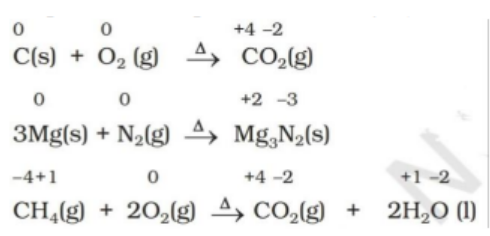
1.) Combination reactions -A combination reaction may be denoted in the manner:
A + B → C
Either A and B or both A and B must be in the elemental form for such a reaction to be a redox reaction. All combustion reactions, which make use of elemental dioxygen, as well as other reactions involving elements other than dioxygen, are redox reactions. Some important examples of this category are:

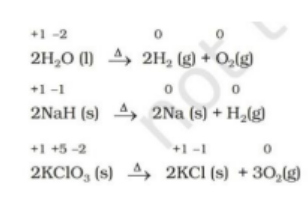
2.) Decomposition reactions- Decomposition reactions are the opposite of combination reactions. Precisely, a decomposition reaction leads to the breakdown of a compound into two or more components at least one of which must be in the elemental state.
Examples of this class of reactions are:

It may carefully be noted that there is no change in the oxidation number of hydrogen in methane under combination reactions and that of potassium in potassium chlorate in reaction. This may also be noted here that all decomposition reactions are not redox reactions. For example, decomposition of calcium carbonate is not a redox reaction.
3.) Displacement reactions- In a displacement reaction, an ion (or an atom) in a compound is replaced by an ion (or an atom) of another element. It may be denoted as:
X + YZ → XZ + Y
Displacement reactions fit into two categories: metal displacement and non-metal displacement.
(a) Metal displacement: A metal in a compound can be displaced by another metal in the uncombined state. Metal displacement reactions find many applications in metallurgical processes in which pure metals are obtained from their compounds in ores.
(b) Non-metal displacement: The non-metal displacement redox reactions include hydrogen displacement and a rarely occurring reaction involving oxygen displacement. All alkali metals and some alkaline earth metals (Ca, Sr, and Ba) which are very good reductants, will displace hydrogen from cold water. Many metals, including those which do not react with cold water, are capable of displacing hydrogen from acids. Dihydrogen from acids may even be produced by such metals which do not react with steam. Cadmium and tin are the examples of such metals.
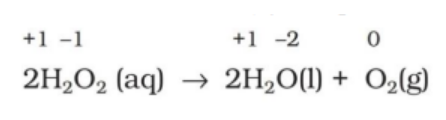
4.) Disproportionation reactions – Disproportionation reactions are a special type of redox reactions. In a disproportionation reaction an element in one oxidation state is simultaneously oxidised and reduced. One of the reacting substances in a disproportionation reaction always contains an element that can exist in at least three oxidation states. The element in the form of reacting substance is in the intermediate oxidation state; and both higher and lower oxidation states of that element are formed in the reaction. The decomposition of hydrogen peroxide is a familiar example of the reaction, where oxygen experiences disproportionation.

Here the oxygen of peroxide, which is present in –1 state, is converted to zero oxidation state in O2 and decreases to –2 oxidation state in H2O.
  1. In … an ion (or an atom) in a compound is replaced by an ion (or an atom) of another element.
  1. displacement reaction
  2. decomposition reaction
  3. disproportionation reaction
  4. combination reaction
  1. leads to the breakdown of a compound into two or more components at least one of which must be in the elemental state.
  1. displacement reaction
  2. decomposition reaction
  3. disproportionation reaction
  4. combination reaction
  1. In …. an element in one oxidation state is simultaneously oxidised and reduced.
  1. displacement reaction
  2. decomposition reaction
  3. disproportionation reaction
  4. combination reaction
  1. Reactions which involve change in oxidation number of the interacting species…
  1. Exothermic reaction
  2. Endothermic reaction
  3. Neutralization reaction
  4. Redox reaction
  1. One of the reacting substances in a disproportionation reaction always contains an element that can exist in at least … oxidation states.
  1. 1
  2. 2
  3. 3
  4. 4
Read the passage given below and answer the following questions from (i) to (v).
A system in thermodynamics refers to that part of universe in which observations are made and remaining universe constitutes the surroundings. The surroundings include everything other than the system. System and the surroundings together constitute the universe. The universe = The system + The surroundings However, the entire universe other than the system is not affected by the changes taking place in the system. Therefore, for all practical purposes, the surroundings are that portion of the remaining universe which can interact with the system. Usually, the region of space in the neighbourhood of the system constitutes its surroundings.
The wall that separates the system from the surroundings is called boundary.
Types of the System We, further classify the systems according to the movements of matter and energy in or out of the system.
  1. Open System In an open system, there is exchange of energy and matter between system and surroundings. The presence of reactants in an open beaker is an example of an open system. Here the boundary is an imaginary surface enclosing the beaker and reactants.
  2. Closed System In a closed system, there is no exchange of matter, but exchange of energy is possible between system and the surroundings. The presence of reactants in a closed vessel made of conducting material e.g., copper or steel is an example of a closed system.
  3. Isolated System In an isolated system, there is no exchange of energy or matter between the system and the surroundings. The presence of reactants in a thermos flask or any other closed insulated vessel is an example of an isolated system.
The State of the System The system must be described in order to make any useful calculations by specifying quantitatively each of the properties such as its pressure (p), volume (V), and temperature (T) as well as the composition of the system. We need to describe the system by specifying it before and after the change. You would recall from your Physics course that the state of a system in mechanics is completely specified at a given instant of time, by the position and velocity of each mass point of the system. In thermodynamics, a different and much simpler concept of the state of a system is introduced. It does not need detailed knowledge of motion of each particle because, we deal with average measurable properties of the system. We specify the state of the system by state functions or state variables. The state of a thermodynamic system is described by its measurable or macroscopic (bulk) properties. We can describe the state of a gas by quoting its pressure (p), volume (V), temperature (T), amount (n) etc. Variables like p, V, T are called state variables or state functions because their values depend only on the state of the system and not on how it is reached. In order to completely define the state of a system it is not necessary to define all the properties of the system; as only a certain number of properties can be varied independently. This number depends on the nature of the system. Once these minimum number of macroscopic properties are fixed, others automatically have definite values. The state of the surroundings can never be completely specified; fortunately it is not necessary to do so.
By conventions of IUPAC in chemical thermodynamics. The q is positive, when heat is transferred from the surroundings to the system and the internal energy of the system increases and q is negative when heat is transferred from system to the surroundings resulting in decrease of the internal energy of the system.
Let us consider the general case in which a change of state is brought about both by doing work and by transfer of heat. We write change in internal energy for this case as: $ \triangle{\text{U}}=\text{q}+\text{w}$
For a given change in state, q and w can vary depending on how the change is carried out. However, $\text{q}+\text{w}=\triangle{\text{U}}$ will depend only on initial and final state. It will be independent of the way the change is carried out. If there is no transfer of energy as heat or as work (isolated system) i.e., if w = 0 and q = 0, then $ \triangle{\text{U}}=0.$ The equation i.e., $ \triangle{\text{U}}=\text{q}+\text{w}$ is mathematical statement of the first law of thermodynamics, which states that The energy of an isolated system is constant. It is commonly stated as the law of conservation of energy i.e., energy can neither be created nor be destroyed.
  1. $\triangle\text{U}=\ ....$
  1. q + w
  2. q + v
  3. q + m
  4. q + z
  1. Which of the following is not an example of state variable?
  1. Pressure
  2. Ionic radius
  3. Volume
  4. Amount
  1. $\triangle\text{U}=\text{q}+\text{w}$ is termed as …
  1. Third law of thermodynamics
  2. Second law of thermodynamics
  3. First law of thermodynamics
  4. None of above
  1. A … in thermodynamics refers to that part of universe in which observations are made.
  1. Universe
  2. System
  3. Surrounding
  4. Boundary
  1. Which of the following is a type if system ?
  1. Open system
  2. Closed system
  3. Lsolated system
  4. All the above