MCQ
The unit for molar susceptibility is
  • $m$
  • B
    $\mathrm{kg}-\mathrm{m}$
  • C
    $\mathrm{kg} m$
  • D
    No units

Answer

Correct option: A.
$m$
(a) Molar susceptiblity
$=\frac{\text { Volume susceptiblity }}{\text { Density of material }} \times \text { molecular weight } $.
$ =\frac{I / H}{\rho} \times M=\frac{I / H}{M / V} \times M$ So it's unit is $m$.

Need a full question paper?

Generate a complete, print-ready paper with questions like this in minutes — across 16+ boards, with answer keys.
Start Generating Free

Similar questions

In a thermodynamics process, pressure of a fixed mass of a gas is changed in such a manner that the gas releases $20 \mathrm{~J}$ of heat and 8J of work is done on the gas. If the initial internal energy of the gas was $30 \%$. The final internal energy will be
A short-circuited coil is placed in a time-varying magnetic field. Electrical power is dissipated due to the current induced in the coil. If the number of turns were to be quadrupled and the wire radius halved, the electrical power dissipated would be
If $n$ represents the actual number of deflections in a converted galvanometer of resistance $G$ and shunt resistance $S$. Then the total current I when its figure of merit is $K$ will be
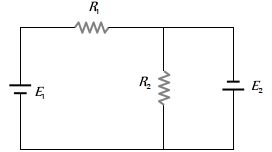
Two resistances $R_1$ and $R_2$ are joined as shown in the figure to two batteries of $\text{e.m.f}. E_1$ and $E_2$. If $E_2$ is short $-$ circuited, the current through $R_1$ isImage
Sound waves have the following frequencies that are audible to human beings
In determining the temperature of a distant star, one makes use of
The ratio of radiant energies radiated per unit surface area by two bodies is $16: 1$, the temperature of hotter body is $1000 K$, then the temperature of colder body will be
Through which mode of propagation, the radio waves can be sent from one place to another
The couple of tuning forks produces $2 $ beats in the time interval of $0.4$ seconds. So the beat frequency is
Distance of geostationary satellite from the surface of earth radius ( $R_e=6400 km$ ) in terms of $R_e$ is