MCQ
The unit of angular acceleration in the SI system is
  • A
    $N\,k{g^{ - 1}}$
  • B
    $m\,{s^{ - 2}}$
  • $rad\,{s^{ - 2}}$
  • D
    $m\,k{g^{ - 1}}K$

Answer

Correct option: C.
$rad\,{s^{ - 2}}$
c
(c) Angular acceleration $ = \frac{{{\rm{Angular velocity}}}}{{{\rm{Time}}}} = \frac{{rad}}{{{{\sec }^2}}}$

Need a full question paper?

Generate a complete, print-ready paper with questions like this in minutes — across 16+ boards, with answer keys.
Start Generating Free

Similar questions

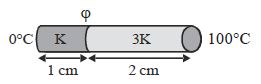
Two bars of thermal conductivities $K$ and $3K$ and lengths $1\,\, cm$ and $2\,\, cm$ respectively have equal cross-sectional area, they are joined lengths wise as shown in the figure. If the temperature at the ends of this composite bar is $0\,^oC$ and $100\,^oC$ respectively (see figure), then the temperature $\varphi $ of the interface is......... $^oC$
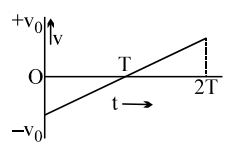
The figure shows the velocity $(v)$ of a particle plotted against time $(t)$
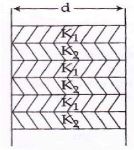
A wall consists of alternating blocks of length $d$ and coefficient of thermal conductivity $K_{1}$ and $K_{2}$ respectively as shown in figure. The cross sectional area of the blocks are the same. The equivalent coefficient of thermal conductivity of the wall between left and right is
An earth satellite is moving around the earth in a circular orbit. In such case, what is conserved?
When heat is given to a gas in an isothermal change, the result will be
$A$ small object is attached to a light string which passes through a hollow tube. The tube is held by one hand and the string by the other. The object is stet into rotation in a circle of radius $r_1$. The string is then pulled down, shortening the radius of the circle to $r_2$. The ratio of the new kinetic energy to original kinetic energy is
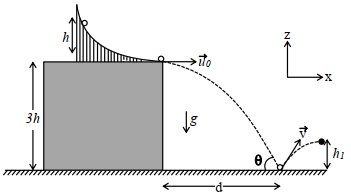
A slide with a frictionless curved surface, which becomes horizontal at its lower end,, is fixed on the terrace of a building of height $3 h$ from the ground, as shown in the figure. A spherical ball of mass $\mathrm{m}$ is released on the slide from rest at a height $h$ from the top of the terrace. The ball leaves the slide with a velocity $\vec{u}_0=u_0 \hat{x}$ and falls on the ground at a distance $d$ from the building making an angle $\theta$ with the horizontal. It bounces off with a velocity $\overrightarrow{\mathrm{v}}$ and reaches a maximum height $h_l$. The acceleration due to gravity is $g$ and the coefficient of restitution of the ground is $1 / \sqrt{3}$. Which of the following statement($s$) is(are) correct?

($AV$) $\vec{u}_0=\sqrt{2 g h} \hat{x}$ ($B$) $\vec{v}=\sqrt{2 g h}(\hat{x}-\hat{z})$  ($C$) $\theta=60^{\circ}$  ($D$) $d / h_1=2 \sqrt{3}$
The value of $g $ at a place decreases by $ 2\%.$ The barometric height of mercury
The specific heat of an ideal gas is
The coordinates of a particle moving in a plane are given by $x = a\cos (pt)$ and $y(t) = b\sin (pt)$ where $a,\,\,b\,( < a)$ and $p$ are positive constants of appropriate dimensions. Then