MCQ
The unit of inductance is
  • A
    Volt/ampere
  • B
    Joule/ampere
  • Volt-sec/ampere
  • D
    Volt-ampere/sec

Answer

Correct option: C.
Volt-sec/ampere
c
(c)$e = L\frac{{di}}{{dt}}$$ \Rightarrow L = \frac{{Volt - \sec }}{{Ampere}}$

Need a full question paper?

Generate a complete, print-ready paper with questions like this in minutes — across 16+ boards, with answer keys.
Start Generating Free

Similar questions

A $2 \mathrm{~A}$ current carrying straight metal wire of resistance $1 \Omega$, resistivity $2 \times 10^{-6} \Omega \mathrm{m}$, area of cross-section $10 \mathrm{~mm}^2$ and mass $500 \mathrm{~g}$ is suspended horizontally in mid air by applying a uniform magnetic field $\vec{B}$. The magnitude of $B$ is__________.$\times 10^{-1} \mathrm{~T}\left(\right.$ given, $\mathrm{g}=10 \mathrm{~m} / \mathrm{s}^2$ )
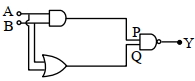
In the following logic circuit the sequence of the inputs ${A}, {B}$ are $(0,0),(0,1),(1,0)$ and $(1,1)$. The output $Y$ for this sequence will be :
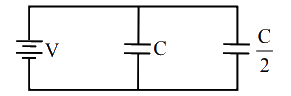
Two condensers, one of capacity $C$ and other of capacity $C/2$ are connected to a $V-$ volt battery, as shown in the figure. The work done in charging fully both the condensers is
The capacitance of an air capacitor is 15 μF the separation between the parallel plates is 6mm. A copper plate of 3mm thickness is introduced symmetrically between the plates. The capacitance now becomes
A parallel beam of white light falls on a convex lens. Images of blue, red and green light are formed on other side of the lens at distances $x$ , $y$ and $z$ respectively from the pole of the lens. Then
$A$ diminished image of an object is to be obtained on a large screen $1\, m$ from it. This can be achieved by
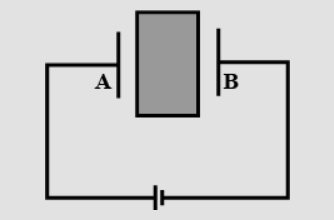
An insulator plate is passed between the plates of a capacitor. Then, current:
The focal length of a concave mirror is $50 \,cm.$ Where an object be placed so that its image is two times and inverted.......$cm$
Read the following statements:

$(A)$ Volume of the nucleus is directly proportional to the mass number.

$(B)$ Volume of the nucleus is independent of mass number.

$(C)$ Density of the nucleus is directly proportional to the mass number.

$(D)$ Density of the nucleus is directly proportional to the cube root of the mass number.

$(E)$ Density of the nucleus is independent of the mass number.

Choose the correct option from the following options.

The energy of hydrogen-atom in its ground state is $-13.6 \,eV$. The energy of the level corresponding to $n=5$ is ........ $eV$