MCQ
The unit of reduction factor of tangent galvanometer is
  • Ampere
  • B
    Gauss
  • C
    Radian
  • D
    None of these

Answer

Correct option: A.
Ampere
a
The reduction factor of tangent galvanometer is equal to current, and the unit of current is Ampere.So, the unit of reduction factor of tangent galvanometer is Ampere.

Need a full question paper?

Generate a complete, print-ready paper with questions like this in minutes — across 16+ boards, with answer keys.

Start Generating Free

Similar questions

An electromagnetic wave of wavelength $\lambda$ is incident on a photosensitive surface of negligible work function. If $m$ mass is of photoelectron emitted from the surface has de-Broglie wavelength $\lambda_{\mathrm{d}}$, then
A charged particle is suspended in equilibrium in a uniform vertical electric field of intensity 20000 V/m. If mass of the particle is $9.6 \times10^{-16} $kg ,the charge on it and excess number of electrons on the particle are respectively ($g=10m/s^2$)
On passing the current in water voltameter, the hydrogen
Beta particle An unknown particle is being studied in a magnetic field of variable intensity and direction. When the magnetic field is turned off, the particle is observed to move toward the earth. When the magnetic field is turned on, the particle is observed to continue to move toward the earth, no matter the strength or the direction of the magnetic field. Which of the particles listed below is most likely the unknown particle?
Check the incorrect statement: When a magnet is moved into a coil the strength of the current depends on:
In a $YDSE$ apparatus, we use white light then :
The frequencies of X-rays, g-rays and ultraviolet rays are respectively a, b and c. Then
A bar magnet is moved along the axis of a copper ring placed far away from the magnet. Looking from the side of the magnet, an anticlockwise current is found to be induced in the ring. Which of the following may be true
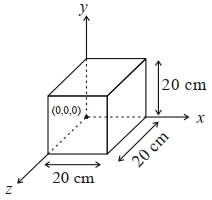
Expression for an electric field is given by $\vec{E}=4000 x^2 \hat{i} \frac{V}{m}$. The electric flux through the cube of side $20\,cm$ when placed in electric field (as shown in the figure) is $.........V cm$.
In Bohr model of the hydrogen atom, the lowest orbit corresponds to