MCQ
The unit of susceptance is.
  • A
    $\text{ohm}$
  • $\text{ohm}^{-1}$
  • C
    $\frac{\text{ohm}}{\text{cm}}$
  • D
    $\frac{\text{ohm}}{\text{m}}$

Answer

Correct option: B.
$\text{ohm}^{-1}$
Susceptance is the imaginary part of admittance.
The admittance is the inverse of impedance.
Unit of admittance is ohm. Unit of admittance is ohm$^{-1}$ or siemens.
Unit of susceptance is same as of admittance.

Need a full question paper?

Generate a complete, print-ready paper with questions like this in minutes — across 16+ boards, with answer keys.

Start Generating Free

Similar questions

How much positive and negative charge is there in a cup of water $(250\;gm)$?
Assertion : Radioactive nuclei emit ${\beta ^ - }$ particles.

Reason : Electrons exist inside the nucleus
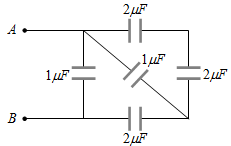
The total capacity of the system of capacitors shown in the adjoining figure between the points A and B is
An electron and a proton are at a distance of $1\,{\mathop A\limits^o }$. The moment of this dipole will be $(C × m)$
Which of the following cannot be polarized?
Find out the $e.m.f$. produced when the current changes from $0$ to $1 \,A$ in $10 \,second$, given $L = 10$ $\mu H$
A coil of wire having finite inductance and resistance has a conducting ring placed coaxially within it. The coil is connected to a battery at time $t = 0$, so that a time-dependent current ${I_1}(t)$ starts flowing through the coil. If ${I_2}(t)$ is the current induced in the ring. and $B(t)$ is the magnetic field at the axis of the coil due to ${I_1}(t),$ then as a function of time $(t > 0)$, the product $I_2$ $(t) \,B(t)$
${U^{238}}$ decays into $T{h^{234}}$ by the emission of an $\alpha - $ particle. There follows a chain of further radioactive decays, either by $\alpha - $ decay or by $\beta $ - decay. Eventually a stable nuclide is reached and after that, no further radioactive decay is possible. Which of the following stable nuclides is the and product of the ${U^{238}}$ radioactive decay chain
Two points $A$ and $B$ are situated at a distance $x$ and $2x$ respectively from the nearer pole of a magnet $2\ cm$ long. The ratio of magnetic field at $A$ and $B$ is:
Planets producing larger magnetic field have larger