MCQ
The units of modulus of rigidity are
  • A
    $N - m$
  • B
    $N/m$
  • C
    $N - {m^2}$
  • $N/{m^2}$

Answer

Correct option: D.
$N/{m^2}$
d
We know that the modulus of rigidity is defined as:

$Y =\frac{\text { Stress }}{\text { Strain }}$

Since strain is a dimensionless quantity. So its unit will be same as that of stress.

Need a full question paper?

Generate a complete, print-ready paper with questions like this in minutes — across 16+ boards, with answer keys.
Start Generating Free

Similar questions

If $r_1$ and $r_2$ are the radii of the atomic nuclei of mass number $64$ and $125$ respectively, then the ratio $(r_1/r_2)$ is
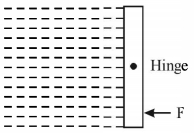
A square gate of size $1\,m \times 1\,m$ is hinged at its mid-point. A fluid of density $\rho$ fills the space to the left of the gate. The force F required to hold the gate stationary is
In 1911 , the physicist Ernest Rutherford discovered that atoms have a tiny, dense nucleus by shooting positively charged particles at a very thin gold foil. A key physical property which led Rutherford to use gold was that it was
Let $V $ and $H $ be the vertical and horizontal components of earth's magnetic field at any point on earth. Near the north pole
The magnetic flux through a coil perpendicular to its plane and directed into paper is  varying according to relation $\phi = 5t^2 + 10t + 5$ milli weber. The $e.m.f.$ induced in the  loop after $5\, sec$ is .....$volt$
A $10\, \mu F$ capacitor is fully charged to a potential difference of $50\, V$. After removing the source voltage it is connected to an uncharged capacitor in parallel. Now the potential difference across them becomes $20\, V$. The capacitance of the second capacitor is......$\mu F$
Electron volt is a unit of
If the Earth has no rotational motion, the weight of a person on the equator is $W$. Determine the speed with which the earth would have to rotate about its axis so that the person at the equator will weight $\frac{3}{4}\,W$ . Radius of the Earth is $6400\, km$ and $g = 10\, m/s^2$
A man balances himself in a horizontal position by pushing his hands and feet against two parallel walls. His centre of mass lies midway between the walls. The coefficients of friction at the walls are equal. Which of the following is not correct?
A bi-convex lens made of glass (refractive index $1.5$) is put in a liquid of refractive index $1.7.$ Its focal length will