The upper end of a wire of radius $4\, mm$ and length $100\, cm$ is clamped and its other end is twisted through an angle of $60^o$. Then angle of shear is .......... $^o$
Medium


Download our appand get started for free
Experience the future of education. Simply download our apps or reach out to us for more information. Let's shape the future of learning together!No signup needed.*
Similar Questions
- 1A wire is loaded by $6\, kg$ at its one end, the increase in length is $12\, mm.$ If the radius of the wire is doubled and all other magnitudes are unchanged, then increase in length will be ......... $mm$View Solution
- 2Consider two wires of same material having their ratio of radii to be $2: 1$. If these two wires are stretched by equal force, then the ratio of stress produced in them isView Solution
- 3A steel wire of length ' $L$ ' at $40^{\circ}\,C$ is suspended from the ceiling and then a mass ' $m$ ' is hung from its free end. The wire is cooled down from $40^{\circ}\,C$ to $30^{\circ}\,C$ to regain its original length ' $L$ '. The coefficient of linear thermal expansion of the steel is $10^{-5} { }^{\circ}\,C$, Young's modulus of steel is $10^{11}\, N /$ $m ^2$ and radius of the wire is $1\, mm$. Assume that $L \gg $ diameter of the wire. Then the value of ' $m$ ' in $kg$ is nearlyView Solution
- 4Young's moduli of the material of wires $A$ and $B$ are in the ratio of $1: 4$, while its area of cross sections are in the ratio of $1: 3$. If the same amount of load is applied to both the wires, the amount of elongation produced in the wires $A$ and $B$ will be in the ratio ofView Solution
[Assume length of wires $A$ and $B$ are same]
- 5A rod of uniform cross-sectional area $A$ and length $L$ has a weight $W$. It is suspended vertically from a fixed support. If Young's modulus for rod is $Y$, then elongation produced in rod is ......View Solution

- 6If the force constant of a wire is $K,$ the work done in increasing the length of the wire by $l$ isView Solution
- 7View SolutionThere are two wire of same material and same length while the diameter of second wire is two times the diameter of first wire, then the ratio of extension produced in the wires by applying same load will be
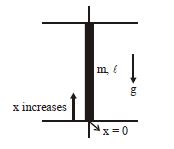
- 8A uniform dense rod with non uniform young's modulus is hanging from ceiling under gravity. If elastic energy density at every point is same then young's modulus with $x$ will change as which of the shown graphView Solution
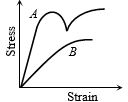
- 9The diagram shows stress v/s strain curve for the materials $A$ and $B$. From the curves we infer thatView Solution
- 10Under the same load, wire $A$ having length $5.0\,m$ and cross section $2.5 \times 10^{-5}\,m ^2$ stretches uniformly by the same amount as another wire $B$ of length $6.0\,m$ and a cross section of $3.0 \times 10^{-5}\,m ^2$ stretches. The ratio of the Young's modulus of wire $A$ to that of wire $B$ will beView Solution