The diagram shows stress v/s strain curve for the materials $A$ and $B$. From the curves we infer that
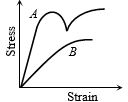
AIIMS 1987, Easy


Download our appand get started for free
Experience the future of education. Simply download our apps or reach out to us for more information. Let's shape the future of learning together!No signup needed.*
Similar Questions
- 1Two exactly similar wires of steel and copper are stretched by equal forces. If the difference in their elongations is $0.5$ cm, the elongation $(l)$ of each wire is ${Y_s}({\rm{steel}}) = 2.0 \times {10^{11}}\,N/{m^2}$${Y_c}({\rm{copper}}) = 1.2 \times {10^{11}}\,N/{m^2}$View Solution
- 2A wire is suspended by one end. At the other end a weight equivalent to $20\, N$ force is applied. If the increase in length is $1.0\, mm$, the increase in energy of the wire will be ....... $joule$View Solution
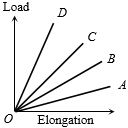
- 3View SolutionThe load versus elongation graph for four wires of the same material is shown in the figure. The thickest wire is represented by the line
- 4When a rubber ball is taken to the bottom of a sea of depth $1400 \,m$, its volume decreases by $2 \%$. The Bulk modulus of rubber ball is .................. $\times 10^8 N / m ^2$ [density of water is $1 \,g cc$ and $g=10 \,m / s ^2$ ]View Solution
- 5A cylindrical wire of radius $1\,\, mm$, length $1 m$, Young’s modulus $= 2 × 10^{11} N/m^2$, poisson’s ratio $\mu = \pi /10$ is stretched by a force of $100 N$. Its radius will becomeView Solution
- 6The Young's modulus of a wire of length $L$ and radius $r$ is $Y$. If the length is reduced to $\frac{L}{2}$ and radius is $\frac{r}{2}$ , then the Young's modulus will beView Solution
- 7In an experiment, brass and steel wires of length $1\,m$ each with areas of cross section $1\,mm^2$ are used. The wires are connected in series and one end of the combined wire is connected to a rigid support and other end is subjected to elongation. The stress requires to produced a new elongation of $0.2\,mm$ is [Given, the Young’s Modulus for steel and brass are respectively $120\times 10^9\,N/m^2$ and $60\times 10^9\,N/m^2$ ]View Solution
- 8If the potential energy of a spring is $V$ on stretching it by $2\, cm$, then its potential energy when it is stretched by $10 \,cm$ will beView Solution
- 9Two persons pull a wire towards themselves. Each person exerts a force of $200 \mathrm{~N}$ on the wire. Young's modulus of the material of wire is $1 \times 10^{11} \mathrm{~N} \mathrm{~m}^{-2}$. Original length of the wire is $2 \mathrm{~m}$ and the area of cross section is $2 \mathrm{~cm}^2$. The wire will extend in length by . . . . . . . .$\mu \mathrm{m}$.View Solution
- 10View SolutionThe possible value of Poisson's ratio is