MCQ
The value $9 \int_0^9\left[\sqrt{\frac{10 x}{x+1}}\right] d x$, where $[t]$ denotes the greatest integer less than or equal to $t$, is___________.
  • $155$
  • B
    $166$
  • C
    $444$
  • D
    $421$

Answer

Correct option: A.
$155$
a
$\frac{10 x}{x+1}=1$           $\Rightarrow x=\frac{1}{9}$

$\frac{10 x}{x+1}=4$           $\Rightarrow x=\frac{2}{3}$

$\frac{10 x}{x+1}=9$           $\Rightarrow x=9$

$\mathrm{I}=9\left(\int_0^{1 / 9} 0 \mathrm{dx}+\int_{1 / 9}^{2 / 3} 1 . \mathrm{dx}+\int_{2 / 3}^9 2 \mathrm{dx}\right)$

$=155$

Need a full question paper?

Generate a complete, print-ready paper with questions like this in minutes — across 16+ boards, with answer keys.

Start Generating Free

Similar questions

Let $I$ be the purchase value of an equipment and $V(t)$ be the value after it has been used for $ t $ years. The value $V(t)$ depreciates at a rate given by differential equation $\frac{{dV\left( t \right)}}{{dt}} = - k\left( {T - t} \right)$ where $k > 0$ is a constant and $T$ is the total life in years of the equipement. Then the scrap value  $V(T)$ of the equipment is 
The value of $\tan\Big(\cos^{-1}\frac{3}{5}+\tan^{-1}\frac{1}{4}\Big)=$
If $R =\left\{(x, y): x, y \in Z , x^2+y^2 \leq 4\right\}$ is a relation in Z then domain of R is :
Let $y=y(x)$ be the solution of the differential equation $(x+1) y^{\prime}-y=e^{3 x}(x+1)^{2}$, with $y(0)=\frac{1}{3}$. Then, the point $x=-\frac{4}{3}$ for the curve $y = y ( x )$ is
The function ${x^5} - 5{x^4} + 5{x^3} - 10$  has a maximum, when $x =$
Identify the statement(s) which is/are True.
$\int\frac{1}{1+\tan\text{x}}\text{ dx}=$
Let $f:(0, \infty) \rightarrow R$ be given by $f(x)=\int_{\frac{1}{x}}^x e^{-\left(t+\frac{1}{t}\right)} \frac{d t}{t}$. Then

$(A)$ $f(x)$ is monotonically increasing on $[1, \infty)$

$(B)$ $f(x)$ is monotonically decreasing on $(0,1)$

$(C)$ $f(x)+f\left(\frac{1}{x}\right)=0$, for all $x \in(0, \infty)$

$(D)$ $f\left(2^x\right)$ is an odd function of $x$ on $R$
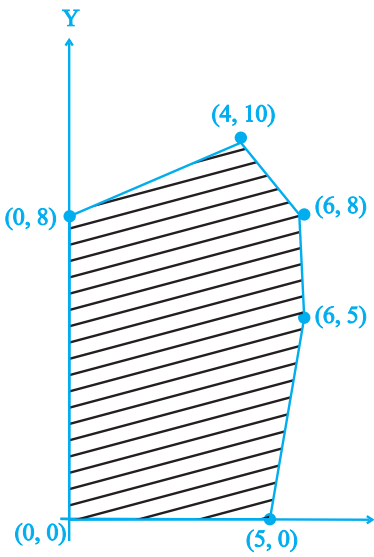
Choose the correct answer from the given four options. The feasible solution for a $\text{LPP}$ is shown in. Let $Z = 3x - 4y$ be the objective function. Maximum of $Z$ occurs at :
The value of the function $(x - 1){(x - 2)^2}$ at its maxima is