The value of electric potential at any point due to any electric dipole is
Easy


Download our appand get started for free
Experience the future of education. Simply download our apps or reach out to us for more information. Let's shape the future of learning together!No signup needed.*
Similar Questions
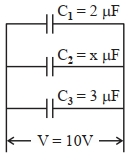
- 1In the given figure the total charge stored in the combination of capacitors is $100\,\mu C$. The value of ' $x$ ' is $............$.View Solution
- 2The electric field between the plates of a parallel plate capacitor when connected to a certain battery is ${E_0}$. If the space between the plates of the capacitor is filled by introducing a material of dielectric constant $K$ without disturbing the battery connections, the field between the plates shall beView Solution
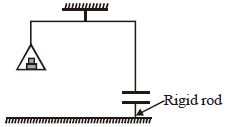
- 3The lower plate of a parallel plate capacitor is supported on a rigid rod. The upper plate is suspended from one end of a balance. The two plates are joined together by a thin wire and subsequently disconnected. The balance is then counterpoised. Now a voltage $V = 5000\, volt$ is applied between the plates. The distance between the plates is $d =5\, mm$ and the area of each plate is $A = 100 cm^2.$ Then find out the additional mass placed to maintain balance.......$g$ [All the elements other than plates are massless and nonconducting] :-View Solution
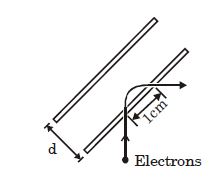
- 4A problem of practical interest is to make a beam of electrons turn at $90^o$ corner. This can be done with the electric field present between the parallel plates as shown in the figure. An electron with kinetic energy $8.0 × 10^{-17}\ J$ enters through a small hole in the bottom plate. The strength of electric field that is needed if the electron is to emerge from an exit hole $1.0\ cm$ away from the entrance hole, traveling at right angles to its original direction is $y × 10^5\ N/C$ . The value of $y$ isView Solution
- 5How will the voltage $(V)$ between the two plates of a parallel plate capacitor depend on the distance $(d)$ between the plates, if the charge on the capacitor remains the same?View Solution
- 6A condenser of capacity ${C_1}$ is charged to a potential ${V_0}$. The electrostatic energy stored in it is ${U_0}$. It is connected to another uncharged condenser of capacity ${C_2}$ in parallel. The energy dissipated in the process isView Solution
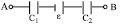
- 7A circuit shown in the figure consists of a battery of $emf$ $10$ $V$ and two capacitance $C_1$ and $C_2 $ of capacitances $1.0$ $ \mu F$ and $2.0$ $\mu F$ respectively. The potential difference $V_A - V_B$ is $5\,V$View Solution
- 8Consider a sphere of radius $R$ with uniform charge density and total charge $Q$. The electrostatic potential distribution inside the sphere is given by $\theta_{(r)}=\frac{Q}{4 \pi \varepsilon_{0} R}\left(a+b(r / R)^{C}\right)$. Note that the zero of potential is at infinity. The values of $(a, b, c)$ areView Solution
- 9A point charge $2 \times 10^{-2}\,C$ is moved from $P$ to $S$ in a uniform electric field of $30\,NC ^{-1}$ directed along positive $x$-axis. If coordinates of $P$ and $S$ are $(1,2$, $0) m$ and $(0,0,0) m$ respectively, the work done by electric field will be $.........\,mJ$View Solution
- 10Two identical thin metal plates has charge $q _{1}$ and $q _{2}$ respectively such that $q _{1}> q _{2}$. The plates were brought close to each other to form a parallel plate capacitor of capacitance $C$. The potential difference between them is.View Solution