A condenser of capacity ${C_1}$ is charged to a potential ${V_0}$. The electrostatic energy stored in it is ${U_0}$. It is connected to another uncharged condenser of capacity ${C_2}$ in parallel. The energy dissipated in the process is
Diffcult


Download our appand get started for free
Experience the future of education. Simply download our apps or reach out to us for more information. Let's shape the future of learning together!No signup needed.*
Similar Questions
- 1A $30\,\mu F$ capacitor is charged by a constant current of $30\, mA$. If the capacitor is initially uncharged, how long does it take for the potential difference to reach $400\, V$.....$s$View Solution
- 2Two point charges $100\,\mu \,C$ and $5\,\mu \,C$ are placed at points $A$ and $B$ respectively with $AB = 40\,cm$. The work done by external force in displacing the charge $5\,\mu \,C$ from $B$ to $C$, where $BC = 30\,cm$, angle $ABC = \frac{\pi }{2}$ and $\frac{1}{{4\pi {\varepsilon _0}}} = 9 \times {10^9}\,N{m^2}/{C^2}$.........$J$View Solution
- 3Which of the following statement$(s)$ is/are correct?View Solution
$(A)$ If the electric field due to a point charge varies as $r^{-25}$ instead of $r^{-2}$, then the Gauss law will still be valid.
$(B)$ The Gauss law can be used to calculate the field distribution around an electric dipole.
$(C)$ If the electric field between two point charges is zero somewhere, then the sign of the two charges is the same.
$(D)$ The work done by the external force in moving a unit positive charge from point $A$ at potential $V_A$ to point $B$ at potential $V_B$ is $\left(V_B-V_A\right)$.
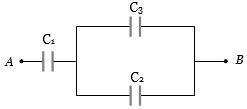
- 4The combination of capacitors with ${C_1} = 3\,\mu \,F,\,{C_2} = 4\,\mu \,F$ and ${C_3} = 2\,\mu \,F$ is charged by connecting $AB$ to a battery. Consider the following statementsView Solution
$I.$ Energy stored in ${C_1}$ $=$ Energy stored in ${C_2}$ $+$ Energy stored in ${C_3}$
$II.$ Charge on ${C_1}$ $=$ Charge on ${C_2}$ $+$ Charge on ${C_3}$
$III.$ Potential drop across ${C_1}$ $=$ Potential drop across ${C_2}$ $=$ Potential drop across ${C_3}$
Which of these is/are correct
- 5View SolutionOn increasing the plate separation of a charged condenser, the energy
- 6The radii of the inner and outer spheres of a condenser are $9\,cm$ and $10\,cm$ respectively. If the dielectric constant of the medium between the two spheres is $6$ and charge on the inner sphere is $18 \times {10^{ - 9}}\;coulomb$, then the potential of inner sphere will be, if the outer sphere is earthed........$volts$View Solution
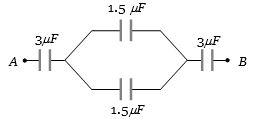
- 7The capacitance between the points $A$ and $B$ in the given circuit will be.......$\mu \,F$View Solution
- 8Two small equal point charges of magnitude $q$ are suspended from a common point on the ceiling by insulating mass less strings of equal lengths. They come to equilibrium with each string making angle $\theta $ from the vertical. If the mass of each charge is $m,$ then the electrostatic potential at the centre of line joining them will be $\left( {\frac{1}{{4\pi { \in _0}}} = k} \right).$View Solution
- 9View SolutionA conductor with a positive charge
- 10At a certain distance from a point charge, the field intensity is $500\, Vm^{-1}$ and the potential is $-3000\, V$. The distance to the charge and the magnitude of the charge respectively areView Solution