MCQ
The value of $\int\limits_{ - \pi /2}^{\pi /2} {\frac{{{{\sin }^2}\,x}}{{1 + {2^x}}}dx} $ is
  • A
    $ \pi $
  • B
    $\frac{\pi}{2}$
  • C
    $4 \pi $
  • $\frac{\pi}{4}$

Answer

Correct option: D.
$\frac{\pi}{4}$
d
(d) $I = \int\limits_{\pi /2}^{\pi /2} {\frac{{{{\sin }^2}x}}{{1 + {2^x}}}dx} $ $......(1)$

$ \Rightarrow I = \int\limits_{ - \pi /2}^{\pi /2} {\frac{{{{\sin }^2}x}}{{1 - {2^{ - x}}}}dx} $ by replacing $x$ by

$\left(\frac{\pi}{2}-\frac{\pi}{2}-x\right)$

$ \Rightarrow I = \int\limits_{ - \pi /2}^{\pi /2} {\frac{{{2^x}.{{\sin }^2}x}}{{1 + {2^x}}}dx} $

Adding equations $(i)$ and $(ii),$ we get

$2I = \int\limits_{ - \pi /2}^{\pi /2} {{{\sin }^2}xdx} $

$ = \frac{1}{2}\int\limits_{ - \pi /2}^{\pi /2} {\left( {1 - \cos 2x} \right)dx} $

$\Rightarrow \quad \mathrm{I}=\frac{1}{4}\left[x+\frac{\sin 2 x}{2}\right]_{-\pi / 2}^{\pi / 2}$

$=\frac{1}{4}\left[\left(\frac{\pi}{2}+\frac{\sin \pi}{2}\right)-\left(-\frac{\pi}{2}+\frac{\sin (-\pi)}{2}\right)\right]$

$\Rightarrow \quad 1=\frac{1}{4}\left[\frac{\pi}{2}+\frac{\pi}{2}\right]=\frac{\pi}{4}$

Need a full question paper?

Generate a complete, print-ready paper with questions like this in minutes — across 16+ boards, with answer keys.

Start Generating Free

Similar questions

If $R$ be a relation $<$ from $A = \{1,2, 3, 4\}$ to $B = \{1, 3, 5\}$ i.e., $(a,\,b) \in R \Leftrightarrow a < b,$ then $Ro{R^{ - 1}}$ is
Let $y=y(x)$ be the solution of the differential equation

$\frac{d y}{d x}=1+x e^{y-x},-\sqrt{2}\,<\,x\,<\,\sqrt{2}, y (0)=0$ then, the minimum value of $y(x)$ , $\mathrm{x} \in(-\sqrt{2}, \sqrt{2})$ is equal to:

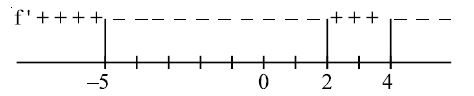
 $(i)$  $f (x)$ is continuous and defined for all real numbers

$(ii)$ $f '(-5) = 0 \,; \,f '(2)$ is not defined and $f '(4)  = 0$

$(iii)$ $(-5, 12)$ is a point which lies on the graph of $f (x)$

$(iv)$ $f ''(2)$ is undefined, but $f ''(x)$ is negative everywhere else.

$(v)$ the signs of  $f '(x)$ is given below

Possible graph of $y = f (x)$ is
$A (2,6,2), B (-4,0, \lambda), C (2,3,-1)$ and $D (4,5,0)$, $|\lambda| \leq 5$ are the vertices of a quadrilateral $A B C D$. If its area is $18$ square units, then $5-6 \lambda$ is equal to $.........$.
If $u, v$  and $w$  are three non-coplanar vectors, then $(u + v - w)\,.\,[(u - v) \times (v - w)]$ equals
If $f(x)$ be such that $f(x) = max (|2-x|, 2-x^3), x \in R$
In a box containing $100$ bulbs, $10$ are defective. The probability that out of a sample of $5$ bulbs, none is defective is
The co-ordinates of a point $P$ are $(3, 12, 4)$ with respect to origin $O$, then the direction cosines of $OP$ are
If $a, b, c$ are non-zero real numbers and if the system of equations $(a - 1 )x = y + z,$  $(b - 1 )y = z + x ,$ $(c - 1 )z= x + y,$ has a non-trivial solution, then $ab + bc + ca$ equals
If $tan^{-1 } \frac{1}{1+2}+tan^{-1 } \frac{1}{1+(2)(3)}+ tan^{-1 }\frac{1}{1+(3)(4)}+$ ......$tan^{-1}\frac{1}{{1 + n(n + 1)}}=tan^{-1} \theta,$ then $\theta$ =