MCQ
The value of $\int(x+3)(x+2) d x$ is:
  • $\frac{x^3}{3}+\frac{5 x^2}{2}+2 x+C$
  • B
    $x^3+\frac{5}{2} x^2+x+C$
  • C
    $\frac{x^3}{3}+\frac{x^2}{2}+2 x+C$
  • D
    $\frac{x^3}{3}+\frac{x^2}{2}+x+C$

Answer

Correct option: A.
$\frac{x^3}{3}+\frac{5 x^2}{2}+2 x+C$
(A) $x^3+\frac{5}{2} x^2+x+C$
Explanation: Let
$\begin{aligned} I & =\int(x+3)(x+2) d x \\ & =\int\left(x^2+5 x+2\right) d x \\ & =\int x^2 d x+5 \int x d x+2 \int d x \\ & =\frac{x^3}{3}+\frac{5 x^2}{2}+2 x+C\end{aligned}$

Need a full question paper?

Generate a complete, print-ready paper with questions like this in minutes — across 16+ boards, with answer keys.

Start Generating Free

Similar questions

An observed set of the population that has been selected for analysis is called
A box contains 20 identical balls of which 10 balls are white and 10 balls are red. The balls are drawn at random from the box one at a time with replacement. The probability that a white ball is drawn for the 4th time on the 7th draw is
Which of the term is not used in a linear programming problem:
The following are the movement(s) in the secular trend.
A team played 40 games in a season and won in 24 of them. What percent of games played did the team win?
Let X be a discrete random variable whose probability distribution is given below:
$X=x_i$01234567
$P\left(X=x_i\right)$02K2K3K$K^2$2$K^2$7$K^2$2K
The value of K is:
In a large consignment of electric bulbs 5% of a batch of batteries are defective. A random sample of 80 is taken for inspection with replacement. Then the Variance of the number of defectives in the sample, is
A machine makes car wheels and in a random sample of 26 wheels, the test statistic is found to be 3.07. As per tdistribution test (of 5% level of significance), what can you say about the quality of wheels produced by the machine? (Use $\left.t_{25}(0.05)=2.06\right)$
A specific characteristics of a sample is known as _________
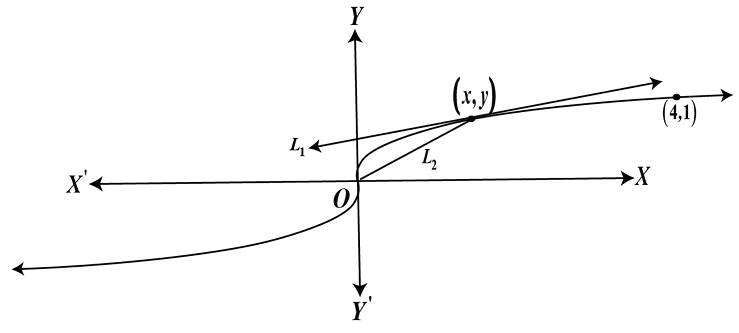
Shown below is a curve.


Image
$L_1$ is the tangent to any point $(x, y)$ on the curve.
$L_2$ is the line that connects the point $(x, y)$ to the origin.
The slope of $L_1$ is one third of the slope of $L_2$.
Then the differential equation, using the given conditions is: