Questions

MCQ

🎯

Test yourself on this topic

15 questions · timed · auto-graded

MCQ 11 Mark
If the supply function for a commodity is p = 4 + x and 12 units of goods are sold, then the producer's surplus is given by:
  • A
    70
  • 72
  • C
    12
  • D
    48
Answer
Correct option: B.
72
(B) 72
Explanation: Given, the supply function is
p = 4 + x .....(i)
and the market demand $x_0=12$.
At equilibrium, $p_0=4+x_0$
Substituting this value of $x_0$ in (i), we get
$p_0=4+12$
$\Rightarrow \quad p_0=16$
So, Producer's Surplus
$\begin{array}{l}=12 \times 16-\int_0^{12}(4+x) d x \\ =192-\left[4 x+\frac{x^2}{2}\right]_0^{12} \\ =192-(48+72)+0 \\ =192-120 \\ =72\end{array}$
View full question & answer
MCQ 21 Mark
If the demand function for a commodity is $p=35-2 x-x^2$ Then the consumer's surplus at equilibrium price $p_0=20$ is given by:
  • A
    20
  • 27
  • C
    25
  • D
    35
Answer
Correct option: B.
27
(B) 27
Explanation: Given, the demand function is
$p=35-2 x-x^2$ .....(i)
and the equilibrium price, $p_0=20$
Note: At equilibrium demand function is
$p_0=35-2 x_0-x_0^2$
Substituting this value of $p_0$ in (i), we get
$20=35-2 x_0-x_0^2$
$\Rightarrow \quad x_0^2+2 x_0-15=0$
$\begin{array}{lr}\Rightarrow & \left(x_0+5\right)\left(x_0-3\right)=0 \\ \Rightarrow & x_0=-5, \text { or } x_0=3 \\ \because & x_0 \neq-5, \text { so } x_0=3\end{array}$
So, consumer's Surplus
$\begin{array}{l}=\int_0^3\left(35-2 x-x^2\right) d x-3 \times 20 \\ =\left[35 x-x^2-\frac{x^3}{3}\right]_0^3-60 \\ =(105-9-9)-60 \\ =27\end{array}$
View full question & answer
MCQ 31 Mark
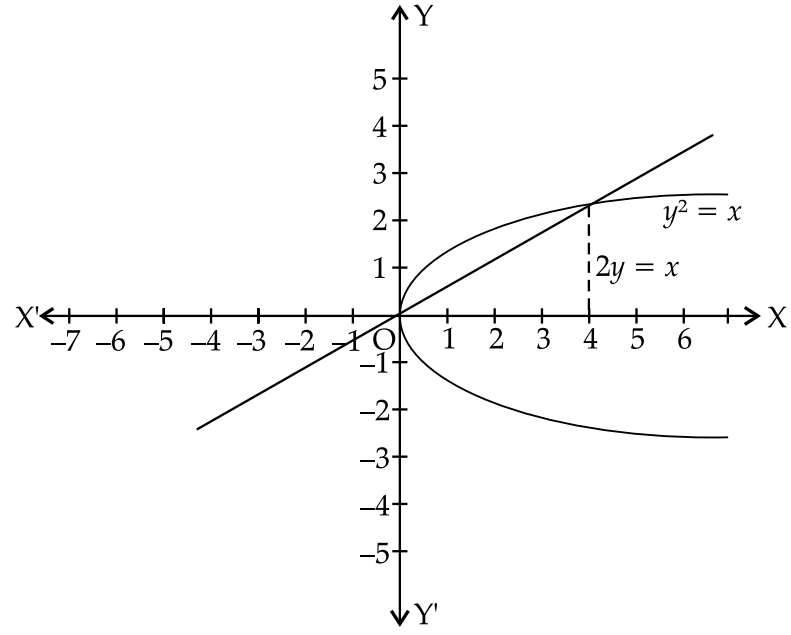
The area of the region bounded by parabola $y^2=x$and the straight line 2y = x is:
  • A
    $\frac{4}{3}$ sq. units
  • B
    1 sq. units
  • C
    $\frac{2}{3}$ sq. units
  • D
    $\frac{1}{3}$ sq. units
View full question & answer
MCQ 41 Mark
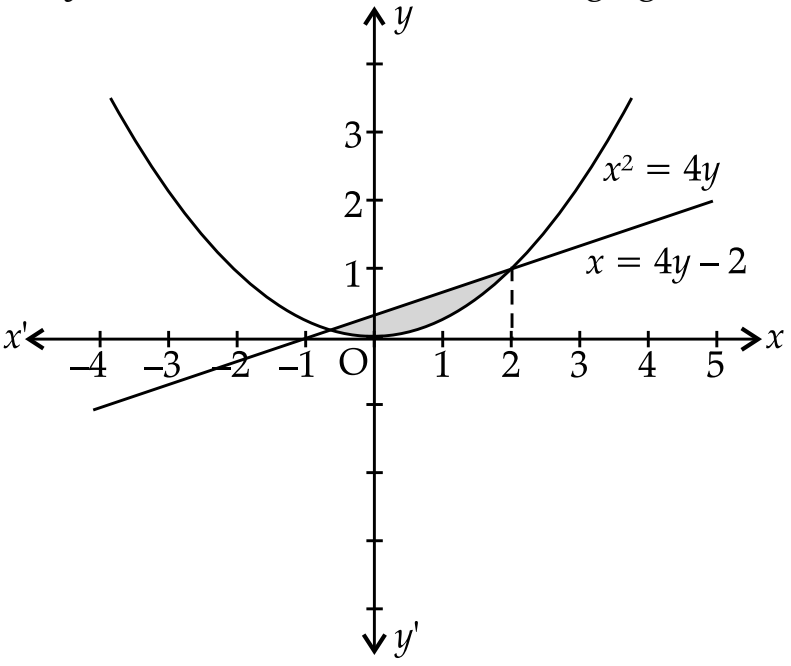
The area of the region bounded by the curve $x^2=4 y$ and the straight-line $x=4 y-2$ is:
  • A
    $\frac{3}{8}$ sq. units
  • B
    $\frac{5}{8}$ sq. units
  • C
    $\frac{7}{8}$ sq. units
  • $\frac{9}{8}$ sq. units
Answer
Correct option: D.
$\frac{9}{8}$ sq. units
(D) $\frac{9}{8}$ sq. units
Explanation: $x^2=x+2$
$x^2-x-2=0$
(x - 2)(x + 1) = 0
x = - 1, 2
For $x=-1, y=\frac{1}{4}$ and for $x=2, y=1$
Points of intersection are $\left(-1, \frac{1}{4}\right)$ and $(2,1)$.
Graphs of parabola $x^2=4 y$ and the straight line $x=4 y-2$ are shown in the following figure:
Image
$\begin{array}{l} A =\int_{-1}^2\left[\frac{x+2}{4}-\frac{x^2}{4}\right]^2 d x \\ =\frac{1}{4}\left[\frac{x^2}{2}+2 x-\frac{x^3}{3}\right]_{-1}^2 \\ =\frac{1}{4}\left[\frac{2^2}{2}+2 \times 2-\frac{2^3}{3}-\frac{(-1)^2}{2}-2 \times(-1)+\frac{(-1)^3}{3}\right] \\ =\frac{1}{4}\left[6-\frac{8}{3}-\frac{1}{2}+2-\frac{1}{3}\right] \\ =\frac{1}{4}\left[8-3-\frac{1}{2}\right] \\ =\frac{9}{8} \text { sq. units }\end{array}$
View full question & answer
MCQ 51 Mark
Find the value of $\int_1^4|x-5| d x$.
  • A
    2
  • $\frac{15}{2}$
  • C
    $\frac{2}{15}$
  • D
    15
Answer
Correct option: B.
$\frac{15}{2}$
(B)$\frac{15}{2}$
$\int_1^4|x-5| d x=\int_1^4-(x-5) d x$
$=-\frac{1}{2}\left[(x-5)^2\right]_1^4$
$\int_1^4|x-5| d x=-\frac{1}{2}[1-16]=\frac{15}{2}$
View full question & answer
MCQ 61 Mark
If $f(a+b-x)=f(x)$, then $\int_a^b x f(x) d x$ is equal to
  • A
    $\frac{a+b}{2} \int_a^b f(b-x) d x$
  • B
    $\frac{a+b}{2} \int_a^b f(b+x) d x$
  • C
    $\frac{b-a}{2} \int_a^b f(x) d x$
  • $\frac{a+b}{2} \int_a^b f(x) d x$
Answer
Correct option: D.
$\frac{a+b}{2} \int_a^b f(x) d x$
(D) $\frac{a+b}{2} \int_a^b f(x) d x$
Let, $I=\int_a^b x f(x) d x$ ....(i)
$I=\int_a^b(a+b-x) f(a+b-x) d x$ $\left[\because \int_a^b f(x) d x=\int_a^b f(a+b-x) d x\right]$
$\begin{array}{ll}\Rightarrow & I=\int_a^b(a+b-x) f(x) d x \\ \Rightarrow & I=(a+b) \int_a^b f(x) d x-I \quad \text { [Using Eq. (i)] }\end{array}$
$\begin{aligned} \Rightarrow & I+I & =(a+b) \int_a^b f(x) d x \\ \Rightarrow & 2 I & =(a+b) \int_a^b f(x) d x\end{aligned}$
$\Rightarrow \quad I=\left(\frac{a+b}{2}\right) \int_a^b f(x) d x$
View full question & answer
MCQ 71 Mark
The value of: $\int_{-1}^1 x^2 \sqrt{x^3+1} d x$ is:
  • A
    $\frac{4}{9}$
  • B
    $\frac{4 \sqrt{2}}{3}$
  • $\frac{4 \sqrt{2}}{9}$
  • D
    $-\frac{4}{9}$
Answer
Correct option: C.
$\frac{4 \sqrt{2}}{9}$
(C) $\frac{4 \sqrt{2}}{9}$
Let, $I=\int_{-1}^1 x^2 \sqrt{x^3+1} d x$
Let $x^3+1=t \Rightarrow 3 x^2 d x=d t \Rightarrow x^2 d x=\frac{d t}{3}$
Also, when $x=-1, t=0$ and when $x=1, t=2$
$=\frac{1}{3}\left[\frac{t^{3 / 2}}{3 / 2}\right]_0^2$
$=\frac{2}{9}\left[2^{3 / 2}-0\right]$
$=\frac{4 \sqrt{2}}{9}$
View full question & answer
MCQ 81 Mark
The value of: $\int_0^1 \frac{1}{\sqrt{1+x^2}} d x$ is:
  • A
    $\log \sqrt{2}$
  • $\log (1+\sqrt{2})$
  • C
    $\log (1-\sqrt{2})$
  • D
    $\frac{1}{\log (1+\sqrt{2})}$
Answer
Correct option: B.
$\log (1+\sqrt{2})$
(B) $\log (1+\sqrt{2})$
$\int_0^1 \frac{1}{\sqrt{1+x^2}} d x=\log \left|x+\sqrt{1+x^2}\right|_0^1$
$=\log \left|1+\sqrt{1+1^2}\right|-\log |0+\sqrt{1+0}|$
$=\log (1+\sqrt{2})-\log 1$
$=\log (1+\sqrt{2}) \quad[\because \log 1=0]$
View full question & answer
MCQ 91 Mark
$\int e^x\left(\frac{1-x}{1+x^2}\right)^2 d x$ is equal to:
  • $\frac{e^x}{1+x^2}+C$
  • B
    $\frac{-e^x}{1+x^2}+C$
  • C
    $\frac{e^x}{\left(1+x^2\right)^2}+C$
  • D
    $\frac{-e^x}{\left(1+x^2\right)^2}+C$
Answer
Correct option: A.
$\frac{e^x}{1+x^2}+C$
(A) $\frac{e^x}{1+x^2}+C$
$\begin{aligned} \int e^x\left(\frac{1-x}{1+x^2}\right)^2 d x & =\int e^x \frac{1+x^2-2 x}{\left(1+x^2\right)^2} d x \\ & =\int e^x\left[\frac{1}{\left(1+x^2\right)}-\frac{2 x}{\left(1+x^2\right)^2}\right] d x \\ & =\int e^x\left[f(x)+f^{\prime}(x)\right] d x,\end{aligned}$
[where $f(x)=\frac{1}{1+x^2}$ ]
$\begin{array}{l}=e^x f(x)+C \\ =\frac{e^x}{1+x^2}+C\end{array}$

View full question & answer
MCQ 101 Mark
$\int x^2 e^{x^3} d x$ is equal to:
  • $\frac{1}{3} e^{x^3}+C$
  • B
    $\frac{1}{3} e^{x^2}+C$
  • C
    $\frac{1}{2} e^{x^3}+C$
  • D
    $\frac{1}{2} e^{x^2}+C$
Answer
Correct option: A.
$\frac{1}{3} e^{x^3}+C$
(A) $\frac{1}{3} e^{x^3}+C$
Explanation:
Let, $I=\int x^2 e^{x^3} d x$
Also, let $x^3=t$
$\Rightarrow \quad 3 x^2 d x=d t$
$\Rightarrow \quad I=\frac{1}{3} \int e^t d t$
$\begin{array}{l}=\frac{1}{3}\left(e^t\right)+C \\ =\frac{1}{3} e^{x^3}+C\end{array}$
View full question & answer
MCQ 111 Mark
$\int \sqrt{1+x^2} d x$ is equal to:
  • $\frac{x}{2} \sqrt{1+x^2}+\frac{1}{2} \log \left|\left(x+\sqrt{1+x^2}\right)\right|+C$
  • B
    $\frac{2}{3}\left(1+x^2\right)^{3 / 2}+C$
  • C
    $\frac{2}{3} x\left(1+x^2\right)^{3 / 2}+C$
  • D
    $\frac{x^2}{2} \sqrt{1+x^2}+\frac{1}{2} x^2 \log \left(x+\sqrt{1+x^2}\right)+C$
Answer
Correct option: A.
$\frac{x}{2} \sqrt{1+x^2}+\frac{1}{2} \log \left|\left(x+\sqrt{1+x^2}\right)\right|+C$
(A) $\frac{x}{2} \sqrt{1+x^2}+\frac{1}{2} \log \left|\left(x+\sqrt{1+x^2}\right)\right|+C$
Explanation: It is known that,
$\begin{array}{l}\int \sqrt{a^2+x^2} d x=\frac{x}{2} \sqrt{a^2+x^2}+\frac{a^2}{2} \log \left|x+\sqrt{x^2+a^2}\right|+C \\ \therefore \int \sqrt{1+x^2} d x=\frac{x}{2} \sqrt{1+x^2}+\frac{1}{2} \log \left|x+\sqrt{1+x^2}\right|+C\end{array}$
View full question & answer
MCQ 121 Mark
The value of $3^{3^x} 3^x d x$ is:
  • $\frac{3^{3^x}}{(\log 3)^2}+C$
  • B
    $\frac{3^x}{(\log 3)^2}+C$
  • C
    $\frac{3^{3 x}}{\log 3}+C$
  • D
    $\frac{3^{3 x}}{\log 3^x}+C$
Answer
Correct option: A.
$\frac{3^{3^x}}{(\log 3)^2}+C$
(A) $\frac{3^{3^x}}{(\log 3)^2}+C$
Explanation: Let $I=\equiv^{3^x} 3^x d x$\
Put, $3^x=t$
$\Rightarrow \quad 3^x \log 3 d x=d t$
$\therefore \quad I=3^t \frac{d t}{\log 3}$
$\begin{array}{l}=\frac{1}{\log 3} 3^t d t \\ =\frac{1}{\log 3}\left(\frac{3^t}{\log 3}\right)+C \\ =\frac{3^{3^x}}{(\log 3)^2}+C\end{array}$
View full question & answer
MCQ 131 Mark
The value of$\int\left[a^x+a^{-x}\right]^2 d x$ is:
  • A
    $\frac{a^x}{2}+\frac{a^{-x}}{2}+2 x+C$
  • B
    $\frac{a^{2 x}}{2}+\frac{a^{-2 x}}{2}+2 x+C$
  • $\frac{a^{2 x}}{2 \log a}-\frac{a^{-2 x}}{2 \log a}+2 x+C$
  • D
    $2 \frac{a^x}{\log a}-\frac{a^{-x}}{2 \log a}+2 x+C$
Answer
Correct option: C.
$\frac{a^{2 x}}{2 \log a}-\frac{a^{-2 x}}{2 \log a}+2 x+C$
(C) $\frac{a^{2 x}}{2 \log a}-\frac{a^{-2 x}}{2 \log a}+2 x+C$
$\begin{aligned} I & =\int\left[a^x+a^{-x}\right]^2 d x \\ & =\int\left(a^{2 x}+a^{-2 x}+2 a^x a^{-x}\right) d x \\ & =\int\left(a^{2 x}+a^{-2 x}+2\right) d x \\ & =\frac{a^{2 x}}{2 \log a}+\frac{a^{-2 x}}{-2 \log a}+2 x+C \\ & =\frac{a^{2 x}}{2 \log a}-\frac{a^{-2 x}}{2 \log a}+2 x+C\end{aligned}$
View full question & answer
MCQ 141 Mark
The value of $\int\left[\sqrt{x}+\frac{1}{\sqrt{x}}\right]^2 d x$ is
  • A
    $x^2-2 x+\log |x|+C$
  • $\frac{x^2}{2}+2 x+\log |x|+C$
  • C
    $x^2+2 x-\log |x|+C$
  • D
    $x^2-x+\log |x|+C$
Answer
Correct option: B.
$\frac{x^2}{2}+2 x+\log |x|+C$
(B) $\frac{x^2}{2}+2 x+\log |x|+C$
$\begin{aligned} I & =\int\left[\sqrt{x}+\frac{1}{\sqrt{x}}\right]^2 d x \\ & =\int\left(x+\frac{1}{x}+2\right) d x \\ & =\int x d x+\int \frac{1}{x} d x+2 \int d x \\ & =\frac{x^2}{2}+\log |x|+2 x+C\end{aligned}$
View full question & answer
MCQ 151 Mark
The value of $\int(x+3)(x+2) d x$ is:
  • $\frac{x^3}{3}+\frac{5 x^2}{2}+2 x+C$
  • B
    $x^3+\frac{5}{2} x^2+x+C$
  • C
    $\frac{x^3}{3}+\frac{x^2}{2}+2 x+C$
  • D
    $\frac{x^3}{3}+\frac{x^2}{2}+x+C$
Answer
Correct option: A.
$\frac{x^3}{3}+\frac{5 x^2}{2}+2 x+C$
(A) $x^3+\frac{5}{2} x^2+x+C$
Explanation: Let
$\begin{aligned} I & =\int(x+3)(x+2) d x \\ & =\int\left(x^2+5 x+2\right) d x \\ & =\int x^2 d x+5 \int x d x+2 \int d x \\ & =\frac{x^3}{3}+\frac{5 x^2}{2}+2 x+C\end{aligned}$
View full question & answer
MCQ - Applied Maths STD 12 Science Questions - Vidyadip