MCQ
The value of $k$ so that the function $f(x) = \left\{ \begin{array}{l}k(2x - {x^2}),\;\;\;{\rm{when\,}}\,x < 0\\\,\,\,\,\,\,\,\,\,\cos x,\,\,\,\,\,\,{\rm{when\,}}\,x \ge {\rm{0}}\end{array} \right.$ is continuous at $x = 0$, is
  • A
    $1$
  • B
    $2$
  • C
    $4$
  • None of these

Answer

Correct option: D.
None of these
d
(d) $f(0 - ) = \mathop {\lim }\limits_{x \to 0 - } \,k(2x - {x^2}) = 0$; 

$f(0 + ) = \mathop {\lim }\limits_{x \to 0 + } \,\cos x = 1$

$\therefore \,\,\,f(0) = \cos x = 1$

Hence no value of $k$ can make $f(0 - ) = 1.$

Need a full question paper?

Generate a complete, print-ready paper with questions like this in minutes — across 16+ boards, with answer keys.

Start Generating Free

Similar questions

Which of the following functions cannot have their inverse defined ? (where $[.]\, \to$ greatest integer function)
$\left| {\begin{array}{*{20}{c}}{1 + {{\sin }^2}\theta }&{{{\sin }^2}\theta }&{{{\sin }^2}\theta }\\{{{\cos }^2}\theta }&{1 + {{\cos }^2}\theta }&{{{\cos }^2}\theta }\\{4\sin 4\theta }&{4\sin 4\theta }&{1 + 4\sin 4\theta }\end{array}} \right| = 0$ then $\sin \,4\theta $ equal to
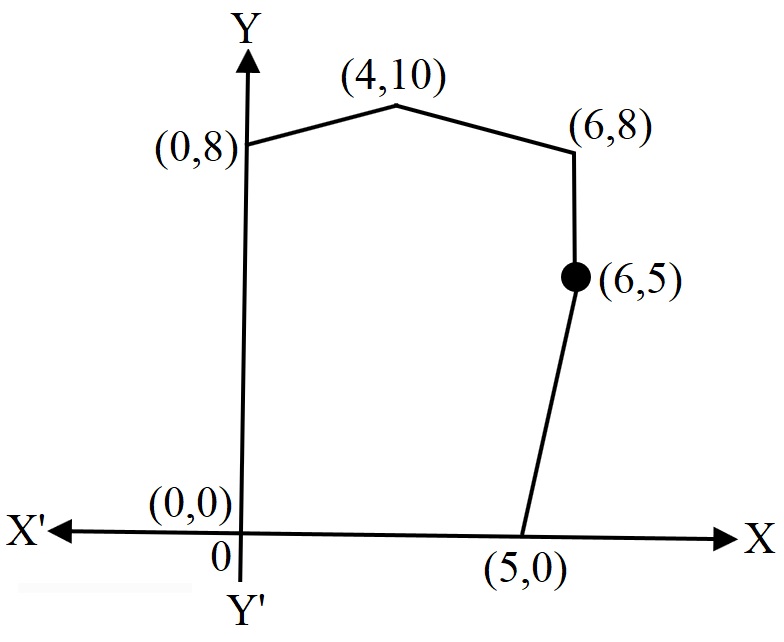
The feasible solution for a LPP is shown in the following figure. Let Z = 3x - 4y be the objective function.

Minimum of Z occurs at:

  1. (0, 0)
  2. (0, 8)
  3. (5, 0)
  4. (4, 10)
The length of the side of a square sheet of metal is increasing  at the rate of $4cm/\sec $. The rate at which the area of the sheet is increasing when the length of its side is $2\, cm$, is ........ $c{m^2}/\sec $.
${d \over {dx}}{e^{x\sin x}} = $
If  $A$  is involutory matrix and $ I$  is unit matrix of same order, then $(I - A)(I + A)$ is
If a line makes angles $\alpha,\beta,\gamma,\delta$ with four diagonals of a cube, then $\cos^2\alpha+\cos^2\beta+\cos^2\gamma+\cos^2\delta$ is equal to:
Let a line passing through the point $(-1,2,3)$ intersect the lines $L_1: \frac{x-1}{3}=\frac{y-2}{2}=\frac{z+1}{-2}$ at $\mathrm{M}(\alpha, \beta, \gamma)$ and $\mathrm{L}_2: \frac{\mathrm{x}+2}{-3}=\frac{\mathrm{y}-2}{-2}=\frac{\mathrm{z}-1}{4}$ at $\mathrm{N}(\mathrm{a}, \mathrm{b}$, c). Then the value of $\frac{(\alpha+\beta+\gamma)^2}{(a+b+c)^2}$ equals
For any real number $\mathrm{x}$, let $|\mathrm{x}|$ denote the largest integer less than or equal to $\mathrm{x}$. Let $\mathrm{f}$ be a real valued function defined on the interval $[-10,10]$ by

$f(x)=\left\{\begin{array}{cc}x-[x] & \text { if }[x] \text { is odd } \\ 1+[x]-x & \text { if }[x] \text { is even }\end{array}\right.$

Then the value of $\frac{\pi^2}{10} \int_{-10}^{10} f(x) \cos \pi x d x$ is

Area between the parabolas y2 = 4ax and x2 = 4ay is:
  1. $\frac{2}{3}\text{a}^2-5$
  2. $\frac{15}{4}\text{a}^2+5$
  3. $\frac{16}{3}\text{a}^2+2$
  4. $\frac{16}{3}\text{a}^2$