MCQ
The value of $\sin \cot ^{-1} x$ :
  • A
    $\sqrt{1+x^2}$
  • B
    $x$
  • C
    $\left(1+x^2\right)^{\frac{3}{2}}$
  • $\left(1+x^2\right)^{\frac{-1}{2}}$

Answer

Correct option: D.
$\left(1+x^2\right)^{\frac{-1}{2}}$
(D)
$\sin \cot ^{-1} x$
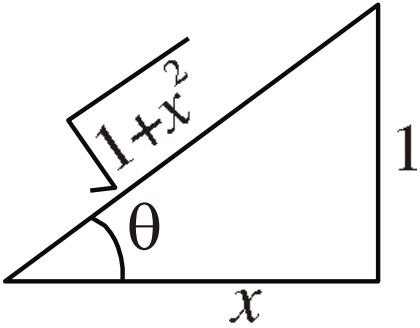
Suppose $\cot ^{-1} x=\theta \therefore x=\cot \theta$
$\therefore \quad \sin \theta=\frac{1}{\sqrt{1+x^2}}$
or $\sin \theta=\left(1+x^2\right)^{\frac{-1}{2}}$ Hence correct option is (D).

Image

Need a full question paper?

Generate a complete, print-ready paper with questions like this in minutes — across 16+ boards, with answer keys.

Start Generating Free

Similar questions

If $y = \sqrt {{{1 + \tan x} \over {1 - \tan x}}} $, then ${{dy} \over {dx}} = $
Let $f:(-1,1) \rightarrow$ IR be such that $f(\cos 4 \theta)=\frac{2}{2-\sec ^2 \theta}$ for $\theta \in\left(0, \frac{\pi}{4}\right) \cup\left(\frac{\pi}{4}, \frac{\pi}{2}\right)$. Then the value(s) of $f\left(\frac{1}{3}\right)$ is (are)

$(A)$ $1-\sqrt{\frac{3}{2}}$ $(B)$ $1+\sqrt{\frac{3}{2}}$ $(C)$ $1-\sqrt{\frac{2}{3}}$ $(D)$ $1+\sqrt{\frac{2}{3}}$

The area of the region bounded by the parabola $(y - 2)^2 = x - 1,$ the tangent to it at the point with the ordinate $3$ and the $x-$axis is:
Let $f : Z \rightarrow Z$ be given by $\text{f(x)}=\begin{cases}\frac{\text{x}}{2}, \text{if x is even 0}, \text{if x is odd}\end{cases}\}.$ Then$, f$ is:
If $a < \frac{1}{{32}},$ then the number of solution of ${({\sin ^{ - 1}}x)^3} + {({\cos ^{ - 1}}x)^3} = a{\pi ^3}$ is
Let $\text{f(x)}=\frac{\alpha\text{x}}{\text{x}+1},\ \text{x}\neq-1.$ Then, for what value of $\alpha$ is f(f(x)) = x?
For any real number $x$, let $[ x ]$ denote the largest integer less than equal to $x$. Let $f$ be a real valued function defined on the interval $[-10,10]$ by $f(x)=\left\{\begin{array}{cl}x-[x], & \text { if }(x) \text { is odd } \\ 1+[x]-x & \text { if }(x) \text { is even }\end{array}\right.$ Then the value of $\frac{\pi^{2}}{10} \int_{-10}^{10} f(x) \cos \pi x d x$ is.
Let $R=\left\{\left(\begin{array}{lll}\mathrm{a} & 3 & \mathrm{~b} \\ \mathrm{c} & 2 & \mathrm{~d} \\ 0 & 5 & 0\end{array}\right): \mathrm{a}, \mathrm{b}, \mathrm{c}, \mathrm{d} \in\{0,3,5,7,11,13,17,19\}\right\}$. Then the number of invertible matrices in $\mathrm{R}$ is
Area of the region bounded by the curve $y = |x + 1| + 1, x = –3, x = 3$ and $y = 0$ is:
The number of solutions of $y' = \frac{{y + 1}}{{x - 1}},\,y(1) = 2$ is