Questions

M.C.Q (1 Marks)

Take a timed test

15 questions · 14 auto-graded MCQ + 1 self-marked written.

MCQ 11 Mark
The domain of function $\cos ^{-1}(2 x-3)$ is :
  • A
    $[-1,1]$
  • B
    $(1,2)$
  • C
    (-1,1)
  • $[1,2]$
Answer
Correct option: D.
$[1,2]$
(D)
The domain of $\cos ^{-1}(\theta)$ is $-1 \leq \theta \leq 1$$
\begin{array}{ll}
\text { So, } & -1 \leq 2 x-3 \leq 1 \\
\Rightarrow & -1+3 \leq 2 x-3+3 \leq 1+3 \\
\Rightarrow & 2 \leq 2 x \leq 4 \\
\Rightarrow & 1 \leq x \leq 2 \\
\Rightarrow & x \in[1,2]
\end{array}
$
Hence correct option is (D).
View full question & answer
MCQ 21 Mark
The principal value of $\tan ^{-1}\left(\tan \frac{9 \pi}{8}\right)$ :
  • $\frac{\pi}{8}$
  • B
    $\frac{3 \pi}{8}$
  • C
    $\frac{-\pi}{8}$
  • D
    $\frac{-3 \pi}{8}$
Answer
Correct option: A.
$\frac{\pi}{8}$
$\tan ^{-1}\left(\tan \frac{9 \pi}{8}\right)=\tan ^{-1}\left[\tan \left(\pi+\frac{\pi}{8}\right)\right]$
$=\tan ^{-1}\left[\tan \frac{\pi}{8}\right]=\frac{\pi}{8}$
Hence, correct option is $(A)$
View full question & answer
MCQ 31 Mark
The principal value of $\cos ^{-1}\left(\frac{1}{2}\right)+\sin ^{-1}\left(\frac{-1}{\sqrt{2}}\right)$
  • $\frac{\pi}{12}$
  • B
    $\pi$
  • C
    $\frac{\pi}{3}$
  • D
    $\frac{\pi}{6}$
Answer
Correct option: A.
$\frac{\pi}{12}$
$\cos ^{-1}\left(\frac{1}{2}\right)+\sin ^{-1}\left(\frac{-1}{\sqrt{2}}\right)$
$=\frac{\pi}{3}+\left(\frac{-\pi}{4}\right)=\frac{\pi}{12}$
Hence correct opiton is $(A).$
View full question & answer
MCQ 41 Mark
The domain of function $f(x)=\sin ^{-1} x+\cos x$ is-
  • $[-1,1]$
  • B
    $[-1, \pi+1]$
  • C
    $[-\infty, \infty]$
  • D
    $\phi$
Answer
Correct option: A.
$[-1,1]$
(A)
$[-1,1]$
Function $\sin ^{-1} x$ has domain $D _1=[-1,1]$ and function $\cos x$ has domain $D _2= R$
$\therefore$ Domain of $f(x)=\sin ^{-1} x+\cos x$ is $= D _1 \cap D _2=$ $[-1,1] \cap R =[-1,1]$
Hence correct option is (A).
View full question & answer
MCQ 51 Mark
Domain of $f(x)=\sin ^{-1}\left(-x^2\right)$ is :
  • A
    $[0,1]$
  • B
    $(0,1)$
  • $[-1,1]$
  • D
    $\phi$
Answer
Correct option: C.
$[-1,1]$
(C)
$f(x)=\sin ^{-1}(-x)^2$ will be defined if $-1 \leq-x^2 \leq 1$$
\begin{array}{ll}
\Rightarrow & 1 \geq x^2 \geq-1 \\
\Rightarrow & 0 \leq x^2 \leq 1 \\
\Rightarrow & x^2-1 \leq 0
\end{array}
$
$
\begin{array}{ll}
\Rightarrow & -1 \leq x \leq 1 \\
\Rightarrow & x \in[-1,1]
\end{array}
$
Hence function $f(x)=\sin ^{-1}\left(-x^2\right)$ has domain $[-1,1]$
Hence correct option is (C)
View full question & answer
MCQ 61 Mark
Domain of $f(x)=\sin ^{-1} \sqrt{x-1}$ is :
  • $[1,2]$
  • B
    $[-1,1]$
  • C
    $[0,1]$
  • D
    None of these
Answer
Correct option: A.
$[1,2]$
(A)
$f(x)=\sin ^{-1} \sqrt{x-1}$ will be defined if$
\begin{array}{ll} 
& x-1 \geq 0 \text { and }-1 \leq \sqrt{x-1} \leq 1 \\
\Rightarrow & x \geq 1 \text { and } 0 \leq \sqrt{x-1} \leq 1 \quad[\because \sqrt{x-1} \geq 0] \\
\Rightarrow & x \geq 1 \text { and } 1 \leq x \leq 2 \\
\Rightarrow & x \in[1,2]
\end{array}
$
So, domain of $f(x)$ is $[1,2]$
Hence correct option is (A)
View full question & answer
MCQ 71 Mark
The domain of $\cos ^{-1}(2 x-1)$
  • $[0,1]$
  • B
    $[-1,1)$
  • C
    $(-1,1]$
  • D
    $[0, \pi]$
Answer
Correct option: A.
$[0,1]$
$\cos ^{-1}(2 x-1)$ will be defined if $-1 \leq 2 x-1 \leq 1$
$\Rightarrow 0 \leq 2 x \leq 2$
$\Rightarrow 0 \leq x \leq 1$
$\Rightarrow x \in[0,1]$
Hence domain of $\cos ^{-1}(2 x-1)[0,1]$
Hence correct option is $(A)$
View full question & answer
MCQ 81 Mark
The domain of function $\sin ^{-1} 2 x$ is :
  • A
    $[0,1]$
  • B
    $[-1,1]$
  • $\left[-\frac{1}{2}, \frac{1}{2}\right]$
  • D
    $[-2,2]$
Answer
Correct option: C.
$\left[-\frac{1}{2}, \frac{1}{2}\right]$
(C)
$\quad \sin ^{-1} 2 x$ will be defined if $-1 \leq 2 x \leq 1 \Rightarrow-\frac{1}{2} \leq$$
x \leq \frac{1}{2} \Rightarrow x \in\left[-\frac{1}{2}, \frac{1}{2}\right]
$
Hence correct option is (C)
View full question & answer
MCQ 91 Mark
$\cot ^{-1} \frac{\sqrt{1-x^2}}{x}$ equal to :
  • A
    $\sin ^{-1}\left(\frac{1}{x}\right)$
  • $\operatorname{cosec}^{-1}\left(\frac{1}{x}\right)$
  • C
    $\tan ^{-1}\left(\frac{1}{x}\right)$
  • D
    None of these
Answer
Correct option: B.
$\operatorname{cosec}^{-1}\left(\frac{1}{x}\right)$
(B)
$\cot ^{-1} \frac{\sqrt{1-x^2}}{x}$
taking $x=\sin \theta$
$\Rightarrow \quad \cot ^{-1} \frac{\sqrt{1-\sin ^2 \theta}}{\sin \theta}=\cot ^{-1} \frac{\cos \theta}{\sin \theta}$
$\Rightarrow \quad \cot ^{-1}(\cot \theta)=\theta=\sin ^{-1} x=\operatorname{cosec}^{-1}\left(\frac{1}{x}\right)$
Hence correct option is (B).
View full question & answer
MCQ 101 Mark
The value of $\sin \cot ^{-1} x$ :
  • A
    $\sqrt{1+x^2}$
  • B
    $x$
  • C
    $\left(1+x^2\right)^{\frac{3}{2}}$
  • $\left(1+x^2\right)^{\frac{-1}{2}}$
Answer
Correct option: D.
$\left(1+x^2\right)^{\frac{-1}{2}}$
(D)
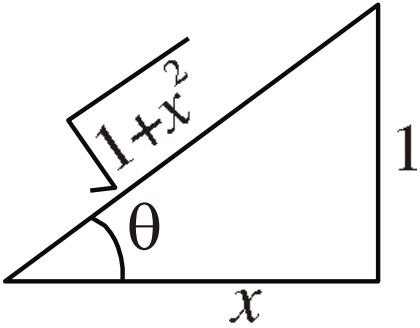
$\sin \cot ^{-1} x$
Suppose $\cot ^{-1} x=\theta \therefore x=\cot \theta$
$\therefore \quad \sin \theta=\frac{1}{\sqrt{1+x^2}}$
or $\sin \theta=\left(1+x^2\right)^{\frac{-1}{2}}$ Hence correct option is (D).

Image
View full question & answer
MCQ 111 Mark
If $\tan ^{-1}(1)+\cos ^{-1}\left(\frac{1}{\sqrt{2}}\right)=\sin ^{-1} x$ the value of $x$ is :
  • A
    -1
  • B
    $0$
  • 1
  • D
    $\frac{-1}{2}$
Answer
Correct option: C.
1
(C)
$\tan ^{-1}(1)+\cos ^{-1}\left(\frac{1}{\sqrt{2}}\right)=\sin ^{-1} x$
$\Rightarrow \quad \frac{\pi}{4}+\frac{\pi}{4}=\sin ^{-1} x$
$\Rightarrow \quad \frac{\pi}{2}=\sin ^{-1} x \therefore x=\sin \frac{\pi}{2}=1$
Hence correct option is (C).
View full question & answer
MCQ 121 Mark
The value of $\sin ^{-1}\left(\frac{\sqrt{3}}{2}\right)+2 \cos ^{-1}\left(\frac{\sqrt{3}}{2}\right)$ :
  • A
    $\frac{\pi}{2}$
  • B
    $\frac{\pi}{3}$
  • $\frac{2 \pi}{3}$
  • D
    $\pi$
Answer
Correct option: C.
$\frac{2 \pi}{3}$
(C)
The range of principal value branch of $\sin ^{-1} x$ is $\left[\frac{-\pi}{2}, \frac{\pi}{2}\right]$ and the range of principal value branch of $\cos ^{-1} x$ is $[0, \pi]$.
$\therefore \sin ^{-1}\left(\frac{\sqrt{3}}{2}\right)=\frac{\pi}{3}$ and $\cos ^{-1}\left(\frac{\sqrt{3}}{2}\right)=\frac{\pi}{6}$
Hence, $\frac{\pi}{3}+2 \times \frac{\pi}{6}=\frac{\pi}{3}+\frac{\pi}{3}=\frac{2 \pi}{3}$
Hence correct option is (C)
View full question & answer
MCQ 131 Mark
If $\sin ^{-1}\left(\frac{1}{2}\right)=x$ then find the general value of $x$ :
  • A
    $2 n \pi \pm \frac{\pi}{6}$
  • B
    $\frac{\pi}{6}$
  • C
    $n \pi \pm \frac{\pi}{6}$
  • $n \pi+(-1)^n \frac{\pi}{6}$
Answer
Correct option: D.
$n \pi+(-1)^n \frac{\pi}{6}$
(D)
If $\sin ^{-1}\left(\frac{1}{2}\right)=x$ then $\sin x=\frac{1}{2}$
$\sin x=\sin \frac{\pi}{6}$ then general value of $x=n \pi+(-1)^n \frac{\pi}{6}$
Hence correct option is (D).
View full question & answer
MCQ 151 Mark
Principal value of $\tan ^{-1}(-1)$ :
  • A
    $45^{\circ}$
  • B
    $135^{\circ}$
  • $-45^{\circ}$
  • D
    $-60^{\circ}$
Answer
Correct option: C.
$-45^{\circ}$
(C)
Suppose $\tan ^{-1}(-1)=x$
$\therefore$ tan x = -1 = -tan $45^{\circ}$
tan x =tan $\left(-45^{\circ}\right)$ $\therefore$ x = $-45^{\circ}$
$\because$The range of principal value branch of $\tan ^{-1} x$ is
$\left(-\frac{\pi}{2}, \frac{\pi}{2}\right)$.
Hence correct option is (C).
View full question & answer