MCQ
The value of Young's modulus for a perfectly rigid body is ...........
  • A
    $1$
  • B
    Less than $1$
  • C
    Zero
  • Infinite

Answer

Correct option: D.
Infinite
d
(d)

For perfectly rigid body the condition is that there should not be any elognation $(\Delta L=0)$ for any value of force

So from the formulae we know $\frac{F L}{A \cdot \Delta L}=Y$

If we put $\Delta L=0$

We get $Y$ as $\infty$

Need a full question paper?

Generate a complete, print-ready paper with questions like this in minutes — across 16+ boards, with answer keys.
Start Generating Free

Similar questions

The additional kinetic energy to be provided to a satellite of mass $m$ revolving around a planet of mass $M,$ to transfer it from a circular orbit of radius $R_1$ to another of radius $R_2\,(R_2 > R_1)$ is 
$Assertion :$ In pressure-temperature $(P-T)$ phase diagram of water, the slope of the melting curve is found to be negative.
$Reason :$ Ice contracts on melting to water.
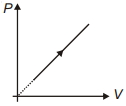
During the thermodynamic process shown in figure for an ideal gas
A particle starting from rest and moves with constant acceleration travels a distance $x$ in first $2$ seconds and a distance $y$ in next two seconds, then
A lead bullet at $27°C$ just melts when stopped by an obstacle. Assuming that $25\%$ of heat is absorbed by the obstacle, then the velocity of the bullet at the time of striking........ $m/sec$  ($M.P.$ of lead $= 327°C,$ specific heat of lead $= 0.03\, cal/gm°C,$ latent heat of fusion of lead $= 6\, cal/gm$ and $J = 4.2\, joule/cal)$
In rotation of a rigid body about a fixed axis is that in which:
The kinetic energy per gm mol for a diatomic gas at room temperature is
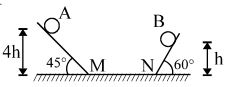
Two identical balls $A$ and $B$ are released from the positions shown in figure. They collide elastically on horizontal portion $MN$. All surfaces are smooth. The ratio of heights attained by $A$ and $B$ after collision will be(Neglect energy loss at $M$ & $N$)
$Assertion$ : Retardation is directly opposite to the velocity.
$Reason$ : Retardation is equal to the time rate of decrease of speed.
A body travels uniformly a distance of $(13.8 \pm 0.2) m$ in a time $(4.0 \pm 0.3) s$. Its velocity with error limits and percentage error is