Question
The vector $(\cos\text{a}\cos\beta)\hat{\text{i}}+(\cos\text{a}\sin\beta)\hat{\text{j}}+(\sin\text{a})\hat{\text{k}}$is a:
  1. Null vector
  2. Unit vector
  3. Constant vector
  4. None of these

Answer

  1. Unit vector
Solution:
Let $\vec{\text{a}}=(\cos\text{a}\cos\beta)\hat{\text{i}}+(\cos\text{a}\sin\beta)\hat{\text{j}}+(\sin\text{a})\hat{\text{k}}$
$|\vec{\text{a}}|=\sqrt{\cos^2\text{a}\cos^2\beta+\cos^2\text{a}\sin^2\beta+\sin^2\text{a}}$
$=\sqrt{\cos^2\text{a}(\cos^2\beta+\sin^2\beta)+\sin^2\text{a}}$
$=\sqrt{\cos^2\text{a}(1)+\sin^2\text{a}}$
$=\sqrt{\cos^2\text{a}+\sin^2\text{a}}$
$=\sqrt{1}$
$=1$
So, $\vec{\text{a}}$ is a unit vector.

Need a full question paper?

Generate a complete, print-ready paper with questions like this in minutes — across 16+ boards, with answer keys.
Start Generating Free

Similar questions

If A = {1, 2, 3}, then a relation R = {(2, 3)} on A is:
  1. Symmetric and transitive only.
  2. Symmetric only.
  3. Transitive only.
  4. None of these.
Choose the correct answer from the given four option.
The general solution of $\text{e}^{\text{x}}\cos\text{ydx}-\text{e}^\text{x}\sin\text{ydy}=0$ is:
  1. $\text{e}^{\text{x}}\cos\text{y}=\text{k}$
  2. $\text{e}^{\text{x}}\sin\text{y}=\text{k}$
  3. $\text{e}^{\text{x}}=\text{k}\cos\text{y}$
  4. $\text{e}^{\text{x}}=\text{k}\sin\text{y}$
If $\text{A}=\begin{bmatrix}5&\text{x}\\\text{y}&0\end{bmatrix}$ and $A = A^T,$ then$:$
Choose the correct answer from the given four options. Assume that in a family, each child is equally likely to be a boy or a girl. A family with three children is chosen at random. The probability that the eldest child is a girl given that the family has at least one girl is:
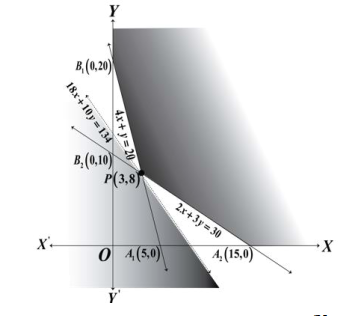
A linear programming problem (LPP) along eith the graph of its constraints is shown below.The correspondig objective function is :Z = 18x + 10y which has to be minimized. The smallest value of the objective function Z is 134 and is obtained at the corner point (3,8).
Image
The optimal solution of the above linear programming problem_______________.
If $d$ is the determinant of a square matrix $A$ of order $n,$ then the determinant of its adjoint is:
Let $A=\{1,2,3,4\}$ and $R$ be a relation in $A$ given by $R=\{(1,1),(2,2),(3,3),(4,4),(1,2)$, $(2,1),(3,1)\}$. Then, $R$ is
In a class, 40% of the students study math and science. 60% of the students study math. What is the probability of a student studying science given he/she is already studying math?
The direction ratios of the vector $3 \vec{a}+2 \vec{b}$, where $\vec{a}=\hat{i}+\hat{j}-2 \hat{k}$ and $\vec{b}=2 \hat{i}-4 \hat{j}+5 \hat{k}$ are
A letter is known to have come either from $\text{LONDON}$ or $\text{CLIFTON;}$ on the postmark only the two consecutive letters $\text{ON}$ are ellegible. The probability that it came from $\text{LONDON}$ is: