MCQ
The velocity of the planet when it is closest to sun is:
  • Maximum.
  • B
    Minimum.
  • C
    Can have any value.
  • D
    None of the above

Answer

Correct option: A.
Maximum.
From conservation of angular momentum,
Velocity of planet $(v) \propto\frac{1}{\text{Distance of the planet from sun (r)}}$
So, $r_p$ is minimum for perihelion $(P).$
$= V_p$ is maximum.

Need a full question paper?

Generate a complete, print-ready paper with questions like this in minutes — across 16+ boards, with answer keys.
Start Generating Free

Similar questions

Water waves produced by a motor boat sailing in water are:
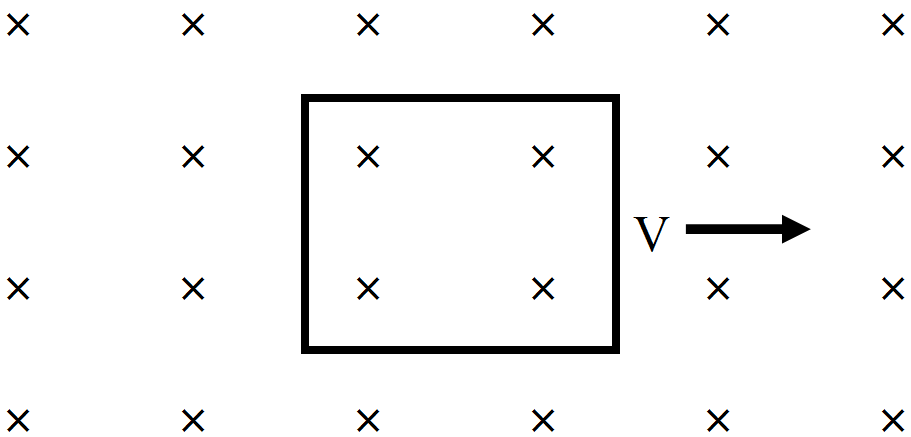
A conducting square loop of side l and resistance R moves in its plane with a uniform velocity u perpendicular to one of its sides. A uniform and constant magnetic field B exists along the perpendicular to the plane of the loop as shown in figure. The current induced in the loop is:
A ring and a disc are initially at rest, side by side, at the top of an inclined plane which makes an angle $60^{\circ}$ with the horizontal. They start to roll without slipping at the same instant of time along the shortest path. If the time difference between their reaching the ground is $(2-\sqrt{3}) / \sqrt{10} \mathrm{~s}$, then the height of the top of the inclined plane, in metres, is. . . . . . Take $g=10 \mathrm{~m} \mathrm{~s}^{-2}$.
The potential energy of a particle executing S.H.M. is $ 2.5\, J$, when its displacement is half of amplitude. The total energy of the particle be .... $J$
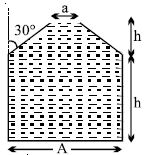
The vessel shown in the figure has two sections. The lower part is a rectangular vessel with area of cross-section $A$ and height $h$. The upper part is a conical vessel of height $h$ with base area $‘A’$ and top area $‘a’$ and the walls of the vessel are inclined at an angle $30^o$  with the vertical.A liquid of density $\rho$ fills both the sections upto a height $2h$. Neglecting atmospheric pressure. 
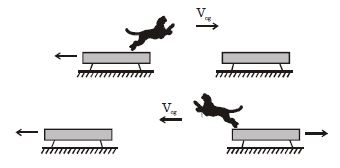
A strange cat with a mass $m_c$ is sitting at rest on the left plank of a pair of identical planks. Each plank has mass $m_s$ and they rest on frictionless ice. Suddenly, the cat leaps to the right plank, traveling with a horizontal speed $v_{cg}$ measured with respect to the ground. The instant the cat reaches the right plank, it turns around and leaps back to the left plank. The horizontal component of the cat’s speed is again $v_{cg}$ measured with respect to the ground. The final speed of right plank in terms of the masses of the cat and planks and the cat’s leaping speed is (The cat remains on the left plank after its return).
During an adiabatic process, the pressure of a gas is found to be proportional to the cube of its temperature. The ratio of  $\frac{{{C_P}}}{{{C_V}}}$  for the gas is
A block of rectangular size of mass $m$ and area of cross-section $A$, floats in a liquid of density $\rho$. If we give a small vertical displacement from equilibrium, it undergoes $S H M$ with time period $T$, then
The conversion of $1 \;MW$ power in a new system having basic unit of mass, length and time as $10 \;kg , 1 \;dm$ and $1 \;minute$ respectively is:
A particle is performing simple harmonic motion
$(i)$ its velocity-displacement graph is parabolic in nature
$(ii)$ its velocity-time graph is sinusoidal in nature
$(iii)$ its velocity-acceleration graph is elliptical in nature
Correct answer is