MCQ
The velocity of train increases uniformly from $20\; km / h$ to $60\; km / h$ in $4\; hours$. The distance travelled by the train during this period is
  • $160$
  • B
    $180$
  • C
    $100$
  • D
    $120$

Answer

Correct option: A.
$160$
a
$v=u+a t$

$60=20+(a \times 4)$

$a=\frac{60-20}{4}=10 \;km / h ^{2}$.

$d=u t+\frac{1}{2} a t^{2}=(20 \times 4)+\frac{1}{2} \times 10 \times(4)^{2}=160 \;km$

Need a full question paper?

Generate a complete, print-ready paper with questions like this in minutes — across 16+ boards, with answer keys.
Start Generating Free

Similar questions

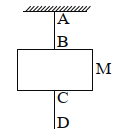
An object of mass $M$ is hung by a thread $A B$ and thread CD is hanging below the object. If end D is pulled down with a jerk then :
Image
If at any point on the path of a projectile its velocity is $u$ at inclination $\alpha$ then it will  move at right angles to former direction after time
Which of the following is not the property of an ideal fluid?
If the value of $‘g’$ acceleration due to gravity, at earth surface is $10\,m/{s^2}$, its value in $m/{s^2}$ at the centre of the earth, which is assumed to be a sphere of radius ‘R’ metre and uniform mass density is
The absolute temperature of a gas is determined by
In a turbulent flow, the velocity of the liquid molecules in contact with the walls of the tube is:
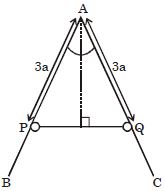
In the diagram, $BAC$ is a rigid fixed rough wire and angle $BAC$ is $60^o$. $P$ and $Q$ are two identical rings of mass $m$ connected by a light elastic string of natural length $2a$ and elastic constant $\frac{mg}{a}$. If $P$ and $Q$ are in equilibrium when $PA = AQ = 3a$ then the least coefficient of friction between the ring and the wire is $\mu$. Then value of $\mu + \sqrt 3 $ is :-
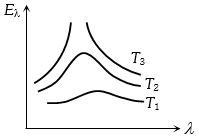
Variation of radiant energy emitted by sun, filament of tungsten lamp and welding arc as a function of its wavelength is shown in figure. Which of the following option is the correct match
The initial temperature of a body is $80°C$ . If its temperature falls to $64°C$ in $5$ minutes and in $10$ minutes to $52°C$ then the temperature of surrounding will be ...... $^oC$
At the highest point of the path of a projectile, its