The velocity of water waves $v$ may depend upon their wavelength $\lambda $, the density of water $\rho $ and the acceleration due to gravity $g$. The method of dimensions gives the relation between these quantities as
Medium


Download our appand get started for free
Experience the future of education. Simply download our apps or reach out to us for more information. Let's shape the future of learning together!No signup needed.*
Similar Questions
- 1The period of oscillation of a simple pendulum is $T=2\pi \sqrt {\frac{l}{g}} $. Measured value of $L$ is $20.0\; cm$ known to $1\; mm$ accuracy and time for $100$ oscillations of the pendulum is found to be $90\ s$ using a wrist watch of $1\; s$ resolution. The accuracy in the determination of $g$ is ........ $\%$View Solution
- 2View SolutionWhat is the dimensions of impedance?
- 3The random error in the arithmetic mean of $100$ observations is $x$; then random error in the arithmetic mean of $400$ observations would beView Solution
- 4In $S = a + bt + c{t^2}$. $S$ is measured in metres and $t$ in seconds. The unit of $c$ isView Solution
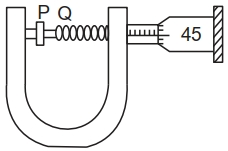
- 5In an experiment to find out the diameter of wire using screw gauge, the following observation were noted.View Solution
$(a)$ Screw moves $0.5\,mm$ on main scale in one complete rotation
$(b)$ Total divisions on circular scale $=50$
$(c)$ Main scale reading is $2.5\,mm$
$(d)$ $45^{\text {th }}$ division of circular scale is in the pitch line
$(e)$ Instrument has $0.03 \;mm$ negative error
Then the diameter of wire is $...........\,mm$
- 6Three students $S_{1}, S_{2}$ and $S_{3}$ perform an experiment for determining the acceleration due to gravity $(g)$ using a simple pendulum. They use different lengths of pendulum and record time for different number of oscillations. The observations are as shown in the table.View Solution
Student No. Length of pendulum $(cm)$ No. of oscillations $(n)$ Total time for oscillations Time period $(s)$ $1.$ $64.0$ $8$ $128.0$ $16.0$ $2.$ $64.0$ $4$ $64.0$ $16.0$ $3.$ $20.0$ $4$ $36.0$ $9.0$ (Least count of length $=0.1 \,{m}$, least count for time $=0.1\, {s}$ )
If $E_{1}, E_{2}$ and $E_{3}$ are the percentage errors in $'g'$ for students $1,2$ and $3$ respectively, then the minimum percentage error is obtained by student no. ....... .
- 7Assertion : The error in the measurement of radius of the sphere is $0.3\%$. The permissible error in its surface area is $0.6\%$View Solution
Reason : The permissible error is calculated by the formula $\frac{{\Delta A}}{A} = \frac{{4\Delta r}}{r}$ - 8A length-scale $(l)$ depends on the permittivity $(\varepsilon)$ of a dielectric material. Boltzmann constant $\left(k_B\right)$, the absolute temperature $(T)$, the number per unit volune $(n)$ of certain charged particles, and the charge $(q)$ carried by each of the particless. Which of the following expression($s$) for $l$ is(are) dimensionally correct?View Solution
($A$) $l=\sqrt{\left(\frac{n q^2}{\varepsilon k_B T}\right)}$
($B$) $l=\sqrt{\left(\frac{\varepsilon k_B T}{n q^2}\right)}$
($C$)$l=\sqrt{\left(\frac{q^2}{\varepsilon n^{2 / 3} k_B T}\right)}$
($D$) $l=\sqrt{\left(\frac{q^2}{\varepsilon n^{1 / 3} k_B T}\right)}$
- 9A student uses a simple pendulum of exactly $1 \mathrm{~m}$ length to determine $\mathrm{g}$, the acceleration due to gravity. He uses a stop watch with the least count of $1 \mathrm{sec}$ for this and records $40$ seconds for $20$ oscillations. For this observation, which of the following statement$(s)$ is (are) true?View Solution
$(A)$ Error $\Delta T$ in measuring $T$, the time period, is $0.05$ seconds
$(B)$ Error $\Delta \mathrm{T}$ in measuring $\mathrm{T}$, the time period, is $1$ second
$(C)$ Percentage error in the determination of $g$ is $5 \%$
$(D)$ Percentage error in the determination of $g$ is $2.5 \%$
- 10The resistance $\mathrm{R}=\frac{\mathrm{V}}{\mathrm{I}}$ where $\mathrm{V}=(200 \pm 5) \mathrm{V}$ and $I=(20 \pm 0.2) A$, the percentage error in the measurement of $R$ is :View Solution