Question
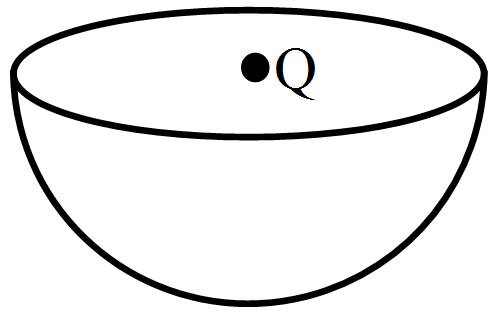
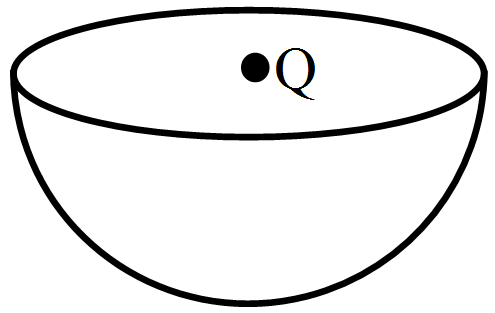
A charge Q is placed at the centre of an imaginary hemispherical surface. Using symmetry arguments and the Gauss's law, find the flux of the electric field due to this charge through the surface of the hemisphere (figure).
Answer

From Guass's law, flux through a closed surface,

$\phi=\frac{\text{Q}_{\text{en}}}{\in_0},$

where

Qen = charge enclosed by the closed surface

Let us assume that a spherical closed surface in which the charge is enclosed is Q.

The flux through the sphere,

$\phi=\frac{\text{Q}}{\in_0}$

Hence for a hemisphere(open bowl), total flux through its curved surface,

$\phi'=\frac{\text{Q}}{\in}\times\frac{1}{2}=\frac{\text{Q}}{2\in_0}$

Need a full question paper?

Generate a complete, print-ready paper with questions like this in minutes — across 16+ boards, with answer keys.
Start Generating Free

Similar questions

Can the dispersive power $\omega=\frac{\mu_\text{v}-\mu\text{r}}{\mu-1}$ be negative? What is the sign of co if a hollow prism is immersed into water?
When a nucleus at rest emits a beta particle, it is found that the velocities of the recoiling nucleus and the beta particle are not along the same straight line. How can this be possible in view of the principle of conservation of momentum?
"Monochromatic light should be used to produce pure spectrum". Comment on this statement.
You are given ‘n’ resistors, each of resistance 'r'. These are first connected to get minimum possible resistance. In the second case, these are again connected differently to get maximum possible resistance. Compute the ratio between the minimum and maximum values of resistance so obtained.
A dbuteron and an alpha particle are accelerated with the same accelerating potential. Which one of the two has:
  1. Greater value of de-Broglie wavelength, associated with it and
  2. Less kinetic energy? Explain.
Whether the diffraction effects from a slit will be more clearly visible or less clearly, if the slit-width is increased?
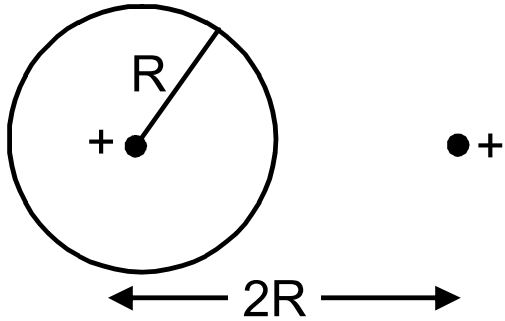
Find the flux of the electric field through a spherical surface of radius R due to a charge of 10-7C at the centre and another equal charge at a point 2R away from the centre.

A conducting loop of face-area A and resistance R is placed perpendicular to a magnetic field B. The loop is withdrawn completely from the field. Find the charge which flows through any cross-section of the wire in the process. Note that it is independent of the shape of the loop as well as the way it is withdrawn.
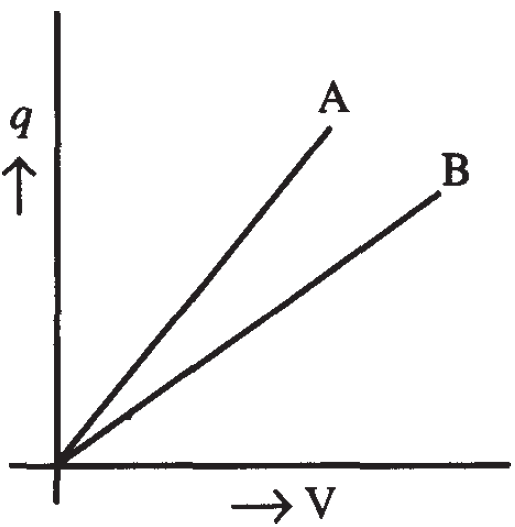
The given graph shows the variation of charge q versus potential difference V for two capacitors C1 and C2. The two capacitors have same plate separation, but the plate area of C2 is double than that of C1. Which of the lines in the graph correspond to C1 and C2 and why?

Give the explanation of the velocity of $E M$ wave and derive the equation of refractive index $n=\sqrt{\mu_r K }$.