MCQ
The wavelength of light observed on the earth, from a moving star is found to decrease by $0.05 \%$. Relative to the earth the star is
  • A
    Moving away with a velocity of $1.5 \times 10^5 m / s$
  • Coming closer with a velocity of $1.5 \times 10^5 m / s$
  • C
    Moving away with a velocity of $1.5 \times 10^4 m / s$
  • D
    Coming closer with a velocity of $1.5 \times 10^4 m / s$

Answer

Correct option: B.
Coming closer with a velocity of $1.5 \times 10^5 m / s$
$\frac{\Delta \lambda}{\lambda}=\frac{v}{c} \Rightarrow \frac{0.05}{100}=\frac{v}{3 \times 10^8} \Rightarrow v=1.5 \times 10 m / s$(Since wavelength is decreasing, so star coming closer)

Need a full question paper?

Generate a complete, print-ready paper with questions like this in minutes — across 16+ boards, with answer keys.

Start Generating Free

Similar questions

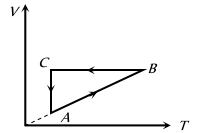
A cyclic process $A B C A$ is shown in the $V-T$ diagram. Process on the $P^{-} V$ diagram is
Image
The focal lengths of convex lens for red and blue light are $100 \mathrm{~cm}$ and $96.8 \mathrm{~cm}$ respectively. The dispersive power of material of lens is
The temperature of a hypothetical gas increases to $\sqrt{2}$ times when compressed adiabatically to half the volume. Its equation can be written as
If the radius of a planet is $R$ and its density is $\rho$, the escape velocity from its surface will be
Hubble's law is related with
A circular coil of $500$ turns of wire has an enclosed area of $0.1 \mathrm{~m}^2$ per turn. lt is kept perpendicular to a magnetic field of induction $0.2 \ T$ and rotated by $180^{\circ}$ about a diameter perpendicular to the field in $0.1 \mathrm{sec}$. How much charge will pass when the coil is connected to a galvanometer with a combined resistance of $50 \mathrm{ohms}$
When a current of $5\ mA$ is passed through a galvanometer having a coil of resistance $15\ \Omega$, it shows full scale deflection. The value of the resistance to be put in series with the galvanometer to convert it into to voltmeter of range $0 - 10\ V$ is
Two bodies with kinetic energies in the ratio of $4: 1$ are moving with equal linear momentum. The ratio of their masses is
A person travels along a straight road for half the distance with velocity $v_1$ and the remaining half distance with velocity $v_2$ The average velocity is given by
For high frequency, a capacitor offers