Question
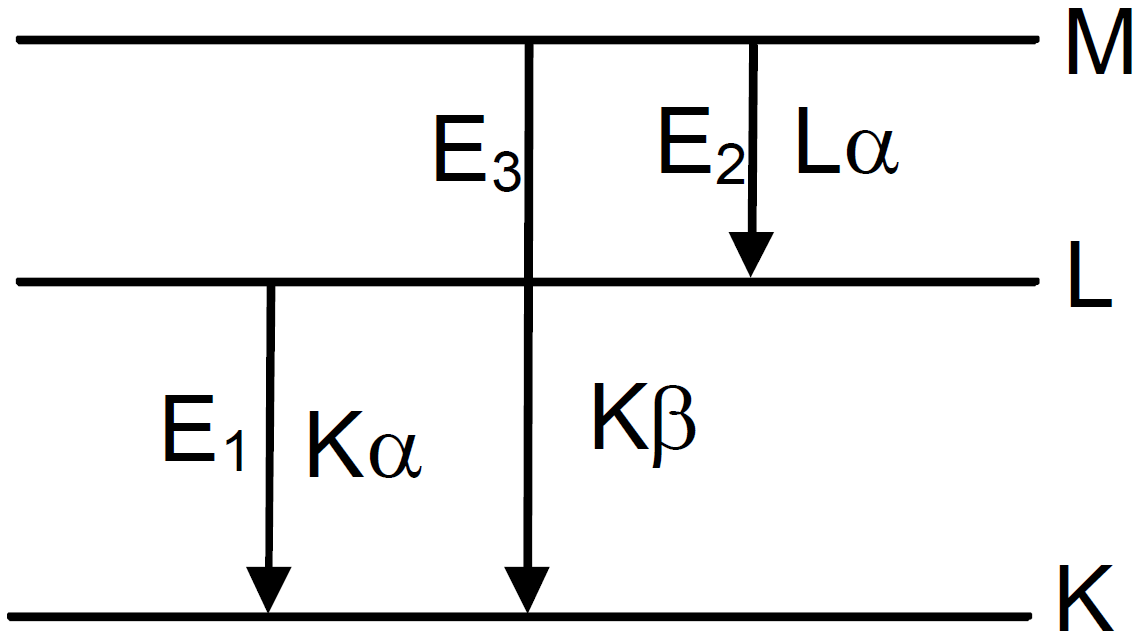
The wavelengths of $\text{K}_\alpha$ and $\text{L}_\alpha$ X-rays of a material are 21.3pm and 141pm respectively. Find the wavelength of $\text{K}_\beta$ X-ray of the material.
Answer


$\text{E}_1=\frac{1242}{21.3\times10^{-3}}=58.309\times10^3\text{eV}$
$\text{E}_2=\frac{1242}{141\times10^{-3}}=8.8085\times10^3\text{eV}$
$\text{E}_3=\text{E}_1+\text{E}_2$
$\Rightarrow(58.309+8.809)\text{ev}=67.118\times10^3\text{ev}$
$\lambda=\frac{\text{hc}}{\text{E}_3}=\frac{1242}{67.118\times10^3}$
$=18.5\times10^{-3}\text{nm}=18.5\text{pm}$

Need a full question paper?

Generate a complete, print-ready paper with questions like this in minutes — across 16+ boards, with answer keys.
Start Generating Free

Similar questions

Springs of spring constants $k, 2k, 4k, 8k$ ............ are connected in series. A mass m kg is attached to the lower end of the last spring and the system is allowed to vibrate. What is the time period of oscillations? Given $m = 40gm; k = 20Ncm^{-1}$
A SHM is expressed by the equation $\text{x}=\text{A}\cos(\omega\text{t}+\phi)$ and the phase angle $\phi=0$ . Draw graphs to show variation of displacement, velocity and acceleration for one complete cycle in SHM.
A helicopter lifts a $72kg$ astronaut $15m$ vertically from the ocean by means of a cable. The acceleration of the astronaut is $\frac{\text{g}}{10}$.

How much work is done on the astronaut by:
  1. The force from the helicopter and
  2. The gravitational force on him?
  3. What are the kinetic energy and
  4. The speed of the astronaut just before he reaches the helicopter?(Take, $g = 10ms^{‑2}$)
Show that work done by a stretching force to produce certain extension in the wire is given by $\text{w}=\frac{1}{2}$ stretching force × extension. A wire that obeys Hooke's law is of length $l_1$ when it is in equilibrium under a tension $F_1$. Its length becomes $l_2$ when the tension is increased to $F_2$. Calculate the energy stored in the wire during this process.
A small block of mass $200g$ is kept at the top of a frictionless incline which is $10m$ long and $3.2m$ high. How much work was required.
  1. To lift the block from the ground and put it at the top.
  2. To slide the block up the incline? What will be the speed of the block when it reaches the ground.
  3. It falls off the incline and drops vertically on the ground.
  4. It slides down the incline? Take $g = 10m/s^2$​​​​​​​.
The length of a sonometer wire between two fixed ends is $110cm$. Where should the two bridges be placed so as to divide the wire into three segments, whose fundamental frequencies are in the ratio $1 : 2 : 3$?
A room has a window fitted with a single $1.0m \times 2.0m$ glass of thickness $2mm$.
  1. Calculate the rate of heat flow through the closed window when the temperature inside the room is $32^\circ C$ and that outside is $40^\circ C$.
  2. The glass is now replaced by two glasspanes, each having a thickness of $1mm$ and separated by a distance of $1mm$. Calculate the rate of heat flow under the same conditions of temperature. Thermal conductivity of window glass = $1.0Js^{-1}m^{-1^\circ}C^{-1}$ and that of air = $0.025Js^{-1}m^{-1^\circ}C^{-1}$.
Define density and relative density and write the value of density of the following substances - mercury, glycerine, iron.
Mercury has an angle of contact equal to $140^{\circ}$ with soda lime glass. A narrow tube of radius $1.00$ mm made of this glass is dipped in a trough containing mercury. By what amount does the mercury dip down in the tube relative to the liquid surface outside? Surface tension of mercury at the temperature of the experiment is $0.465 \mathrm{~N} \mathrm{~m}^{-1}$. Density of mercury $=13.6 \times 10^3 \mathrm{~kg} \mathrm{~m}^{-3}$.
Add vectors $\overrightarrow{\text{A}},\overrightarrow{\text{B}}$ and $\overrightarrow{\text{C}}$ each having magnitude of 100 unit and inclined to the X-axis at angles 45°, 135° and 315° respectively.