Question
A room has a window fitted with a single $1.0m \times 2.0m$ glass of thickness $2mm$.
  1. Calculate the rate of heat flow through the closed window when the temperature inside the room is $32^\circ C$ and that outside is $40^\circ C$.
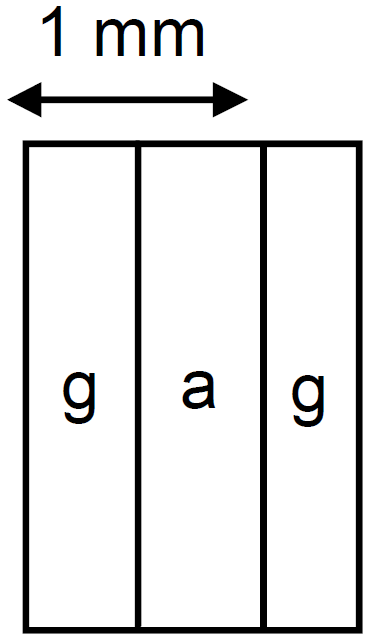
  2. The glass is now replaced by two glasspanes, each having a thickness of $1mm$ and separated by a distance of $1mm$. Calculate the rate of heat flow under the same conditions of temperature. Thermal conductivity of window glass = $1.0Js^{-1}m^{-1^\circ}C^{-1}$ and that of air = $0.025Js^{-1}m^{-1^\circ}C^{-1}$.
Answer

  1. $\frac{\text{Q}}{\text{t}}=\frac{\text{KA}(\theta_1-\theta_2)}{\ell}$
$=\frac{1\times2\times1(40-32)}{2\times10^{-3}}$
$=8000\text{J/sec}.$
  1. Resistance of glass $=\frac{\ell}{\text{ak}_\text{g}}+\frac{\ell}{\text{ak}_\text{g}}$
Resistance of air $=\frac{\ell}{\text{ak}_\text{a}}$
Net resistance $=\frac{\ell}{\text{ak}_\text{g}}+\frac{\ell}{\text{ak}_\text{g}}+\frac{\ell}{\text{ak}_\text{a}}$
$=\frac{\ell}{\text{a}}\Big(\frac{2}{\text{k}_\text{g}}+\frac{1}{\text{k}_\text{a}}\Big)$
$=\frac{\ell}{\text{a}}\Big(\frac{2\text{k}_\text{a}+\text{k}_\text{g}}{\text{k}_\text{g}\text{k}_\text{a}}\Big)$
$=\frac{1\times10^{-3}}{2}\Big(\frac{2\times0.025+1}{0.025}\Big)$
$=\frac{1\times10^{-3}\times1.05}{0.05}$
$\frac{\text{Q}}{\text{t}}=\frac{\theta_1-\theta_2}{\text{R}}$
$=\frac{8\times0.05}{1\times10^{-3}\times1.05}$
$=380.9\approx381\text{W}$

Need a full question paper?

Generate a complete, print-ready paper with questions like this in minutes — across 16+ boards, with answer keys.

Start Generating Free

Similar questions

Explain fluid pressure.
See Fig. 4.15. A wooden block of mass $2 kg$ rests on a soft horizontal floor. When an iron cylinder of mass $25 kg$ is placed on top of the block, the floor yields steadily and the block and the cylinder together go down with an acceleration of $0.1 m s ^{-2}$. What is the action of the block on the floor (a) before and (b) after the floor yields ? Take $g=10 m s ^{-2}$. Identify the action-reaction pairs in the problem.
Define gravitational potential energy of a body. Derive an expression for the gravitational potential energy of a body of mass 'm' located at a distance 'r' from the centre of the earth.
Find at what temperature the velocity of sound is air will be $1\frac{1}{2}$ times the velocity at 11°C.
Two Carnot engines A and B are operated in series. The first one A receives heat at $900K$ and rejects it to a reservoir at temperature T. The second engine B operates on this reservoir and rejects heat to a reservoir at $400K$. Calculate temperature T when,
  1. Efficiencies of both A and B are equal.
  2. The work outputs of both A and B are equal.
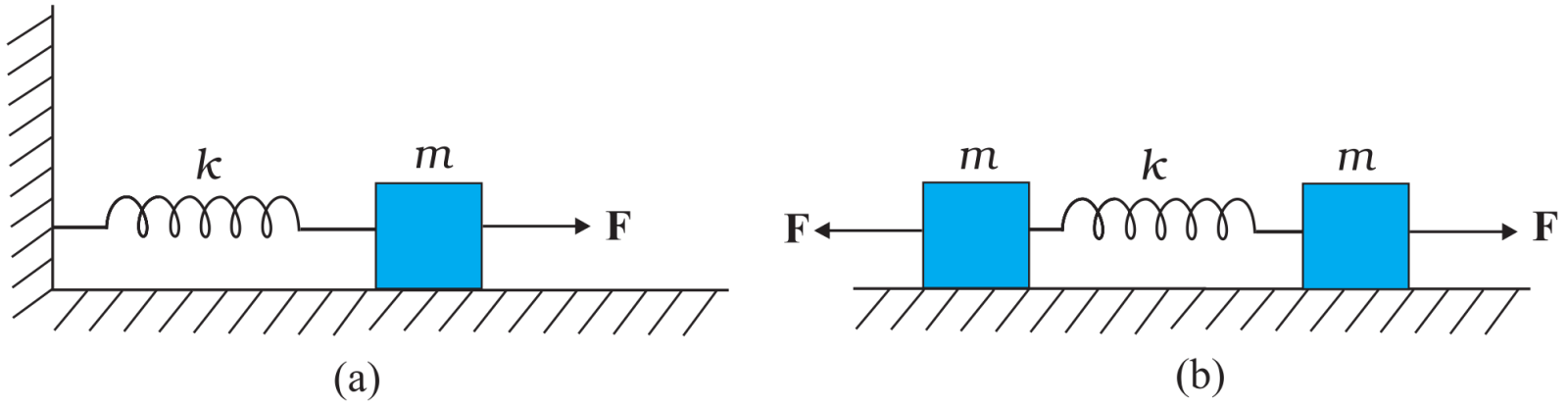
Figure (a) shows a spring of force constant k clamped rigidly at one end and a mass m attached to its free end. A force F applied at the free end stretches the spring. Figure (b) shows the same spring with both ends free and attached to a mass m at either end. Each end of the spring in Fig. (b) is stretched by the same force F.
If the mass in Fig. (a) and the two masses in Fig. (b) are released, what is the period of oscillation in each case?
Name the physical quantity of the dimension given below:
i. $\mathrm{ML}^{\circ} \mathrm{T}^{-3}$
ii. $\mathrm{ML}^{-1} \mathrm{~T}^{-1}$
iii. $\mathrm{M}^{-1} \mathrm{~L}^3 \mathrm{~T}^{-2}$
iv. $\mathrm{ML}^2 \mathrm{~T}^{-3}$
v. $\mathrm{ML}^0 \mathrm{~T}^{-2}$
vi. $\mathrm{T}^{-1}$
On a two-lane road, car A is travelling with a speed of $36km h^{–1}$. Two cars B and C approach car A in opposite directions with a speed of $54km h^{–1}$ each. At a certain instant, when the distance AB is equal to AC, both being 1km, B decides to overtake A before C does. What minimum acceleration of car B is required to avoid an accident?
A bar magnet of length $1cm$ and cross-sectional area $1.0cm^2$ produces a magnetic field of $1.5 \times 10$. T at a point in end-on position at a distance $15cm$ away from the centre.
  1. Find the magnetic moment M of the magnet.
  2. Find the magnetization I of the magnet.
  3. Find the magnetic field B at the centre of the magnet.
An incident wave and a reflected wave are represented by
$\xi_1=\text{a}\sin\frac{2\pi}{\lambda}(\nu\text{t}-\text{x})$
$\xi_2=\text{a}\sin\frac{2\pi}{\lambda}(\nu\text{t}+\text{x})$
Derive the equation of the stationary wave, and calculate the position of the nodes and antinodes.