MCQ
The weight of man in a lift moving upward is $608\,N$ while the weight of the same man in the lift moving downwards with the same acceleration is $368\, N$. His normal weight is  ............ $ N$
  • A
    $480$
  • $488$
  • C
    $588$
  • D
    $240$

Answer

Correct option: B.
$488$
b
When the lift accelerates at a upwards

$\mathrm{m}(\mathrm{g}+\mathrm{a})=608$           $...(i)$

When the lift accelerates at a downwards

$m(g-a)=368$           $...(ii)$

From $(i)$ and $(ii)$ we geta $=2.4 \mathrm{m} / \mathrm{s}^{2}$

$m=49.8 \mathrm{kg}$

The normal weight $=\mathrm{mg}$

${w=49.8 \times 9.8}$

${w=488 \mathrm{N}}$

Need a full question paper?

Generate a complete, print-ready paper with questions like this in minutes — across 16+ boards, with answer keys.
Start Generating Free

Similar questions

The work done in an adiabatic change in a gas depends only on
A black body, at a temperature of $227\,^oC$ radiates heat at a rate of $7\,cal\,cm^{-2}\, s^{-1}$ . At a temperature of $727\,^oC$ , the rate of heat radiated in the same units will be
A ring of a thin wire of cross-sectional area a and length $l$ is dipped into a liquid of surface tension $\sigma$ and taken out so that a film of liquid is formed in the ring. If young's modulus of material of wire is $Y$ then longitudinal strain developed in the ring will. be
A whistle revolves in a circle with an angular speed of $20\; rad/sec$ using a string of length $50 \;cm.$ If the frequency of sound from the whistle is $385\; Hz,$ then what is the minimum frequency heard by an observer, which is far away from the centre in the same plane ... $Hz$ ? ($v = 340 \;m/s$)
A ball is dropped from a height of $49\,m$. The wind is blowing horizontally. Due to wind a constant horizontal acceleration is provided to the ball. Choose the correct statement (s). (Take $g=9.8\,m / s ^2$ )
A juggler maintains four ball in vertically upward motion. He attempts next ball after $1/4\, sec$. For the shows to go on, what should be the height for which he throws the ball ?.........$m$ $(g=10\,m/s^2)$
Diatomic molecules like hydrogen have energies due to both translational as well as rotational motion. From the equation in kinetic theory $\text{PV} = \frac{2}{3} E,E$ is:
If $I = 50\, kg-m^2$, then ......... $N-m$ torque will be applied to stop it in $10\, sec$. Its initial angular speed is $20\, rad/sec$.
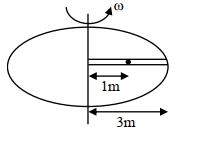
A circular table is rotating with an angular velocity of $\omega \mathrm{rad} / \mathrm{s}$ about its axis (see figure). There is a smooth groove along a radial direction on the table. A steel ball is gently placed at a distance of $1 \mathrm{~m}$ on the groove. All the surface are smooth. If the radius of the table is $3 \mathrm{~m}$, the radial velocity of the ball w.r.t. the table at the time ball leaves the table is $x \sqrt{2} \omega \mathrm{m} / \mathrm{s}$, where the value of $x$ is............
The specific heat at constant volume for the monoatomic argon is $0.075\, kcal/kg-K,$ whereas its gram molecular specific heat ${C_V}$ $= 2.98\, cal/mole/K.$ The mass of the argon atom is

$(Avogadro’s \,number = 6.02 \times {10^{23}}\,molecules/mole)$