MCQ
The wires 1 and 2
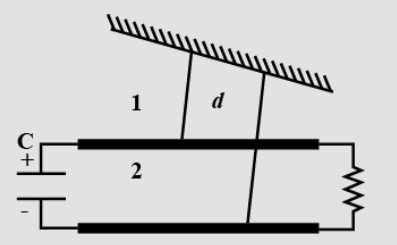
- AMove apart
- BCome closer
- CRemain at their position
- DNone of these
Explanation:
It is evident from the question that current in the two is in opposite direction so on using the formulas of current carrying straight conductor we can say that they will repel each other.
Generate a complete, print-ready paper with questions like this in minutes — across 16+ boards, with answer keys.
Diameter of a plano–convex lens is 6 cm and thickness at the centre is 3 mm. If the speed of light in the material of the lens is 2 × 10⁸ m/sec, the focal length of the lens is
|
(a) 15 cm |
(b) 20 cm |
(c) 30 cm |
(d) 10 cm |
In a transformer, the coefficient of mutual inductance between the primary and the secondary coil is 0.2 henry. When the current changes by 5 ampere/second in the primary, the induced e.m.f. in the secondary will be
|
(a) 5 V |
(b) 1 V |
(c) 25 V |
(d) 10 V |
The order of the size of nucleus and Bohr radius of an atom respectively are
|
(a) |
(b) |
(c) |
(d) |
If two streams of protons move parallel to each other in the same direction, then they
|
(a) Do not exert any force on each other |
|
(b) Repel each other |
|
(c) Attract each other |
|
(d) Get rotated to be perpendicular to each other |
There are three voltmeters of the same range but of resistances 1000Ω, 8000 Ω and 4000 Ω respectively. The best voltmeter among these is the one whose resistance is
|
(a) 10000 W |
(b) 8000 W |
(c) 4000 W |
(d) All are equally good |



