MCQ
The work done in which of the following processes is zero
  • A
    Isothermal process
  • B
    Adiabatic process
  • Isochoric process
  • D
    None of these

Answer

Correct option: C.
Isochoric process
(c) $W=P \Delta V=0$(As $\Delta V=0$ )

Need a full question paper?

Generate a complete, print-ready paper with questions like this in minutes — across 16+ boards, with answer keys.
Start Generating Free

Similar questions

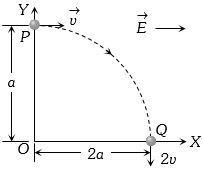
A particle of charge $+q$ and mass $m$ moving under the influence of a uniform electric field $E\hat i$ and a uniform magnetic field $B\hat k$ follows trajectory from $P$ to $Q$ as shown in figure. The velocities at $P$ and $Q$ are $v\hat i$ and $ - 2v\hat j$ respectively. Which of the following statement(s) is/are correct
A bomb of $12 \mathrm{~kg}$ divides in two parts whose ratio of masses is $1: 3$. If kinetic energy of smaller part is $216 \mathrm{~J}$, then momentum of bigger part in $\mathrm{kgm} / \mathrm{sec}$ will be
Which of the following quantities has the same dimensions as that of energy
The bob of a simple pendulum executes simple harmonic motion in water with a period $t$, while the period of oscillation of the bob is $t_0$ in air. Neglecting frictional force of water and given that the density of the bob is $(4 / 3) \times 1000 kg / m$. What relationship between $t$ and $t_0$ is true
A diver at a depth of $12 \mathrm{~m}$ in water $(\mu=4 / 3)$ sees the sky in a cone of semi-vertical angle
Quantity that remains unchanged in a transformer is
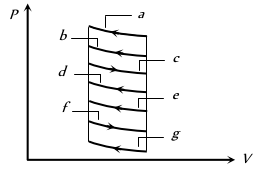
The $P-V$ diagram shows seven curved paths (connected by vertical paths) that can be followed by a gas. Which two of them should be parts of a closed cycle if the net work done by the gas is to be at its maximum value
Image
A ball of mass $m$ falls vertically to the ground from a height $h$ and rebound to a height $h_2$. The change in momentum of the ball on striking the ground is
The vector sum of two forces is perpendicular to their vector differences. In that case, the forces
Photons of energy $6 \mathrm{eV}$ are incident on a metal surface whose work function is $4 \mathrm{eV}$. The minimum kinetic energy of the emitted photoelectrons will be