MCQ
The work done per unit volume in stretching a wire is:
  • A
    stress $\times$ strain
  • $\frac{1}{2}$ stress $\times$ strain
  • C
    $\frac{1}{4}$ stress $\times$ strain
  • D
    stress/strain.

Answer

Correct option: B.
$\frac{1}{2}$ stress $\times$ strain
B

Need a full question paper?

Generate a complete, print-ready paper with questions like this in minutes — across 16+ boards, with answer keys.
Start Generating Free

Similar questions

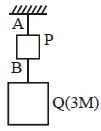
Wires $A$ and $B$ are connected with blocks $P$ and $Q$ as shown. The ratio of lengths, radii and Young's modulus of wires $A$ and $B$ are $r, 2r$ and $3r$ respectively ($r$ is a constant). Find the mass of block $P$ if ratio of increase in their corresponding lengths is $1/6r^2$. The mass of block $Q$ is $3M$.
An ideal gas of Molar mass $M$ is contained in a vertical tube of height $H$, closed at both ends. The tube is accelerating vertically upwards with acceleration $g$ Then, the ratio of pressure at the bottom and the mid point of the tube will be
Longitudinal waves cannot:
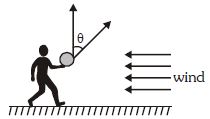
A body throws a ball upwards with velocity $v_0 = 20\, m/s$ . The wind imparts a horizontal acceleration of $4\, m/s^2$ to the ball. The angle $\theta $ from vertical at which the ball must be thrown so that the ball returns to the boy's hand is $(g = 10\, m/s^2)$
At nodes in stationary waves:
Snow is more heat insulating than ice, because
A body of mass $200\,g$ is tied to a spring of spring constant $12.5\,N / m$, while the other end of spring is fixed at point $O$. If the body moves about $O$ in a circular path on a smooth horizontal surface with constant angular speed $5\,rad / s$, then the ratio of extension in the spring to its natural length will be :
The mass of a particle is $1\,\,kg$ and it is moving along  $x-$ axis. The period of its small oscillation is $\frac {\pi }{2}$ . Its potential energy may be
Three moles of an ideal gas $\left( {{C_P} = \frac{7}{2}R} \right)$ at pressure ${P_A}$ and temperature ${T_A}0$ is isothermally expanded to twice its initial volume. It is then compressed at constant pressure to its original volume. Finally the gas is compressed at constant volume to its original pressure ${P_A}.$ The correct $P-V$ and $P-T$ diagrams indicating the process are
A body of mass $40 \,gm$ is moving with a constant velocity of $2\, cm/sec$ on a horizontal frictionless table. The force on the table is  ....... $dyne$