MCQ
The work done to raise a mass $\mathrm{m}$ from the surface of the earth to a height $\mathrm{h}$, which is equal to the radius of the earth, is 
  • A
    $\mathrm{mgR}$
  • B
    ${2} \mathrm{mgR}$
  • $\frac{1}{2} \mathrm{mgR}$
  • D
    $\frac{3}{2} \mathrm{mgR}$

Answer

Correct option: C.
$\frac{1}{2} \mathrm{mgR}$
c
$\mathrm{W}=\frac{\mathrm{mgh}}{1+\mathrm{h} / \mathrm{R}}$

at $\mathrm{h}=\mathrm{R}, \mathrm{W}=\frac{\mathrm{mgR}}{2}$

Need a full question paper?

Generate a complete, print-ready paper with questions like this in minutes — across 16+ boards, with answer keys.
Start Generating Free

Similar questions

What is the shape of the graph between the speed and kinetic energy of a body
The velocity of a body moving in viscous medium is given by $\text{v}=\frac{\text{A}}{\text{B}}\Big[1-\text{e}^{\frac{-\text{t}}{\text{B}}}\Big]$
In a certain thermodynamical process, the pressure of a gas depends on its volume as $kV ^{3}$. The work done when the temperature changes from $100^{\circ} C$ to $300^{\circ} C$ will be .......... $nR$, where $n$ denotes number of moles of a gas.
A faulty thermometer reads $5^{\circ} C$ in melting ice and $95^{\circ} C$ in steam. The correct temperature on absolute scale will be. $.........K$ when the faulty thermometer reads $41^{\circ} C$.
A $140\,g$ ball, in horizontal flight with a speed of $39.0\,m/s$, is struck by a bat. After leaving the bat, the ball travels in the opposite direction with speed $39.0\,m/s$. If the impact time $\Delta t$ for the ball-bat collision is $1.20\,ms$, ............ $N$ average force acts on the ball .
Which of the following is not a unit of energy
A nurse measures the blood pressure of a seated patient to be $190 \,mm$ of $Hg$.
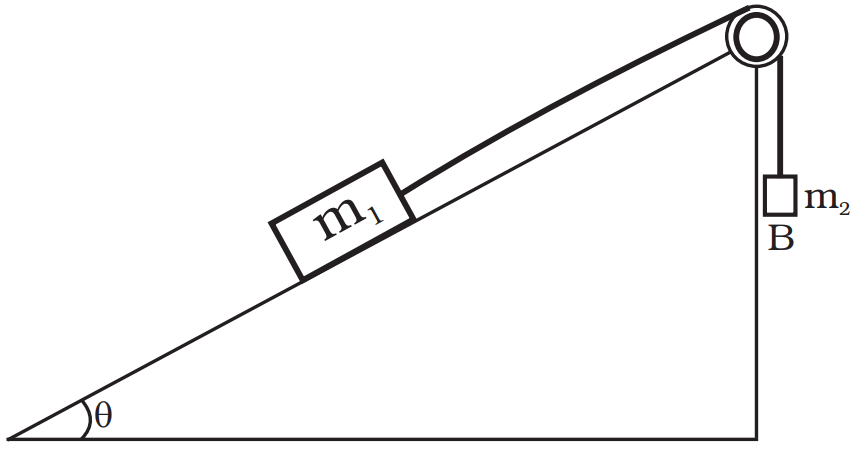
Mass $m_1$ moves on a slope making an angle $\theta$ with the horizontal and is attached to mass $m_2$ by a string passing over a frictionless pulley as shown in The co$-$efficient of friction between $m_1$ and the sloping surface is $\mu$.
Which of the following statements are true?
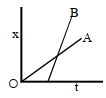
The position-time graphs for two students $A$ and $B$ returning from the school to their homes are shown in figure

$(A)$ $A$ lives closer to the school

$(B)$ $B$ lives closer to the school

$(C)$ $A$ takes lesser time to reach home

$(D)$ $A$ travels faster than $B$

$(E)$ $B$ travels faster than $A$

Choose the correct answer from the options given below :
$110\; J$ of heat is added to a gaseous system, whose internal energy change is $40\; J$, then the amount of external work done is ........ $J$