MCQ
The workdone by a gas molecule in an isolated system is given by, $W =\alpha \beta^{2} e ^{-\frac{ x ^{2}}{\alpha kT }},$ where $x$ is the displacement, $k$ is the Boltzmann constant and $T$ is the temperature, $\alpha$ and $\beta$ are constants. Then the dimension of $\beta$ will be
  • A
    $\left[ M L ^{2} T ^{-2}\right]$
  • $\left[ M L T ^{-2}\right]$
  • C
    $\left[ M ^{2} L T ^{2}\right]$
  • D
    $\left[ M ^{0} L T ^{0}\right]$

Answer

Correct option: B.
$\left[ M L T ^{-2}\right]$
b
$\frac{ x ^{2}}{\alpha kT } \rightarrow$ dimensionless

$\Rightarrow[\alpha]=\frac{\left[ x ^{2}\right]}{[ kT ]}=\frac{ L ^{2}}{ ML ^{2} T ^{-2}}= M ^{-1} T ^{2}$

Now $[ W ]=[\alpha][\beta]^{2}$

$[\beta]=\sqrt{\frac{ ML ^{2} T ^{-2}}{ M ^{-1} T ^{2}}}= M ^{1} L ^{1} T ^{-2}$

Need a full question paper?

Generate a complete, print-ready paper with questions like this in minutes — across 16+ boards, with answer keys.

Start Generating Free

Similar questions

How does the displacement v/s time graph of a uniformly accelerated motion look like?
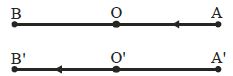
Two particles undergo $SHM$ along parallel lines with the same time period $(T)$ and equal amplitudes. At a particular instant, one particle is at its extreme position while the other is at its mean position. They move in the same direction. They will cross each other after a further time
A particle moves in a straight line with retardation proportional to its displacement. Its loss of kinetic energy for any displacement $x$  is proportional to
Motion of a ball bearing inside a smooth curved bowl, when released from a point slightly above the lower point is:
Four identical thin rods each of mass $M$ and length $l$, form a square frame. Moment of inertia of this frame about an axis through the centre of the square and perpendicular to its plane is
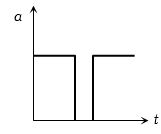
Acceleration-time graph of a body is shown. The corresponding velocity-time graph of the same body is
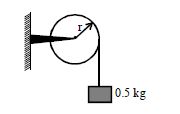
As shown in figure, a mass $m$ = $500\  g$ hangs from the rim of a wheel of radius $r$ = $20\  cm$. When released from rest, the mass falls $2.0\  m$ in $8\  sec$. Then moment of inertia of the wheel is.......... $kg-m^2$. $(g = 10\  m/s^2)$
Doppler's effect holds good for:
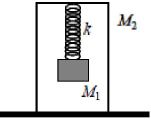
A block of mass $M_1$ is hanged by a light spring of force constant $k$ to the top bar of a reverse $U$ -frame of mass $M_2$ on the floor. The block is pulled down from its equilibrium position by a distance $x$ and then released. The minimum value of $x$ such that the reverse $U$ -frame will leave the floor momentarily, is :-
Two satellites of earth, $S_1$ and $S_2$ are moving in the same orbit. The mass of $S_1$ is four times the mass of $S_2.$ Which one of the following statements is true?