MCQ
Doppler's effect holds good for:
  • A
    Only sound waves.
  • B
    Only electromagnetic waves.
  • C
    Both sound waves and electromagnetic waves.
  • D
    None of the above.

Answer

  1. Both sound waves and electromagnetic waves.

Need a full question paper?

Generate a complete, print-ready paper with questions like this in minutes — across 16+ boards, with answer keys.

Start Generating Free

Similar questions

Turpentine oil is flowing through a tube of length $l$ and radius $r$. The pressure difference between the two ends of the tube is $P .$ The viscosity of oil is given by $\eta=\frac{P\left(r^{2}-x^{2}\right)}{4 v l}$ where $v$ is the velocity of oil at a distance $x$ from the axis of the tube. The dimensions of $\eta$ are
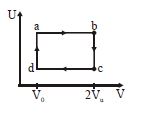
The figure given below shows the variation in the internal energy $U$ with volume $V$ of $2.0\ mole$ of an ideal gas in a cyclic process $abcda$ . The temperatures of the gas during the processes $ab$ and $cd$ are $500\ K$ and $300\ K$ respectively, the heat absorbed by the gas during the complete process is  .... $J$

(Take $R$ = $8.3\ J/mol-K$ and $ln\ 2$ = $0.69$)
Two bodies of masses $m$ and $4 m$ are placed at a distance $r$. The gravitational potential at a point on the line joining them where the gravitational field is zero is
A particle $A$ is projected vertically upwards. Another particle $B$ is projected at an angle of $45^{\circ}$. Both reach the same height. The ratio of the initial kinetic energy of $A$ to that of $B$ is
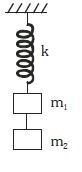
Two masses $m_1$ and $m_2$ are supended together by a massless spring of constant $k$. When the masses are in equilibrium, $m_1$ is removed without disturbing the system; the amplitude of vibration is
 A man is looking at a small object placed at his near point. Without altering the position of his eye or the object, he puts a simple microscope of magnifying power 5X before his eyes. The angular magnification achieved is:
  1. 5
  2. 2.5
  3. 1
  4. 0.2
Consider a body of mass $1.0 \mathrm{~kg}$ at rest at the origin at time $\mathrm{t}=0$. A force $\overrightarrow{\mathrm{F}}=(\alpha \mathrm{t} \hat{\mathrm{i}}+\beta \hat{\mathrm{j}})$ is applied on the body, where $\alpha=1.0 \mathrm{Ns}^{-1}$ and $\beta=1.0 \mathrm{~N}$. The torque acting on the body about the origin at time $\mathrm{t}=1.0 \mathrm{~S}$ is $\vec{\tau}$. Which of the following statements is (are) true?

$(A)$ $|\vec{\tau}|=\frac{1}{3} \mathrm{Nm}$

$(B)$ The torque $\vec{\tau}$ is in the direction of the unit vector $+\hat{\mathrm{k}}$

$(C)$ The velocity of the body at $\mathrm{t}=1$ is $\overrightarrow{\mathrm{v}}=\frac{1}{2}(\hat{\mathrm{i}}+2 \hat{\mathrm{j}}) \mathrm{m} \mathrm{s}^{-1}$

$(D)$ The magnitude of displacement of the body at $\mathrm{t}=1 \mathrm{~s}$ is $\frac{1}{6} \mathrm{~m}$

Amount of heat required to raise the temperature of a body through $1 ^o C$ is called its
Water is flowing through a horizontal tube having cross-sectional areas of its two ends being $A$ and $A'$ such that the ratio $A/A'$ is $5$ છે.જો  If the pressure difference of water between the two ends is $3 \times 10^5\, N\, m^{-2}$, the velocity of water with which it enters the tube will be ......... $m s^{-1}$ (neglect gravity effects)
The earth is assumed to be a sphere of radius $R.$ A platform is arranged at a height $R$ from the surface of the earth. The escape velocity of a body from this platform is $fv$, where $v$ is its escape velocity from the surface of the Earth. The value of $f$ is