MCQ
The Working of an atomizer depends upon
  • Bernoulli's theorem
  • B
    Boyle's law
  • C
    Archimedes principle
  • D
    Newton's law of motion

Answer

Correct option: A.
Bernoulli's theorem
a
(a)

Need a full question paper?

Generate a complete, print-ready paper with questions like this in minutes — across 16+ boards, with answer keys.
Start Generating Free

Similar questions

Two cars $A$ and $B$ are travelling in the same direction with velocities ${v_1}$ and ${v_2}$$({v_1} > {v_2})$. When the car $A$ is at a distance $d$ ahead of the car $B$, the driver of the car $A$ applied the brake producing a uniform retardation $a$ There will be no collision when
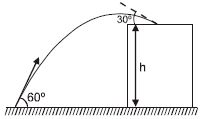
A stone projected at an angle of $60^o$ from the ground level strikes at an angle of $30^o$ on the roof of a building of height $‘h= 30\,m ’$ . Find the speed of projection(in $m/s$ ) of the stone
The temperature of the hydrogen at which the average speed of its molecules is equal to that of oxygen molecules at a temperature of $31\,^oC,$ is  ........ $^oC$
If a simple pendulum oscillates with an amplitude of $50\, mm$ and time period of $2\, sec$, then its maximum velocity is .... $m/s$
A stationary particle explodes into two particles of masses $x$ and $y$, which move in opposite directions with velocity $v_1$ and $v_2$. The ratio of their kinetic energies $\left(E_1: E_2\right)$ is
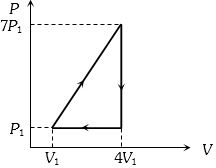
In the cyclic process shown in the figure, the work done by the gas in one cycle is
Two projectiles are thrown simultaneously in the same plane from the same point. If their velocities are $v_1$ and $v_2$ at angles $\theta _1$ and $\theta_2$ respectively from the horizontal, then answer the following question

The trajectory of particle $1$ with respect to particle $2$ will be

Kinetic energy of a particle executing simple harmonic motion in straight line is $pv^2$ and potential energy is $qx^2$, where $v$ is speed at distance $x$ from the mean position. It time period is given by the expression
A hall has the dimensions $10\,m \times 12\,m \times 14\,m.$A fly starting at one corner ends up at a diametrically opposite corner. What is the magnitude of its displacement...........$m$
If e is the electronic charge, $c$ is the speed of light in free space and $h$ is Planck's constant, the quantity $\frac{1}{4 \pi \varepsilon_{0}} \frac{| e |^{2}}{h c}$ has dimensions of .......